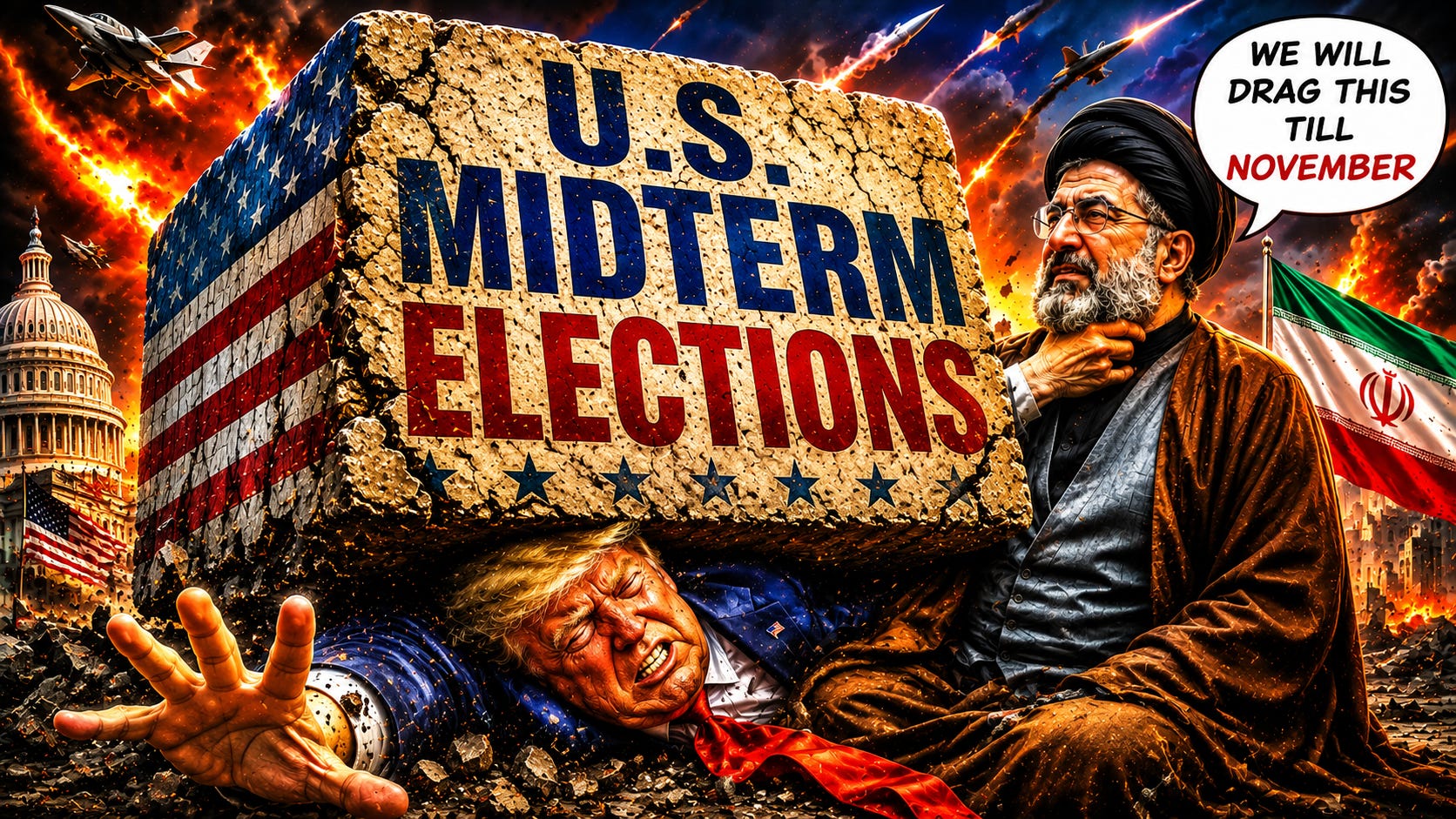
Four military objectives. Four public reversals. One superpower now trying to negotiate from a position it never intended to occupy.
There is a particular kind of announcement that sounds routine on the surface.
If you do not read it carefully, it feels like standard policy language.
If you do read it carefully, it sounds like a confession.
Washington just made one.
The United States has launched a new strategy toward Iran: economic isolation, sanctions, financial pressure. The language is calm, procedural, almost antiseptic, as if this were simply the next logical step in a long policy sequence.
It isn’t.
It is the fourth pivot in a war Washington has been quietly losing since the day it began.
And that is why this story matters. It is not a story about Iran being punished. It is a story about American power hitting its limits in public, on the record, in real time.
What follows is not speculation.
It’s the fourth pivot in a war that Washington has been quietly losing since the day it started. And if you trace the full arc of this conflict — objective by objective, failure by failure — you start to see something most mainstream coverage has completely missed: this isn’t a story about Iran being punished. It’s a story about the visible unraveling of American military and strategic dominance, told in real time.
Let’s walk through it properly. Every detail matters here.
This did not begin as improvisation.
By February 2026, the model Washington was about to deploy had already been field-tested and refined across several countries in recent years. It started in Sri Lanka. It was then used to help dismantle Imran Khan's government in Pakistan. It followed with unrest in Bangladesh and Nepal, and even some lighter, less successful attempts around India's 2024 election cycle. And this isn't framed as a closed chapter — the same playbook is described as still being lightly attempted in various places even in recent times, an ongoing method rather than a one-time historical experiment.
Iran was not an experiment.
Iran was next on the list.
On February 28, 2026, the United States, working in direct coordination with Israel, launched a massive military assault on Iran. Publicly, the justification was framed around two familiar aims: dismantling Iran’s nuclear program and degrading its ballistic missile capability.
But according to the logic visible in how the war was actually planned and executed, that was never the real endgame.
The real endgame was regime change.
And the mechanism chosen to achieve it was coldly simple.
The theory was this: every centralized or authoritarian government depends on a psychological anchor. A top figure. A symbol of continuity. A presence so central that fear, obedience, and stability all orbit around it. Remove that figure suddenly, violently, and without warning, and the entire structure is supposed to shake.
The assumption is not merely that the leader dies.
The assumption is that fear dies with him.
Kill the anchor figure, and the theory says the psychological scaffolding collapses. Once fear evaporates, people pour into the streets. Once people pour into the streets, the regime loses control. Once the regime loses control, regime change becomes possible from within.
That was the plan.
In the opening hours of the war, Iran’s Supreme Leader Ali Khamenei was killed, along with several senior regime officials. The expectation was that this would create exactly the kind of shockwave Washington wanted.
It did not.
Instead, the opposite logic took hold.
In Shia political culture, violent loss can consolidate identity rather than destroy it. The killing of Khamenei did not open the regime to collapse. It hardened it. The succession followed quickly. The state did not fracture. It consolidated.
And that was the first great mistake.
By March 15 to 17, roughly two and a half weeks after the war began, it had become obvious to American planners that the expected uprising was not coming.
There was no mass mobilization.
No spontaneous street revolution.
No collapse from within.
The psychological theory had failed.
The expected chain reaction never arrived.
That failure mattered because the original plan had assumed speed. Washington seems to have believed that if fear disappeared quickly enough, the state would not have time to adapt. The regime would not have time to re-form. The vacuum would open before the system could harden around it.
That is not what happened.
The state adapted. The succession happened. The regime stayed in place.
And this failure came at a brutal cost — not just “losses” in the sanitized military-briefing sense, but something closer to a rout: a superpower’s forces mauled and humbled in a conflict it expected to walk through. In the course of trying to force that collapse, the United States suffered a battlefield humiliation during what was, relative to America’s usual engagements, a remarkably short and intense war. Military historians who have since studied the conflict have repeatedly flagged something uncomfortable in their assessments:** that the damage done to American military standing and long-term strategic positioning during this short window may end up being more consequential — more detrimental, in their own language — than anything gained.**
“Analysts studying America’s own military history are describing this war as a net strategic loss — not from the outside looking in, but from within America’s own defense-analyst community.”
This was not just a failed political gamble. It was the kind of military and strategic setback that makes a superpower look small.
The headlines never quite captured that scale of failure, but the consequences were immediate and far larger than a normal battlefield disappointment.
Because the failure was not only on the ground.
It was in the air.
For decades, American military doctrine has rested on one core assumption: control the sky, and you control the battlefield.
That assumption is one of the foundations of modern U.S. power.
American aircraft can travel thousands of kilometers from their bases. Stealth platforms reduce radar visibility. Cruise missiles can strike with precision. Satellites can feed intelligence. Electronic warfare aircraft can disrupt enemy communications. Sensors, aircraft, commanders, and targeting systems all connect into one enormous machine.
On paper, that is overwhelming.
But Iran introduced a different kind of problem.
Iran did not need to defeat every aircraft.
It did not need to destroy every base.
It did not need to win complete air superiority in the classic sense.
It only needed to make American commanders ask one dangerous question:
What is actually watching us?
That question is devastating because it changes the psychology of war.
Once commanders begin asking it, every strike becomes more uncertain. Every sortie becomes more expensive. Every target becomes less clear. Every approach becomes more dangerous. Every mission starts to slow down.
And once that happens, air power no longer feels like domination.
It feels like risk.
That is a profound shift.
Iran did not have to beat American air power directly. It only had to make American air power hesitate. And for a military built on speed, confidence, and decisive movement, hesitation is its own form of defeat.
The conflict also exposed how much a modern battlefield depends on information, not just weapons.
Reports during the war pointed to
Chinese-made air-defense systems, surveillance radars, and a distributed command structure that made the battlefield harder to read and easier to survive. The result was not one isolated defense. It was an adaptive network.
That is a crucial distinction.
A lone missile launcher is a weapon.
A lone radar is a sensor.
But a connected network of sensors, communications, command systems, electronic warfare, and weapons becomes something much more powerful.
One part detects.
Another confirms.
A command center interprets.
Another unit receives the information.
And then the aircraft that thought it was hunting becomes the thing being hunted.
That is why the air campaign stalled.
Not because every aircraft was destroyed.
Because the environment itself became uncertain.
And once uncertainty enters the cockpit and the command center, American air power becomes slower, costlier, and less decisive.
This is, without question, the most underreported and most dangerous part of the entire episode.
Iran did not just survive the opening attack.
It helped expose American positions across the Middle East and made a previously hidden map more visible.
That matters more than most headlines will ever admit.
Here’s a basic rule of modern warfare that almost never gets discussed publicly: military bases are never listed on public maps. Every nation on Earth operates by this unspoken rule. It's not that adversary nations can't eventually locate these bases — high-resolution satellite imagery makes that technically possible for any state with the right capability. It's that there is a diplomatic and strategic code of silence around actually confirming, cataloguing, and publicly disclosing another country's classified military footprint. Everyone knows roughly where things are. Nobody says it out loud. That silence is itself a form of stability.
Iran shattered that silence.
Using intelligence support — reportedly including satellite imagery access facilitated through Russia and China — Iran was able to systematically identify and strike a wide network of American military installations across the Middle East. Bases that had never been publicly acknowledged. Positions the American public had no idea existed.
Now pause and consider what this actually means on two separate levels:
First, on a purely military level, a regional power effectively degraded a superpower’s forward operating infrastructure across an entire region in a matter of weeks.
Second — and this is the part that should genuinely alarm strategists everywhere — by destroying these bases, Iran effectively published their existence and locations to the rest of the watching world. Every other government paying attention now has a much clearer picture of exactly where and how the United States builds its Middle Eastern military footprint. That’s not a one-time tactical loss. That’s a permanent compromise of operational security with consequences stretching years into the future.
It gets worse. China has since referenced knowledge of U.S. military base locations openly — publicly enough that the American president has had to acknowledge it, on the record, multiple times since the war began.
“A superpower’s classified base network, exposed mid-conflict, confirmed by a rival power, acknowledged by the American president himself. That is an unprecedented level of operational compromise.”
Let that sink in. That is an unprecedented level of operational compromise for a nation that has spent eighty years building the myth of untouchable global reach.
Once it became undeniable that regime change wasn’t happening, Washington didn’t stop the war. It simply changed what it claimed the war was about.
The new stated objective: destroy Iran’s nuclear assets entirely.
For the following fifteen to twenty days, the conflict ground on almost exclusively around this goal.
It didn’t work either. Iran’s nuclear infrastructure, while damaged in places, was not eliminated. The second stated war aim collapsed just as the first one had.
This matters because the changing explanation is not just rhetoric. It is a signal that the original military effort did not work, so the goal itself had to be replaced.
When that happens once, it can be called adjustment.
When it happens repeatedly, starts to look like confusion.
With two objectives publicly abandoned, a third emerged: prevent Iran from exercising control over the Strait of Hormuz, one of the most critical oil shipping chokepoints on the planet, through which a massive share of the world’s daily crude oil supply passes.
Iran’s response was direct and effective. It choked the strait — restricting and controlling passage through it — and kept it choked until it extracted the terms and concessions it wanted. Global shipping companies had to reroute. Oil markets felt it. And Washington, despite its overwhelming naval presence in the region, could not force Iran to relinquish that leverage.
Three objectives. Three public failures. Each one announced with confidence. Each one quietly abandoned when reality didn’t cooperate.
Stop and count what that actually means, because it’s worth saying plainly before moving to the fourth pivot: this is a superpower that could not force regime change, could not destroy the regime’s nuclear capability, and could not wrest a single strategic chokepoint away from a country a fraction of its military size. Zero for three, in six months, against one adversary.
Iran understood that geography is leverage.
Its response was direct and effective. It choked the strait. It restricted and controlled passage through it. It kept that pressure in place until it extracted the terms and concessions it wanted.
This was not just a blockade in the crude sense.
It was selective access.
Some states could move.
Others could not.
That is what made the move so effective. Selective access turns shipping into a loyalty test. It turns geography into diplomacy.
Iran was not merely creating pain. It was deciding who would feel the pressure and who would not.
That is a much more sophisticated form of power than a simple blockade.
Western coverage often misses this point because it focuses on ships and tonnage and headlines.
But the real story is control.
Iran did not need to dominate the entire Persian Gulf.
It did not need to match American naval power ship for ship.
It only needed to threaten shipping from multiple directions at once: coastal missiles, drones, small boats, mines, radar, aircraft, and land-based systems, all operating together.
U.S. Central Command specifically described strikes against Iranian coastal radar, air defenses, anti-ship capabilities, and small boats as part of efforts to protect shipping through the strait.
Read that carefully.
American forces were striking those systems for weeks and still could not restore free passage.
That is the point.
Presence itself became a weapon.
A weapon does not need to destroy its target to shape the battlefield. If it forces aircraft to change altitude, change route, activate defenses, or abandon a mission, it has already changed the equation.
A multi-million dollar aircraft that must worry about a relatively cheap shoulder-fired missile does not need to be shot down to be slowed.
The threat alone changes behavior.
That is one of the simplest and most important truths in modern war.
Iran understood it.
Washington did not.
And each time, the adjustment was presented as if it were a normal continuation of policy rather than a retreat from the previous failure.
That is not how a winning power behaves.
It is how a power improvises under pressure.
Which brings us back to today.
Having failed to force regime change, failed to eliminate the nuclear program, and failed to seize control of the strait, Washington has now pivoted to what is essentially the last tool left in its box when military force hasn't worked: economic strangulation. Sanctions. Isolation from international financial systems.
The hope that if Iran can be squeezed hard enough economically, it will eventually produce the specific behavioral change that three separate military campaigns couldn't force.
Here’s the question worth sitting with: **when a superpower changes its stated war ob…