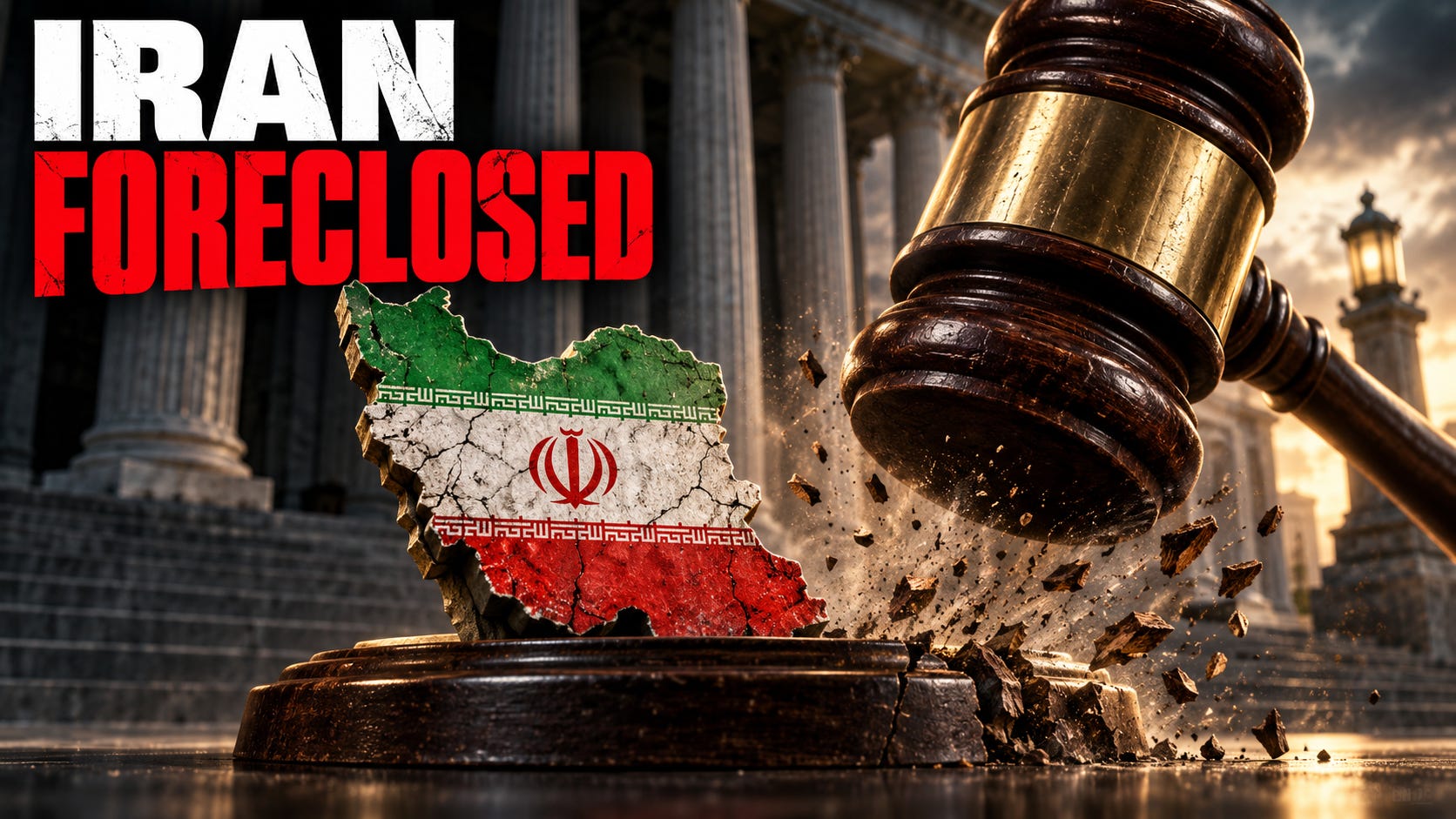
While cable news counts missiles and debates who won the latest news cycle, I’m looking at the balance sheet. Occupational hazard. After years chasing judgments and finding assets that supposedly didn’t exist, you learn something: looking powerful and being solvent are two entirely different things. Especially when your creditors start knocking.
That’s the lens through which I view Iran: a potential foreclosure crisis with missile launchers. The question isn’t simply how much punishment Tehran can absorb. It’s whether the regime can keep collecting revenue, moving supplies, and paying the people who keep it in power. Even revolutionary zeal has a payroll department.
🧩 The Cable News Blind Spot
The television version offers two choices: America is trapped in another endless quagmire, or the Iranian regime will collapse before the next commercial break. Both make convenient programming. Neither tells you much about the machinery underneath. For that, you need to follow the money—and find out what happens when it stops arriving.
America and Iran operate under radically different financial constraints. Washington can borrow in its own currency and spread costs across an enormous economy. Tehran depends much more heavily on access to export revenue and usable foreign exchange. Both sides can suffer expensive losses, but their ability to replace those losses is hardly equal.
Hardware matters, too. An arsenal is an inventory, and inventories require replenishment. The relevant question is how quickly each side can replace what it fires, loses, or wears out. A spectacular missile launch might dominate the evening news while leaving the country that launched it poorer and less capable the following morning.
The Trouble Around the Edges
Iran’s central government rules a country with significant ethnic, regional, and political divisions. Kurdish, Azeri, and Baloch communities have distinct histories and grievances. They aren’t interchangeable, and they don’t constitute one unified opposition army. But a government under financial pressure has fewer resources available to manage multiple sources of unrest.
Think about the geography. The Kurdish west, Azeri northwest, and Baloch southeast sit near borders that matter for trade, movement, and security. If armed opposition or disruptions intensify in those regions, Tehran faces competing demands on its personnel and logistics. Every unit assigned to protect one corridor becomes unavailable somewhere else.
Military planners call part of this problem “force fixation”: keeping your opponent occupied where you want him occupied. Regional opponents don’t necessarily need to march on the capital to impose costs. They can force the government to guard roads, reinforce outposts, and defend infrastructure. Eventually, management spends its entire day dealing with branch-office emergencies.
That doesn’t make fragmentation an automatic recipe for regime collapse. Divided opposition groups can fight one another as readily as they fight the central government. But it does complicate Tehran’s financial equation. Holding a country together gets considerably more expensive when several regions simultaneously decide they have complaints about the service.
💸 Even a Police State Has to Make Payroll
A government can demand loyalty. It still needs fuel, food, spare parts, and people willing to show up for work. The men enforcing its orders have households of their own. “Death to America” might fit nicely on a banner, but the grocer generally prefers payment in something he can spend.
That’s why pressure on oil exports, shipping, and payment channels matters so much. Every interrupted transaction can make it harder to turn crude into usable cash. Oil sitting in a tank is an asset. Oil sold to a buyer whose payment you cannot access is a collection problem. Believe me, the distinction matters.
Pressure on foreign exchange can then spread through the domestic economy. Imports become harder to finance, purchasing power deteriorates, and wages buy less. Add industrial disruption or labor unrest, and the government faces rising costs alongside weakening revenue. That’s the sort of financial statement that makes even an optimistic accountant develop a facial twitch.
In that environment, firing scarce military assets for temporary publicity can resemble burning the furniture to keep the house warm. You get heat tonight. Tomorrow you have fewer chairs and exactly the same structural problem. A regime can win a news cycle while steadily consuming the assets it needs to survive the next one.
The $38 Billion Question
Take the $38 billion operational-cost figure cited in this debate. Against a $1.5 trillion spending baseline, that works out to roughly 2.5 percent. Calling it a “rounding error” makes a point about scale, but it’s still real money. Only in Washington can a sum that large sound like somebody misplaced a receipt.
The accounting categories matter, too. Previously budgeted spending, new appropriations, replacement costs, and long-term obligations aren’t the same thing. You don’t make a war inexpensive by putting its bills in different drawers. Washington has considerable experience with that filing system, but the taxpayer eventually gets invited to admire the total.
The stronger argument is about financing capacity. The United States can sustain costs that would overwhelm a much smaller, financially isolated economy. That doesn’t guarantee military success or make every expenditure sensible. It does mean Tehran cannot assume that imposing another billion dollars in costs will automatically force Washington to pack up and leave.
The W-2 Versus 1099 War
I use “W-2 versus 1099” as shorthand for a broader shift in how military capability gets delivered. Uniformed forces can operate alongside contractors, commercial technology providers, and local partners. The mix matters because it changes the logistical footprint and distributes responsibilities across organizations with very different contracts, incentives, and reporting structures.
But a contractor badge doesn’t magically make spending disappear from the government’s books, and “contractor” doesn’t necessarily mean an independent worker filing a 1099. The useful distinction concerns how the work gets organized. Who supplies the equipment? Who maintains it? Who gets paid to solve the next operational problem?
Commercial drones, satellite communications, software, and technical support can give relatively small teams capabilities that once required a much larger organization. That creates opportunities for suppliers and integrators. It also creates dependencies. Somewhere behind the futuristic battlefield sits a service agreement, a replacement-parts order, and a guy asking whether anyone approved his invoice.
Claims about precisely who is operating inside Iran require evidence. The economic incentive, however, is straightforward: governments want capability they can deploy quickly, and vendors want contracts to deliver it. Follow the purchase orders alongside the troop movements. You’ll learn considerably more than you will from another panel arguing over somebody’s facial expression at a press conference.
The Defense Industry Gets an Order Book
Expended munitions and damaged equipment create demand for replacements. Sustained operations can increase pressure to expand production of interceptors, rocket motors, drones, and communications systems. Whether that translates into profitable business depends on actual contracts, costs, and execution. A busy factory and a profitable shareholder are not always the same person.
The incentives nevertheless deserve attention. Contractors can receive new orders while households absorb higher energy prices and taxpayers finance the spending. Benefits and costs land in different places. When you want to understand why a policy develops momentum, look at who receives the checks and who receives the bill.
⚖️ Read the Balance Sheet
My foreclosure analogy comes down to the ability to keep operating. Can Tehran turn its assets into accessible revenue, maintain its supply network, and pay for the force needed to enforce its authority? A regime can possess substantial wealth on paper and still face an immediate cash crisis. I’ve met plenty of judgment debtors with the same condition.
Nor should anyone assume America will recover its costs through seized tankers, frozen assets, or future access to energy infrastructure. Recovering money is a separate undertaking from identifying something valuable. I spent enough years in collections to know that a promising asset list and a cleared payment are two very different stages of the proceedings.
The thesis is that sustained financial pressure and security demands around Iran’s borders could weaken the regime from within. Its survival would then depend on replenishing resources faster than it consumes them. Missiles can demonstrate that you’re still dangerous. They cannot, by themselves, demonstrate that you’re still a going concern.
That’s the analysis I bring to Insider Advantage: follow the money, examine the incentives, and ask who can afford the next round. ** Grab a seat the Insider Advantage at the 35% off.** for the balance-sheet view of geopolitics—and what it could mean for your purchasing power, precious metals, and financial future. Cable news has the explosion footage covered.