Is Jameela Jamil wrong about Britain being the most evil empire ever?
The other week, a friend texted me, as though I’m their lone historian on speed dial, asking whether they should support England or France in the World Cup. Their support hinged on choosing the less evil colonial nation. When I saw the clips of Jamil discussing British colonialism, I thought back to the conversation I had with my friend.
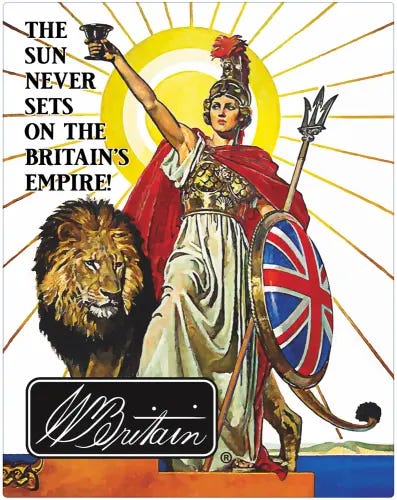
As I wrote recently, the vast majority of humans on Earth have been negatively impacted by colonialism. While the sun never set on the British Empire, many European nations brutalized the people of this globe for their personal gain. And we don’t live in a postcolonial state. The UK still has territories, though now the sun does set, as the Empire is much smaller. Other nations similarly exacted terrible things on their colonies. King Leopold of Belgium grabbed up a part of Africa and literally took people’s land for basically a game preserve. The brutality with which Belgium ruled Congo is hard to fathom. Indonesia suffered so considerably under the Dutch. The Portuguese were known to be brutal to the Africans in what is now Brazil. The Spanish combined religion and genocide in the Americas. And that is a very short list of the kinds of things that happened under colonialism in our world.
But the biggest change colonialism created in society was the concept of European superiority. Until the Age of Exploration, Europeans were often technologically behind Asians. The list of innovations from Asia and West Asia that the Europeans coveted is enormous: gunpowder, zero, astronomy, porcelain, silk, algebra. But during the Age of Exploration, their transformed cultural ethos, largely leveraged on their faster ships and their growing sense of intellectual superiority, transformed the state of power globally. It’s the European superiority that they asserted as an excuse for buying and selling human beings. They held up that superiority when they raped and killed women. It is not a superior person who murders, pillages, steals, and terrorizes other people. That is a morally corrupt person. Almost every faith in human history has seen murder as immoral, and certainly it’s against the tenets of Christianity. So the biggest crime in the state of colonialism was the lie that some people are not human; this untruth was perpetuated to absolve white people of the crimes they committed for personal gain.
The colonial state, however, has also transformed the idea of home and nations. As nations rose up independent from their colonial masters, the fate of the people of both nations became linked. England became home to the people they saw as inferior, and those people often succeeded to the point where the English looked inferior. In Jamil, a stunning, outspoken South Asian Brit, the Empire strikes back. She refuses to comply with racism. She speaks as she wishes instead of just being a pretty face.
In her state as both British and South Asian, she is well within her rights to see British colonialism as the greatest evil on Earth. Because the bigger thing about evil, and the most important thing we should remember when understanding the history of human misery and greed, is that in the abstract sense all evil is equal. To read of any colonial endeavor, like the death rate in Barbados or the terrors of the ships transporting Africans to the colonies, is to understand human suffering in only the most abstract of senses. But to live the experience, to have your own body suffer as so many South Asians do because of the numerous times the British starved the people for nothing other than self-gain, to every day be a foreigner in the nation in which you were born, to see the suffering of the people from the land of your ancestors: this is to personalize the truth of colonialism.
And it’s this personalization that helps fuel the rage-bait cycle. People do not want to face actual truths. Our social media ecosystem wants outrage, but in a very generalized and abstract way. We want to be angry about a group of people, a situation, or a company that has no actual impact on our lives. It’s a safe way to feel something and then not have to do anything. But her comments were about her offering concrete, specific truths from her point of view. Outrage culture wants abstract anger, while Jamil offered specific, personal truth. And there is nothing worse on the internet than somebody who’s asking you to focus on nuance. After all, the people who demanded she go back to India miss the nuance that she’s not from India, and that their ancestors might be why she is from the UK.
Like Jamil, my family lived under the British Empire, and like her, I am a diasporic South Asian. And like her, I remind us all that it isn't only those whose families were literally colonized who suffer. All of us do, because we still live in a world shaped by the iniquities set loose upon the globe 500 years ago.
Her comments shouldn’t send you into a tailspin of anger against her; they should remind us that colonialism is not just bad, it is incredibly evil. While in the abstract, it’s easy to tally up whether X country is worse than Y, understanding evil from the point of view of the post-colonial subjects brings home the atrocity.
Until we as a globe finally come to terms with the truths of colonialism on an individual level, in ways that actually bring home the truths of these horrible states, we will never have true equity globally.