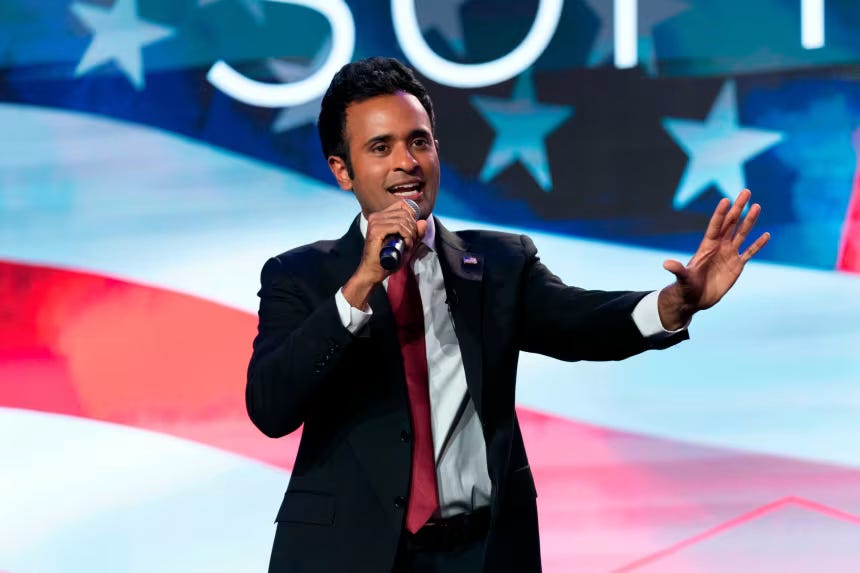
If anything is clear about Vivek Ramaswamy, it’s that he wants to be picked. In fact, almost everybody in Trump’s orbit reeks of needing external validation. Why do such unlikable political characters gravitate to MAGA as a form of joining real America?
Humans are social, and that underlies so much of our history. The earliest cities gave people not only the safety of numbers but also the security of a network. Your extended family could serve as a sounding board, or they could just sound off on you, but either way, in times of strife or famine, you had additional support. Urban spaces were often the ancient world’s safety net.
In our contemporary society, many people have their baseline needs met, which gives them more time to think about being liked and successful. In terms of MAGA, almost everybody in his orbit comes from secure economic backgrounds. People like Santos and Cruz love to try out the hard-working Latino tropes, but their personas are largely hewn from myth, unspoken truths, and outright lies.
But what makes a minority person work so hard to become part of a group that coalesced around hating foreigners? I’d like to blame the way they’re raised. This is the rhetoric Reagan loved to use about Black Americans, demeaning their families as a smoke screen for the ways in which his policies were destroying the fabric of America. So can we go back to the families to see what created such empty, soulless people? Without meeting their parents, it’s hard for me to assess what about their families created people who fly toward hate. Family structures can help define the systemic roots of some of the issues historical figures face.
To understand historical figures, even ones like Vivek who will be forgotten, we need to understand both the figure and the ground to take an expression out of art history. For example, Napoleon was born to lesser nobility who had fallen on hard times and lived on a far-flung island away from France. His never-ending need for power was at least shaped by the loss of station. His background helps explain his figure but only to a certain degree. Understanding the systemic elements of someone’s personality, for example, their class or caste, gives you a useful lens for seeing the macro forces at work. But anyone raised in a family with more than one child knows those forces affect each individual differently. For example, Vivek Ramaswamy has a brother who, until now, has remained pleasantly unremarkable on the national stage. Similarly, there are scores of Brahmin-born Indian-Americans who aren’t dicks. While background helps, something about the person also makes them extra-special excited about signing up to be evil.
What is inherent about individuals who choose to be pick-mes? The phrase pick me is a 21st-century term born of the Internet to describe male-focused women who act against other women to be picked by men. I’m expanding the term here to any minority associated with the Trump administration. Selling out your own people for personal gain is usually not a good long-term investment, since history has forgotten most of those people. When they are remembered, it is usually for being spectacularly terrible. Benedict Arnold sold out the colonists, only to be disliked by the British. His name was often used in common parlance for a turncoat. Vidkun Quisling turned on his people for the nazis and his name eventually became synonymous with a traitor. But both cases show what happens when allying with the enemy doesn’t pay off.
Some characters in the Trump administration might end up like the French painter David. The man happily made his money painting aristocrats until he knew he’d lose his livelihood. He switched to the revolutionaries. He proudly drew Marie Antoinette in her final minutes. The image is a wilted, broken woman, ugly in her aloneness.
David, for all his revolutionary fervor, eventually ended up in Belgium painting people like the son of a wealthy American diplomat, depicted as an irascible Cupid seducing Psyche. Many of Trump’s ilk hope to emulate David's story, always on the side of the people who win.
I think being on the winning side is what draws minorities to MAGA. We’ve all worked with yes-people who are always siding with the CEO or manager. They are handmaidens to power. In being at the right hand, they feel the glow of power adds to their aura.
But sycophants do not actually understand that they’re inherently a personality suck. When you read about the obsequious at court, like at the Ottoman court or the Tang one, the hangers-on are noted for their compliance and existence, but nothing about who they actually are. Because to truly curry favor with power, you must negate yourself. JD Vance has happily given his soul to MAGA and Thiel, but it's easy to find the many times he said he was a never-Trump guy. Similarly, from one side of his mouth Vance stands for heritage Americans (ironically, I’d guess none of whom have actually Native American ancestry), and yet, he celebrates his fourth mixed Indian kid. Vivek Ramaswamy derides immigrants while quietly having married a woman who has said she was born in India. This level of lily-liveredness can only be accomplished by people with no convictions except their need to fit in.
What makes someone decide, you know, I’ve always wanted to be friends with somebody who hates my complete existence? David might offer some comparison. He worked in the French court, full of artists and craftsmen. He was a good painter, certainly, but he wasn’t revolutionizing things. David’s pupil Boucher, for example, wanted to break new ground. Similar around the same time, Goya (in Spain) and Constable (in England) were pushing the boundaries of art. David largely stayed the course, jumping to another master as the course changed. For someone who wants acclaim but isn’t innovative and is happy to change with the winds, being a sycophant is a way to ride the coattails of power.
In people like Vivek and Marco Rubio, you see a desire for power that outweighs their substance. They will happily act dumb or folksy to win the admin's favor. For Vivek, in particular, theater isn't a strength. His attempts at being a real American, like palling around on Buckeye Lake, fail spectacularly. Similarly, Rubio often looks a bit dead inside when pretending alongside Trump. It’s because humans need backbones to stand up straight, and these two men, and every minority in the Trump administration, have given theirs up.
Historical figures like David and Benedict Arnold were not minorities, unlike American political fools like Vivek and Marco. While being a turncoat like Arnold or politically wishy-washy like David is fine when your existence is not contested, figures like Vivek and Marco are attempting to abnegate themselves in a way that is impossible in the system of white supremacy. No matter how many degrees, no matter how many other minorities you sacrifice, you will not be white.
Many Latinos and Indians are finding this out the hard way as visas are rejected or their friends are arrested. But the find-out phase of the Trump admin wouldn’t have needed to exist if so many Americans had seen that supporting the most hateful faction of white American life was not going to make them white.
Passing is a term used for Black Americans who choose to live as white. Historically, doing so meant giving up part of themselves and often their family connections. To go back to the beginning, humans are social. We need to resonate with others and foster goodness together. To pass is to lose your humanity. In people like Vivek, Usha, and Marco Rubio, you see people who have given up their humanity, roots, and souls for power, even if they don’t realize it. Their shells of self, however, likely won't survive the way David's did. Their minority status, the thing they were trying to shed in the first place, will always be there; except after this mess, most of their community will hate them. What will they have? Here’s to hoping—NOTHING