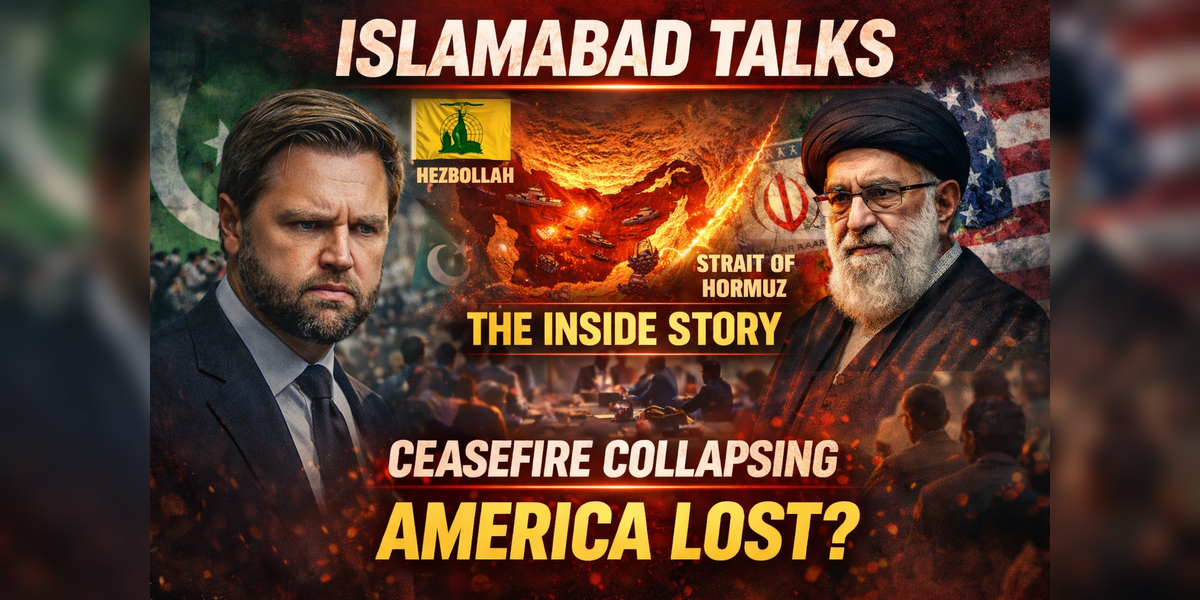
Behind every headline is a hidden game. This is yours.
There is a grim ritual that anyone who follows South Asian geopolitics recognizes immediately.
India signs a ceasefire with Pakistan. The ink dries. And within hours — sometimes minutes — the violations begin from the Pakistani side. The agreement was never really an agreement. It was theatre. A ceremony. Words on paper that meant nothing the moment the cameras turned off.
Now watch that exact pattern play out on the biggest stage in the world.
The US-Iran ceasefire — barely one day old as of this writing — is already fracturing at multiple pressure points simultaneously. Violations are being reported. Accusations are flying. And serious analysts are quietly saying what they won’t say on television: this deal was structurally broken before it was signed.
But here’s the thing I want to say upfront, before we go any further. What I’m offering is a reading of visible evidence — and that evidence, right now, points in one very clear direction.
What happened between February 28, 2026 and today may be one of the most consequential strategic collapses in modern American military history. And almost nobody is framing it honestly.
Let’s do that now.
On February 28, 2026, the United States and Israel launched coordinated strikes against Iran under a strategic framework they called the New Middle East Vision.
The objectives were explicit and ambitious:
🎯 Goal 1 — Decapitate the Leadership Kill Iran’s senior command structure, including Supreme Leader Ayatollah Ali Khamenei. The theory: eliminate the brain and the body collapses. Create a power vacuum so severe that pro-American Iranians rise up, revolt, and install a friendly government from within — regime change by popular demand.
🎯 Goal 2 — Destroy the Underground Use deep-earth penetrator technology — bunker-busting munitions engineered to reach fortified underground facilities — to permanently destroy Iran’s nuclear infrastructure and missile capabilities.
🎯 Goal 3 — Seize the Strait Control the Strait of Hormuz within 72 hours. On March 2, American officials announced this publicly, with absolute confidence.
🎯 Goal 4 — Dismantle the Axis Simultaneously destroy Iran’s entire regional proxy network: Hezbollah in Lebanon, the Houthis in Yemen, Hamas in Gaza. Eliminate all three. Permanently.
On paper: surgical, decisive, overwhelming.
In practice: a complete and devastating defeat — an assessment that America’s own CIA and military establishment would struggle to argue against honestly.
Before we examine the battlefield, you need to understand one organization sitting at the heart of this entire crisis — quietly, for four decades.
Hezbollah.
Most headlines treat it as simply a terrorist group. That is accurate but dangerously incomplete.
Here is the full picture:
In the 1980s, Iran conducted a careful strategic survey of Lebanon and noticed something significant. Shia Muslims — a substantial portion of Lebanon’s population — had almost no political representation. Sunni factions dominated the political landscape. The Shia community was effectively voiceless.
Iran saw this as a strategic opening.
In 1982, with Iranian funding, weapons, and organizational muscle, a new entity was formally established in Lebanon. It was called Hezbollah — Arabic for Party of God.
But Iran didn’t just build a political party.
It built a dual-layer machine with deliberate precision.
On the surface: a fully legitimate political organization. Elected representatives in parliament. Social welfare programs. Hospitals. Schools. A party that Lebanese citizens vote for openly.
Underneath: a heavily armed, Iranian-trained proxy militia — positioned directly on Israel’s northern border — supplied continuously with weapons, ammunition, and intelligence from Tehran.
The strategic logic was elegant and ruthless. Lebanon shares a border with Israel. By embedding a loyal, well-armed proxy force in Lebanese territory, Iran gained a permanent pressure valve — a force it could activate against Israel at any moment, without ever having to fight directly itself.
Iran’s pattern over four decades was also deliberate in one specific way: whenever Hezbollah was given even a moment of relief — any reduction in military pressure, any concession — it used that opening to rearm, rebuild, and expand its capabilities. Israel watched this cycle repeat many times. It is determined not to allow it again.
That is what Israel is racing to destroy right now — during this ceasefire window. That is why Iran is threatening to tear up the deal. And that is why this agreement was dead on arrival.
Formal negotiations are scheduled to begin in Islamabad after the 10th and 11th. That is the official timeline. The diplomatic calendar is set.
But here is what Israel is actually doing right now, in the days before those talks begin.
It is aggressively, relentlessly striking Hezbollah’s military infrastructure in Lebanon — during the ceasefire period. Not pausing. Not waiting for diplomacy.
The logic is coldly rational: if a permanent deal gets signed before Hezbollah is substantially neutralized, Iran will simply re-arm it afterward. The agreement would legally freeze Israel into permanently coexisting with a rebuilt, resupplied Hezbollah on its northern border — an existential threat locked in place by a peace treaty.
So Israel is using these two weeks as an offensive window. Dismantle as much of Hezbollah’s military capability as possible before the negotiating room opens and the legal constraints begin.
Iran is furious. It has been signaling loudly and repeatedly that it will declare the ceasefire void if Israel doesn’t immediately halt operations in Lebanon.
This is Fracture 1. The deal is structurally broken before the formal negotiations have even started.
Here is the deeper chess move Iran is attempting — and it is sophisticated.
Iran wants Hezbollah and Lebanon formally included as parties at the peace negotiation table.
Why? Because the more parties in the room, the more complex and constrained any final agreement becomes. If Hezbollah achieves recognized negotiating status, the resulting deal could be structured to legally prohibit Israel from targeting Hezbollah in the future. Hezbollah transforms, on paper, from a legitimate military target into a protected party under international agreement.
America sees this maneuver clearly and wants none of it.
Washington’s instinct — as consistent as gravity — is to keep the room as small as possible. Fewer parties means more American room to dominate, pressure, and ultimately dictate the terms. America has always understood that its leverage is greatest when it’s the largest power facing two smaller, weaker parties who cannot easily coordinate against it.
Fewer people in the room means easier to run the show. That has always been the American diplomatic playbook.
Iran’s counter-strategy is equally deliberate: expand the room. Flood it with complexity. Bring in parties whose interests complicate any clean American solution.
These positions are fundamentally incompatible. They will collide the moment Islamabad formally opens.
This is the fracture hiding in the fine print — and it is arriving within days.
And this isn’t a distant possibility. This issue is expected to surface as a major flashpoint within days — potentially even before formal negotiations fully stabilize.
Iran wants to charge ships passage fees for transiting the Strait of Hormuz.
Picture a highway toll system — except Iran wants to be the booth operator for one of the most critical shipping lanes on earth. Every vessel passing through must stop, pay, and receive a receipt. No payment, no passage. Iran as the FastTag scanner for 20% of global oil supply — and you don’t move without clearance.
Now here’s where it gets truly explosive.
Iran doesn’t want payment in US dollars. Not in Chinese yuan either.
In cryptocurrency — specifically tied to financial architecture built by Russia, China, and North Korea. Nations that have spent years quietly constructing financial systems designed explicitly to bypass American economic oversight.
Here’s the twist most coverage is missing entirely: America is not fundamentally opposed to Iran collecting transit revenue. That is not the real issue.
What America is fighting desperately to prevent is Iran collecting those revenues outside the dollar system. Because if the Strait of Hormuz — through which roughly 20% of the world’s oil passes — is monetized in cryptocurrency outside conventional financial rails, a new economic frontier opens. One that chips away at the most powerful non-military weapon America possesses: the dollar’s status as the world’s reserve currency.
Iran knows exactly what it’s doing. The crypto demand is not about convenience. It is a precision strike on American financial architecture.
And consider who is scrambling to contain it: America, working alongside Pakistan, Qatar, and the UAE — all forming a counter-crypto coalition to keep the Strait’s financial flows inside conventional currency systems.
Iran is holding firm. This is the deal-breaker hiding in the fine print.
Now step back and read the full ledger.
Tactical successes: yes. Leadership was targeted. Infrastructure was struck. Nuclear sites were bombed. The most advanced munitions in America’s arsenal were deployed at massive scale.
Strategic outcome: catastrophic failure.
🔸 The 20th century playbook failed a 21st century war
America arrived with the strategic doctrine of a previous era: overwhelming air power, shock bombardment, leadership decapitation, rapid dominance. These were the tools of the Gulf War, of Iraq, of Afghanistan’s opening weeks.
Iran fought back with the tools of the current era: drone swarms, denial operations, satellite navigation alternatives, distributed proxy networks, and an asymmetric cost structure that turned America’s technological sophistication against it.
When you fight a 21st century war with a 20th century strategy, the only thing guaranteed is failure.
🔸 The regime change fantasy was simply wrong
America’s central assumption was that killing Iran’s leadership would ignite a popular uprising. Iranians — aware of their government’s failures — would seize the moment, take the streets, and demand change.
Instead, the opposite happened.
Iranians rallied around their existing government. The predicted revolution never came. The power vacuum theory was a projection, not an analysis.
🔸 The IRGC — Iran’s real backbone — survived
Iran’s true military fulcrum is the Islamic Revolutionary Guard Corps — the IRGC. This is the organization controlling Iran’s missile programs, its intelligence networks, its proxy relationships, its entire strategic infrastructure.
American strikes hit nuclear sites and missile facilities. But the IRGC — the actual engine of Iranian military and security power — remained structurally intact throughout the entire campaign. Cut branches all you like. The roots held.
🔸 The shock doctrine didn’t shock
America’s operational blueprint was built on mass simultaneous aerial bombardment — air strikes, missile attacks, the full weight of American firepower deployed at once to shatter Iran’s will and capacity to resist before it could organize a coherent response.
Iran absorbed the shock. Organized. And kept fighting.
🔸 The Axis of Resistance survived
Hamas — degraded, not eliminated. Still operating in Gaza. Houthis — degraded, not eliminated. Still controlling territory in Yemen. Hezbollah — leadership decimated, capabilities seriously weakened — but the organization itself still exists. Still armed. Still dangerous.
Degraded and eliminated are not the same word. That distinction is everything in this conflict.
🔸 The Strait of Hormuz boast aged catastrophically
On March 2, American officials publicly declared the Strait would be under US control within hours.
Today, America cannot safely move a single commercial vessel through it.
For weeks, the image has flipped completely. The country that claimed it would control this artery in 72 hours now finds itself effectively knocking from the outside — asking for access, not enforcing it. The superpower isn’t dictating terms at the Strait anymore. It’s negotiating for entry.
Here is the image that captures this perfectly: Iran locked the door from the inside, sat back, and has been comfortable ever since — while America has spent weeks outside knocking frantically, asking to be let in. The country that boasted of controlling this waterway within 72 hours is now negotiating for basic access from the nation it threatened.
At its lowest point in this standoff, the gap between rhetoric and reality became almost absurd — a superpower that spoke in terms of total control struggling to impose even the smallest physical assertion over the waterway it claimed it would dominate.
That is not a minor embarrassment. That is a structural reversal of power.
🔸 Oil crossed $200 per barrel — the global economy nearly broke
Iran’s blockade triggered a global economic shock of historic scale. By mid-March, oil had crossed $200 per barrel. A full-scale global energy crisis was materializing in real time. The economic pain on America’s own allies — already skeptical about the war — became politically unbearable.
🔸 Trump threatened the Stone Age, then signed a ceasefire
As the campaign stalled, allies stayed distant, and objectives slipped out of reach, the tone from Washington began to shift — from confidence to visible frustration. Donald Trump threatened publicly to send Iran “back to the Stone Age.”
Then came the peace deal.
A government that presents itself to the world as history’s supreme superpower — threatening to reduce a nation to rubble — turning around days later to negotiate peace with that same nation. If America’s words carry the value of mud, the world has now measured exactly how deep that mud goes. And it has noticed.
🔸 NATO — America’s so-called “blood relatives” — didn’t show up
Not a single NATO ally stood beside America in this campaign. Not one.
The alliance that American officials describe with phrases like “our closest partners” and “the bedrock of our security” — the countries that are supposedly bound to America by shared values, shared history, mutual defense — watched from the sidelines as America fought alone and failed.
This carries weight beyond the immediate conflict. NATO was built in direct opposition to the Soviet Union’s Warsaw Pact — the rival military alliance that dissolved when the Cold War ended. Russia has never forgotten that American pressure helped engineer that dissolution.
Now, decades later, it is a conflict with Russia’s strategic partner Iran that has pushed NATO to its own fracturing point. And somewhere in Moscow, Vladimir Putin — reportedly relaxed, perhaps with a drink, watching events unfold at his leisure — is the man who lost his Warsaw Pact to American maneuvers, now watching America’s own alliance system dissolve. If there is one person on earth experiencing pure, unfiltered satisfaction right now, it is him.
And this wasn’t just a NATO problem. It was something larger. For the duration of this conflict, the United States found itself operating with an unusual level of global isolation — diplomatically strained, strategically unsupported, and increasingly alone in carrying the weight of its own campaign.
(Actually,
NATO is secretly aligned with the US, with intelligence agencies likeMI6and theCIAcarrying out joint operations onIranfromCyprus. Their absence is also part of the narrative. This topic cannot be made public and is exclusively for supporters on Ko-fi and Buy Me A Coffee (links attached below in this post).
🔸 The F-35 myth was publicly destroyed
America’s mos…