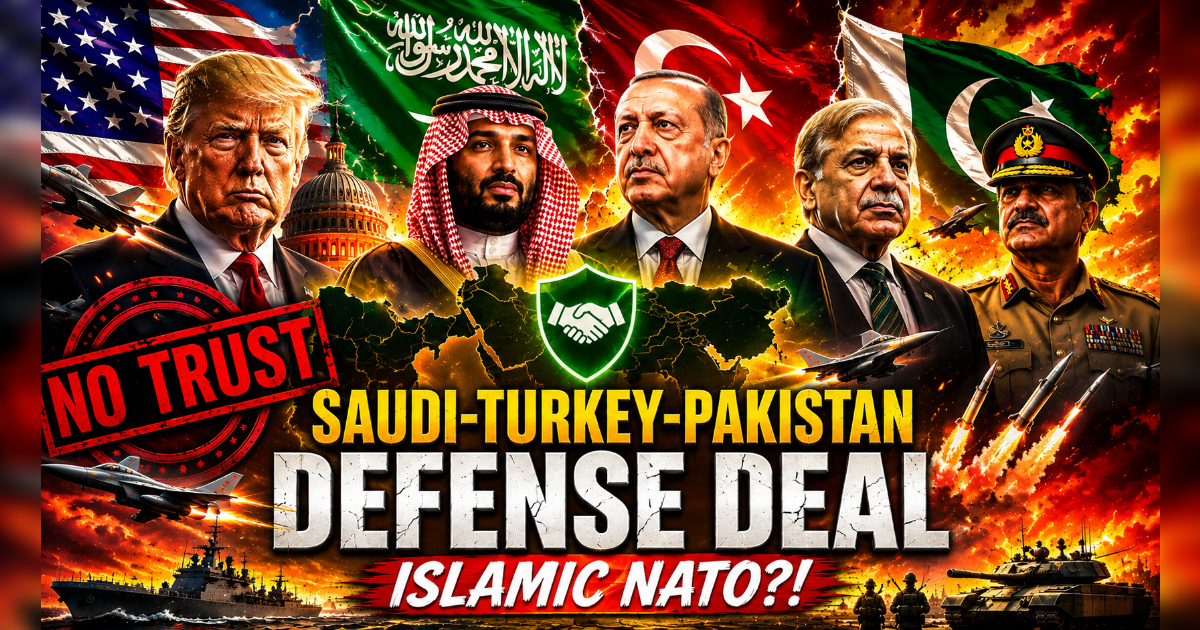
A new power triangle is forming in the Middle East — Saudi Arabia, Pakistan, and Turkey are suddenly huddled together. The headlines call it a historic alliance.** The intelligence community calls it something else entirely — and once you see what they see, you won’t be able to unsee it.**
Picture this.
In a secure briefing room somewhere far from the cameras, an intelligence analyst is staring at a map of the Middle East. Red lines connecting Riyadh, Islamabad, and Ankara. A new pact. A new “bloc.” Some commentators have already reached for the most dramatic label they can find: an “Islamic NATO.”
And yet, that analyst isn’t reaching for the panic button.
Not because the development isn’t real. It is. But because they know something the breathless headlines don’t — the mechanics running underneath this alliance, the desperation fueling it, and the fault line waiting to snap it in half the moment circumstances shift.
This briefing is going to walk you through exactly what they see. Slowly. Completely. Because every single detail here matters — and by the end, you’ll understand this region better than most news anchors currently reporting on it. 🎯
Let’s begin at the beginning — with a mission that quietly failed before it ever made the news.
Rewind a few months, to the height of the confrontation between the United States, Iran, and Israel.
In the middle of that firestorm, Pakistan quietly volunteered itself for a very specific job: mediator. The self-appointed bridge between Washington and Tehran. The country that would step in, calm two furious nations down, and walk away looking like a global statesman.
If you want the full breakdown of exactly why this mediation attempt was structurally doomed from day one — the piece-by-piece reasoning that called this outcome months in advance — go back and read our previously published posts from when the US-Iran-Israel conflict first erupted. Everything that has unfolded since has followed that script almost exactly.
And here’s what this move wasn’t about, contrary to what many assumed watching from the outside. This had nothing to do with Pakistan trying to elevate its international standing, polish its image as a global peacemaker, or earn itself a seat at the grown-ups’ table of world diplomacy. Strip away that flattering assumption entirely.
It was about cash.
Pakistan’s economy has been standing on the edge of a cliff for a long time now — inflation eating away at ordinary lives, foreign reserves stretched thin, debt piling up faster than it can be serviced. For a government in that position, playing “trusted middleman” between two furious global powers wasn’t about honor. It was a lifeline strategy. Broker a deal, collect goodwill, collect financial support, buy a few more months of breathing room for a collapsing economy.
There was just one catastrophic problem.
The mediation never worked. Not even close.
To understand why, you need to understand what each side actually wanted — because their goals were fundamentally incompatible, and no amount of shuttle diplomacy was ever going to bridge that gap.
The United States wanted a very specific, very aggressive outcome from its confrontation with Iran: forced regime change, achieved through overwhelming military pressure. Break the regime. Replace it. That was the real objective sitting underneath the official diplomatic language.
Iran, meanwhile, wanted the mirror-image outcome: the complete expulsion of American military presence from the Middle East, once and for all. Push the Americans out. End the era of US bases dotting the region.
Neither side got what it wanted.
Washington did not achieve its regime-change objective. Tehran did not achieve its expulsion objective. And that left both capitals in a very specific, very dangerous emotional state: fuming, humiliated, and directionless. Not defeated exactly — but stuck. Each side had spent enormous resources, taken enormous risks, and had nothing clean to show for it. That kind of frustrated stalemate is precisely the environment where smaller, opportunistic players smell an opening — and Pakistan smelled one immediately.
Before we go further, it’s worth rewinding even earlier — because the roots of this entire regional scramble stretch back to a single date that most casual coverage of the “Islamic NATO” conveniently skips: October 7, 2023, the day Hamas launched its attack on Israel.
What followed, by most independent tallies, was one of the most devastating military campaigns in the region’s modern history — Israel answered terror with what amounted to a wholesale leveling of the Gaza Strip, a leveling that, according to widely cited figures, left more than 70,000 Palestinians dead, a horrifying share of them — somewhere in the range of 20,000 — children. Multiple ceasefire attempts were floated over two years of fighting, and multiple times they collapsed, with reports pointing to repeated strikes on Hamas’s own lead negotiators as the reason talks kept falling apart. The pattern itself is the accusation: whenever peace looked close, the negotiators themselves became the target — because, as regional critics have put it bluntly, the real objective wasn’t a ceasefire at all. It was continuing the genocide.
Then came the moment that actually rewired Gulf calculations for good — the moment that made it clear this genocide wasn’t going to stay contained inside Gaza’s borders: on September 9, 2025, a Hamas negotiating team wasn’t hit in Gaza or in Iran — it was targeted inside Qatar, a neutral, sovereign Gulf state, in a strike that also killed a Qatari security officer. The world condemned the strike sharply and immediately. But inside the region, it landed as something closer to a warning shot than a scandal. If a sovereign Gulf host nation wasn’t off-limits, nobody was. And the uncomfortable follow-up question wrote itself: if Israel would strike inside Qatar, and Washington — the region’s self-appointed “net security provider” — wouldn’t lift a finger to stop it or even openly condemn its own ally, who exactly was protecting the Gulf?
And underneath that question sits an even blunter one that regional observers keep coming back to: is Washington actually the one calling the shots here, or is it Jerusalem? Watch America’s actual behavior across this entire saga — a strike inside a sovereign Gulf state it barely blinks at, a war where the lion’s share of its munitions quietly get rerouted toward one ally regardless of who else is left exposed — and the pattern starts to look less like an independent superpower setting its own agenda and more like Washington dancing to Israel’s tune. That’s not a fringe theory in the region. It’s close to the default read.
That, not just the later Iran war, is the real ignition point behind the original September Saudi-Pakistan defense pact. Tellingly, the full text and terms of that agreement have never been made public to this day — but what can be said with confidence is that it functions as a NATO-style collective defense treaty, where an attack on one is treated as an attack on both. And when Pakistan’s own defense minister was pressed afterward on whether the pact carried a nuclear-protection clause, he notably declined to rule it out. Translation: under the right circumstances, Pakistan wasn’t ruling out extending its nuclear umbrella over Saudi Arabia to defend it.
Here’s where the story gets genuinely fascinating — and this is the detail that should stop you in your tracks.
This chapter opens in February, when the United States and Israel launched their joint offensive against Iran. Get the date and the opening move right, because it matters more than the vague framing “joint offensive” lets on: on February 28, 2026, Washington and Jerusalem launched coordinated strikes codenamed Operation Epic Fury and Operation Roaring Lion — and in the opening hours, they didn’t just hit installations. They killed Iran’s Supreme Leader, Ali Khamenei, 86, along with several senior aides, in a strike timed to catch him mid-meeting at his Tehran compound. Within 48 hours the war had spread to seven countries — Bahrain, Jordan, Kuwait, Qatar, Saudi Arabia, the UAE, and Iraq all took fire.
Here is the detail that undercuts the entire “America failed to protect the Gulf” storyline in a way almost nobody has connected: the United States and Israel didn’t just fail to achieve regime change. They arguably triggered the opposite of it. Nine days after Khamenei’s death, Iran’s Assembly of Experts named a successor — his own son, Mojtaba Khamenei, a mid-level cleric widely read as more hardline than his father, not less. Iran’s president called it a “new era of dignity and strength.” One regional analyst put the irony bluntly: the strike was meant to tell Iran “you wanted to get rid of our system,” and the system answered with an act of defiance, not collapse. A decapitation strike that was supposed to break Iran’s chain of command instead produced dynastic continuity with a harder edge — which means every calculation in this briefing about “Iran, weakened and unpredictable” needs an asterisk: weakened militarily, perhaps, but arguably more rigid, not less, in how it’s now led.
Iran did not try to fight back head-on in a conventional sense. It didn’t need to. Instead, Tehran leaned into something called asymmetric warfare — using comparatively cheap, mass-produced attack drones (similar in style to the “Shahed” drones that have become infamous in modern conflict zones around the world) to inflict damage that far outweighed their cost. In retaliation, Iran turned its fire on American bases and on the oil-and-gas infrastructure of Gulf states across the region, Saudi Arabia included.
Wave after wave after wave of these low-cost drones systematically exhausted the United States’ advanced Patriot air-defense interceptor stockpiles — the very missile system specifically engineered to intercept and neutralize exactly this kind of threat. Not partially depleted. Not dented. The entire arsenal of these top-tier interceptors was run down.
Put real numbers on that, because the numbers are more alarming than the vague version. The Center for Strategic and International Studies estimates the US entered the war with roughly 2,200–2,300 of its most modernized Patriot interceptors and about 452 THAAD interceptors. By the time the fighting had ground on for months, independent trackers were placing the Patriot stockpile at under 827 — a fall of roughly two-thirds — with THAAD down to fewer than 278. Each Patriot interceptor runs upward of $4 million. Production is capped at a few hundred units a year. CSIS’s own conclusion: rebuilding the stockpile to pre-war levels will take three years or more, which is precisely the kind of hard, closable gap a Gulf monarchy’s planners would circle in red ink — not because America lost the war, but because America spent down the exact insurance policy the Gulf was relying on, and can’t refill it quickly even if it wanted to.
And here’s the part that should genuinely startle you: this wasn’t just a story about America failing to protect its Gulf partners. By multiple regional accounts, the United States couldn’t even fully protect itself. Despite everything thrown at the fight — roughly 40 aircraft, 36 Reaper drones, 4 helicopters, fighter jets, and radar and defense hardware worth trillions of dollars combined — America still hadn’t managed to defeat Iran outright, and, at least as of the most recent reporting available, still hadn’t forced open the Strait of Hormuz, which Iran had choked off entirely. If the world’s most expensive military, sitting on that many assets already stationed in the region, couldn’t even win the fight or reopen a single shipping strait, what exactly was it offering the Gulf states in the way of protection?
And this isn’t a closed chapter you can file under “resolved.” As of this week — the same week the Mecca pact was signed — the Strait is, once again, effectively closed. A US-Iran memorandum of understanding briefly reopened it toll-free in mid-June; that arrangement broke down in early July after strikes on commercial vessels, and traffic has been running at a trickle ever since — a handful of ships a day against a pre-crisis baseline north of 70. Iran and Oman are reportedly circling a new framework, but Tehran itself says an Iran-Oman understanding won’t be enough to reopen the waterway on its own. In other words: the exact vulnerability that pushed Riyadh toward Ankara and Islamabad in the first place isn’t a memory the Gulf states are reacting to after the fact. It’s still live, still unresolved, and still sitting directly under the ink on the Mecca agreement.
And it gets worse. Even the ally Washington supposedly prioritized above everyone — Israel — didn’t come away properly shielded either. By multiple regional accounts, the overwhelming majority of America’s available munitions during that stretch had already been funneled toward Israel, on a logic so blunt it barely qualifies as diplomacy: Israel had to be saved, full stop — and everyone else in the Gulf could, in the crudest possible reading of Washington’s priorities, go to hell. But even that narrower promise came apart at the seams: Israel itself reportedly still wasn’t given adequate air defenses. So the Gulf states were left with the worst possible read of the situation — not protected, and watching the one ally that was the priority also come up short. That’s the moment you start building a plan B.
Sit with that for a second.
A relatively inexpensive weapon, produced in bulk, methodically drained the ammunition reserves of one of the most sophisticated and expensive air-defense networks ever built. This isn’t a minor footnote buried in a military briefing. This is a strategic shockwave — proof that overwhelming firepower and cutting-edge technology can still be worn down through sheer volume and persistence.
Rattled by the visible drain on its own defenses — and by extension, the drain on its credibility — Washington suddenly wanted an off-ramp. Fast. Quiet. A ceasefire, negotiated as quickly as possible, before the world noticed just how exposed those defenses had become.
That is the exact moment Pakistan tried to jump back into the picture — not for the original grand mediation this time, but specifically offering to help broker this urgent ceasefire. “Let us help arrange this,” Pakistan effectively said, sensing one more opportunity to make itself indispensable.
But it had nothing real to offer. The mediation had already collapsed structurally — the two nations were never actually able to hold direct, productive talks through Pakistan’s channel in the first place. Pakistan showed up to a negotiation that no longer had room for a middleman, and walked away with nothing. No fee. No favor. No financial lifeline. 💸➡️❌
Pakistan understood immediately what this meant: because it couldn’t actually resolve the US-Iran standoff, the payday it was counting on — the “commission” for services rendered — never arrived.
Frustrated, and still desperate for revenue, Pakistan needed a new target. A new wealthy patron to attach itself to.
It found one. Saudi Arabia.
While Pakistan was busy chasing a payday that never materialized, something far more consequential was happening one country over.
Saudi Arabia — along with several of its Gulf Cooperation Council partners — found itself directly on the receiving end of Iranian strikes. Not symbolic strikes. Real ones, hitting both civilian and military infrastructure across Saudi territory and allied Gulf states, and critically, destroying American military bases stationed inside these two countries.
Not “damaging.” Not “disrupting.” Destroying.
And in that moment, something shift…