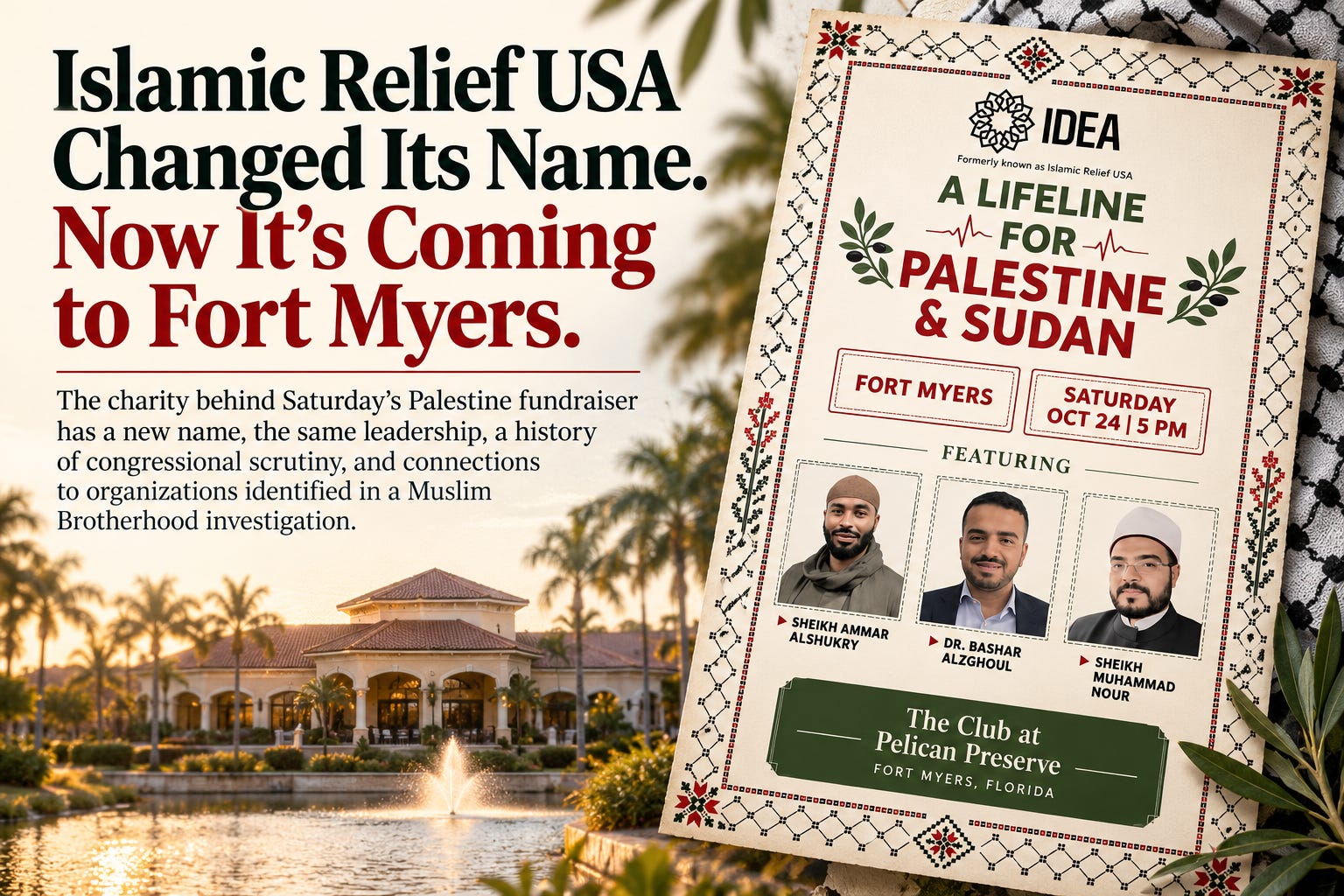
On Saturday, October 24, a national Islamic charity is holding a fundraising dinner at The Club at Pelican Preserve in Fort Myers, Florida. The invitation calls it A Lifeline for Palestine & Sudan, and the evening features three speakers, including a Florida doctor being promoted as a witness to conditions in Gaza.
Dr. Bashar Alzghoul is a pulmonary and critical-care physician who spent two weeks at European Hospital in Khan Younis in March and April 2024. He traveled with a medical delegation supported by the Palestinian American Medical Association (PAMA) and the Jordan American Physicians Association. After returning to Florida, he began speaking publicly about the injuries, overcrowding, and hospital conditions he says he witnessed.
Another advertised speaker is Sheikh Ammar Alshukry, a Sudanese-American Islamic preacher and poet who serves as a director of AlMaghrib USA, an international Islamic education organization. He’s also an imam in the Houston area and has worked with Omar Suleiman, founder of the Yaqeen Institute for Islamic Research. The third speaker is Sheikh Muhammad Nour, whose organizational affiliation isn’t identified in the event materials.
The organization collecting the money is IDEA, short for Islamic Development & Empowerment in America. Until September 15, 2026, it was called Islamic Relief USA.
IDEA has the same federal tax identification number (95-4453134), the leadership hasn’t changed, and it has the same legal identity as Islamic Relief USA. Its new website talks about development, empowerment, and building stronger communities. Behind that new name is a history of congressional scrutiny, a bitter separation from Islamic Relief Worldwide, and connections between its leadership and organizations identified in a recent investigation of the Egyptian Muslim Brotherhood’s American network.
One of those connections leads directly to the man running IDEA today.
Here’s a larger investigation into Florida
Ahmed Shehata is IDEA’s chief executive officer. He previously held senior positions at Islamic Relief USA and became its CEO in 2025, putting him in charge of the organization now raising money in Fort Myers.
In January 2026, George Washington University’s Program on Extremism published The Egyptian Branch of the Muslim Brotherhood in America: Yesterday and Today. Researchers Sergio Altuna and Lorenzo Vidino examined the organizations, activists, and political networks connected to the Egyptian Muslim Brotherhood in the United States.
Shehata appears in that report as a board member of Egyptian Americans for Democracy and Human Rights (EADHR), an organization established in New Jersey in 2013. The researchers placed EADHR within a network of Egyptian Brotherhood-aligned political groups that emerged after Egyptian President Mohamed Morsi, a Muslim Brotherhood leader, was removed from power. Same guy El-Sayed is connected to…
EADHR organized demonstrations, speaking events, and political campaigns concerning Egypt. The researchers traced its connections to other Brotherhood-aligned organizations, including Egyptian Americans for Freedom and Justice and the Egyptian Revolutionary Council. They also examined the overlap between leadership in American Muslim organizations and political activism connected to the Egyptian Brotherhood.
Shehata wasn’t the only Islamic Relief USA figure mentioned. Khaled Lamada, a former senior official on the charity’s board, was also discussed in connection with Egyptian Brotherhood-aligned activism. Lamada had held significant responsibilities within Islamic Relief USA, including board leadership and audit oversight.
The GWU report documents organizational connections involving both men. It doesn’t establish that the Muslim Brotherhood controls IDEA or that either man committed a crime. It does place people who held senior positions at Islamic Relief USA within the political network the researchers were investigating.
And one of those men now runs the charity holding Saturday’s fundraiser.
In September 2024, the House Ways and Means Committee referred Islamic Relief USA to the Internal Revenue Service for an investigation of its tax-exempt status. The committee was examining the American charity’s relationship with Islamic Relief Worldwide, a British-based humanitarian organization with an international network of affiliates.
According to the committee’s financial records, Islamic Relief USA sent approximately $74.7 million in 2021 and $82.9 million in 2022 to Islamic Relief Worldwide. That’s like… $158 million in two years. The American charity was one of Islamic Relief Worldwide’s biggest sources of funding, accounting for approximately 44 percent of its income in 2021 and 29 percent in 2022.
Congress was interested in those transfers because Islamic Relief Worldwide had already faced serious allegations involving Hamas and antisemitism.
In 2014, Israel’s defense minister accused Islamic Relief Worldwide of transferring money to Hamas and prohibited the organization from operating in Israel. Islamic Relief Worldwide denied the allegations. In 2020, the U.S. State Department ended its relationship with Islamic Relief Worldwide following the discovery of antisemitic statements made by members of its leadership. The organization acknowledged the statements and announced changes to its governance.
The congressional investigation also examined decisions by major banks, including HSBC, Credit Suisse, and UBS, to end their relationships with Islamic Relief Worldwide amid terrorism-financing and compliance concerns. The committee continued pressing the IRS to examine the American charity’s tax-exempt status, and in March 2026, Chairman Jason Smith publicly discussed the investigation and Islamic Relief USA’s efforts to separate from its international partner.
The congressional findings document large financial transfers and serious concerns about the international recipient. They don’t establish that Islamic Relief USA sent donations directly to Hamas. By March, however, the two charities were fighting over money, contracts, and their future relationship.
In October 2025, Islamic Relief USA suspended its relationship with Islamic Relief Worldwide, arguing that the international organization’s controversies were damaging its ability to work with banks, government agencies, and humanitarian partners.
On March 23, 2026, Islamic Relief USA filed a federal lawsuit in the Southern District of New York. The complaint described a fight over contracts, trademarks, money, and organizational control. Islamic Relief USA claimed that Islamic Relief Worldwide was holding at least $6,412,509 connected to projects the American charity had completed or ended.
The lawsuit also described a problem involving USA for UNHCR. According to the complaint, a funding arrangement had run into trouble because money was being routed through an account associated with Islamic Relief Worldwide. A compliance hold had been placed on the transfer, prompting efforts to restructure the arrangement so the money would no longer pass through that account.
In July, a federal judge put the lawsuit on hold while the parties pursued the dispute-resolution process in their contracts. On September 12, Islamic Relief Worldwide’s International General Assembly voted unanimously to expel the American organization from its federation.
Three days later, Islamic Relief USA announced its new name…
IDEA.
The organization introduced a redesigned website and a message from Ahmed Shehata about its future. The branding emphasized humanitarian development, community empowerment, and the organization’s American identity. Its federal tax identification number, leadership, and legal history remained unchanged.
Islamic Relief Worldwide subsequently warned donors that IDEA was no longer part of its international federation and no longer had access to its global humanitarian delivery network. IDEA told donors that its programs, recurring contributions, and humanitarian partnerships would continue.
The two former partners were now giving donors different accounts of what the separation meant for humanitarian operations. Islamic Relief Worldwide said the American organization had lost access to its delivery network. IDEA said it had other partners and could continue its work.
On October 9, IDEA announced that it had committed $89.6 million to humanitarian work in Palestine, including $82.3 million for Gaza. The charity reported 32 emergency projects and said its programs had reached more than 2.85 million people through food distribution, medical assistance, clean water, and other services.
Those are IDEA’s reported figures, rather than an independent accounting of how much money has been paid to each organization carrying out the work.
IDEA publishes a list of humanitarian partners that includes Anera, United Palestinian Appeal, and the Palestinian American Medical Association. PAMA helped support Dr. Bashar Alzghoul’s 2024 medical mission to Gaza, and Alzghoul is one of the featured speakers at Saturday’s Fort Myers fundraiser.
That connects the medical network that supported his trip to the charity holding the dinner, although the event announcement doesn’t identify PAMA as a recipient of Saturday’s donations.
There are other substantial financial relationships. In October 2025, Islamic Relief USA announced a five-year, $25 million partnership with World Food Program USA, saying the first $5 million had been authorized for World Food Programme operations in Gaza.
In June 2026, Islamic Relief USA announced a five-year, $25 million arrangement with the Islamic Development Bank’s Response, Recovery and Resilience Facility. Ahmed Shehata signed it during the bank’s annual meetings in Baku, Azerbaijan. Under the terms published by the charity, the bank can reimburse Islamic Relief USA up to $25 million for qualifying emergency-response spending on projects the two organizations approve.
These are two separate financial arrangements. Neither announcement establishes that the full amount has already been transferred or identifies the beneficiaries of Saturday’s Fort Myers dinner.
Islamic Relief USA’s activities have extended well beyond emergency fundraising overseas.
In November 2025, the charity joined the U.S. Council of Muslim Organizations (USCMO) to host an Islamic endowment conference in Reston, Virginia. USCMO is an umbrella organization bringing together American Muslim advocacy, religious, and community groups. Its secretary general, Oussama Jammal, appeared alongside Ahmed Shehata.
Also participating was Gaddoor Saidi, chairman of the North American Islamic Trust (NAIT), an American Islamic property-holding institution involved in mosque ownership and religious endowments. NAIT has appeared in previous investigations into Islamic property ownership and mosque development, including my earlier Florida reporting.
The conference also included Yaqub Mirza, chairman of Sterling Management Group, a financial services and investment organization involved in Islamic financial planning, and Esam Omeish, who chaired Islamic Relief USA’s Endowment Committee.
Omeish is a physician and longtime Muslim community activist who previously served as president of the Muslim American Society. His involvement connects the endowment discussions to another organization whose founders’ historical ties to Muslim Brotherhood activism have drawn scrutiny.
The Reston conference brought together people involved in charitable fundraising, Islamic property ownership, investment management, and long-term endowments. It shows the organizations working together on financial planning beyond individual fundraising dinners, although it doesn’t establish that IDEA financed the mosque being built in downtown Fort Myers.
Islamic Relief USA also had a relationship with the Muslim Public Affairs Council (MPAC), a national Muslim advocacy organization based in Los Angeles and Washington, D.C.
In December 2025, Ahmed Shehata attended MPAC’s Empowering Voices gala alongside Mohamed Elibiary, Islamic Relief USA’s chief external affairs officer, and Naeem Muhammad, a senior fundraising executive.
Elibiary is a Texas-based Muslim political activist and former member of the U.S. Department of Homeland Security’s Homeland Security Advisory Council. His past public statements and political associations have attracted criticism, particularly over concerns about Islamist influence in American institutions.
MPAC officials described Islamic Relief USA’s support for the organization and its work. The relationship adds another national advocacy group to the circle of organizations with which the charity’s leadership worked before the name change.
Islamic Relief USA’s transformation into IDEA also fits into a longer history of American Muslim organizations whose leadership networks can be traced through earlier institutions.
One example is the Council on American-Islamic Relations (CAIR), founded in 1994 by Nihad Awad and Omar Ahmad. Both men had previously been associated with the Islamic Association for Palestine, an organization later identified in federal terrorism-financing litigation as part of a Hamas-support network in the United States. Awad had served as the Islamic Association for Palestine’s public relations director before becoming CAIR’s executive director.
CAIR was established as a separate organization, rather than a legal renaming of the Islamic Association for Palestine. The connection was the movement of people from one organization into another.
IDEA’s situation is more direct. Islamic Relief USA changed its public name while keeping the same legal organization, federal tax identification number, and executives.
The change came during congressional scrutiny of the charity’s former international relationship, a federal lawsuit over its separation, and expulsion from the international federation. The website changed, but the records remained under the same legal entity.
IDEA is taking A Lifeline for Palestine to cities around the country, with events advertised in places such as Minnesota, Arizona, Louisiana, New Jersey, California, and Northern Virginia.
A Lifeline for Palestine
October 3 — Shoreview, MN: Palestine/Gaza
October 3 — Tempe, AZ: Palestine/Gaza
October 4 — New Orleans, LA: Palestine/Gaza
October 10 — Pennsauken, NJ: Palestine/Gaza
October 11 — Elk Grove, CA: Palestine/Gaza
October 17 — Falls Church, VA: Palestine/Gaza
October 24 — Fort Myers, FL: A Lifeline for Palestine & Sudan (invitation title)
December 5 — Birmingham, AL: Palestine/Gaza
Qur’an Tour 2026 — Unity Through Recitation Fundraising for Gaza, Syria, and Sudan.
October 24 — Phoenixville, PA
October 30 — Sarasota, FL
November 13 — Orlando, FL
December 12 — Bakersfield, CA
Our People, Our Pakistan Fundraising for autism support centers, medical missions, and orphan programs in Pakistan.
November 6 — Falls Church, VA
November 8 — New Brunswick, NJ
November 13 — Fort Lauderdale, FL
November 14 — Fremont, CA
November 15 — Fullerton, CA
November 20 — St. Louis, MO
November 21 — Houston, TX
November 22 — Richardson, TX
Tazkiyah: The Journey of the Heart Islamic spiritual program featuring Dr. Haifaa Younis.
November 6 — Sacramento, CA
November 7 — San Diego, CA
Songs for Syria Fundraising for families in Syria.
December 4 — Tulsa, OK
December 6 — Willowbrook, IL
Saturday’s Fort Myers dinner is scheduled for 5 p.m. at The Club at Pelican Preserve. IDEA’s event program allows communities to request fundraising stops, suggesting that local organizers can help bring the national tour to a particular city. The Fort Myers listing names IDEA as the organizer but doesn’t identify the person or local group that arranged the stop.
There is already a Florida fundraising operation connected to the organization. Karim Hajissa has been listed as a contact for Islamic Relief USA and IDE…