Hello from Jerusalem! I’m here for NatCon Jerusalem, and delivered one of the opening speeches, on the topic of why the National Conservative philosophy is the only realistic and decent way forward for the Right. The video will be up soon; I’ll post it here. Starts like this:
It is an honor to be here at the Natcon conference in Jerusalem, especially in a time when this country, Israel, is facing the contempt of much of the world, simply for defending itself against bloodthirsty barbarians. The rest of the world -- especially Europe -- could learn from Israel. For all its faults, Israel continues to be a light unto the nations, even if the Gentiles, in this present darkness, cannot comprehend it.
I come from the United States, where conservatism is in trouble. If pollsters are right, the Republican Party is about to be hit very hard in the midterm elections. And, as a conservative, it gives me no pleasure to say that we will have brought this onto ourselves. Should the Republicans lose, we will hear many voices saying that National Conservatism is finished.
They will be wrong. National Conservatism’s vision does not depend on the success or failure of any particular government. In fact, whatever the failures of the Trump administration and the Republican Party have been, National Conservatism is the only real future conservatism has. Let me explain why.
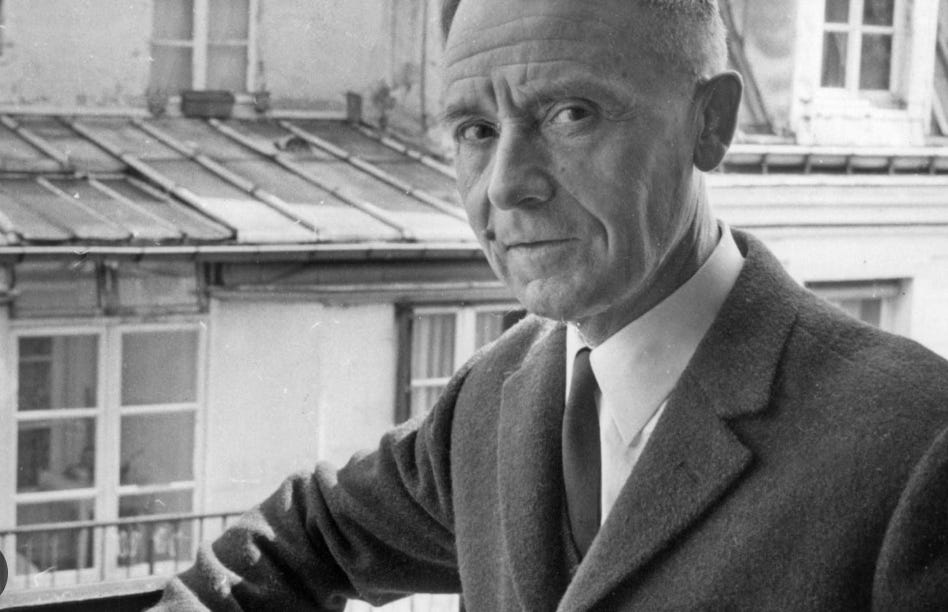
On the flight from Frankfurt to Jerusalem, I read an extraordinary novel, one of the strangest and most beautiful I’ve ever seen. A friend and reader of this newsletter recommended it to me, and boy, was he right. It’s called * The Sunset Lands*; the author is a Frenchman, Julien Gracq. He wrote it in the mid 20th century, but it was only published in 2014. It’s an unfinished novel — Gracq grew frustrated with it, and set it aside — so the ending is necessarily abrupt and unsatisfying. But well worth reading.
It’s set in a fictional late-medieval European kingdom which is prosperous, comfortable, and decadent. A barbarian army gathers on its borders, but the leadership is determined not to take it seriously, and to anesthetize the populace. As you will see in the passages I quote, Gracq is a dense, sensual, lyrical writer; some of his lines land more like poetry than prose (it won’t be to everyone’s taste, admittedly). Here is his description of life in the capital of the Kingdom:
As our possessive instinct seemed sharpened, so, correspondingly, the ground on which we lived was no longer so entirely reassuring and familiar; in the things best suited to serve and support us, in the street’s daily perspective, in the familar maze of country roads, there was a kind of withdrawal, a surly isolation … [F]rom that fatigued anchorage and those heartstrings broken one by one, came a malaise that turns us into antennae for sensing the wind that was starting to gather.
The Kingdom has been at peace for so long that its people have forgotten what it’s like to be threatened. I thought of Europe today, naturally; the last time it was threatened by the armies of Islam was in the 17th century, when the Sultan’s troops were repelled at the gates of Vienna. Europe forgot, and it finds itself today besieged, stunned, and unwilling to see what’s right in front of its face, literally.
The barbarians on the borders in this novel are marked by a “cold will to exterminate.” I had just been watching clips from student protests in Paris, in which some of the students talked about killing white people, and other clips from Muslim radicals in Britain who openly talk about the same thing. 𝕏Here is one British Muslim speaking of Jews:
Anyway, in the Kingdom, “the dignitaries … spoke in public of the need to ‘keep calm’ in the face of these emergent mortal threats… .” The leadership class praises people for their “exemplary composure,” by which they mean not seeing the actual threats, and reacting properly to them. “From this point on, it must be said, everything tended to persuade us of broad daylight at midnight. The very real calm of the Kingdom in itself became for us a proof of how unimportant the danger was.”
Gracq’s unnamed narrator is a functionary in the legal system. He says that the ruling class shushes anyone who speaks plainly about the barbarian threat, chastising them that the barbarians simply need to be “interpreted,” and calling them barbarians only plays into their hands. The government punishes anyone who speaks of the barbarian threat, and urges preparation to fight those who come to destroy them. (Gracq wrote this in the 1950s!)
The narrator says in the Kingdom, words have lost connection with reality; they are used by the elites, and the people under their sway, to manipulate people’s feelings, not to describe the world as it is. Confucius said that the loss of the meaning of words is a precursor to losing shared meaning, and ultimately, freedom (“rectification of names” he called for).
The narrator gets sick of it, and decides to set out with friends for the far countryside, outside the Kingdom’s borders, to spend time with country folk, and join in the defense of the Kingdom. “Leave — yes, it was time to leave — to quit the old Kingdom that was burying itself in winter.” He figures that country people are more in touch with reality, and speak more plainly (“he’d decided to speak more directly, almost man to man, with those spirits who were still awake and hadn’t completely capitulated”). He discovers, though, that “the mental horizon of the little folks of the land seemed to suddenly shrink.” They want to keep themselves focused on village life.
Yet the more time he spends with them, the more he comes to see that their living close to nature, and not in the abstractions of city life, has prepared them in ways he did not foresee. He says, “basically, the Kingdom had no love of that image of itself for which small groups, so far from its frontiers, were fighting like lost children.” That is, the country people still believe in the heroic virtues of their country and their civilization, while the city folk, especially the ruling class, have forgotten, and punish anyone who reminds them. Among the country folk, the narrator and his friends find themselves with “a newly minted sense of righteousness that was so much lacking in the Kingdom’s abstract justice.”
The narrator and his friends are headed for Roscharta, a besieged frontier city, where they plan to join in its defense. On the way, through the re-wilding borderlands, they see that the will of man to civilize the formerly wild places has ebbed. “[N]ow even the appetite for holding on had decayed; everywhere there was an ebbing away, a sorrowful withdrawal.”
As the novel goes on, you see that Roscharta is doomed. Nobody will come to help them, and they aren’t strong enough to hold out against barbarians as bloodthirsty as these. The novel is about how to live with integrity and hope in the face of certain doom. The secret that the country people, and the Roschartans, know comes from their “being incapable of soiling their hands and their mouths with anything that didn’t carnally touch on a certain order they felt within their hearts.”
Reading Gracq’s novel is like staring intensely at a medieval tapestry. It is densely packed with sensual descriptions of nature, architecture, and the physical beauty of people and places in which the narrator moves. This is a book without God, though there are Catholic churches in the cities. The hope the narrator finds comes from intense, direct love of the beauty around him, and of what his dying civilization has distilled.
When the narrator’s party arrive in Roscharta, they are put to work. The narrator doesn’t know what he can do, but one of the Roschartans assigns him to be a “witness” to what is happening, and what their civilization means. In this, the man says, the people can find what they need more than anything else: hope. That is to say, they need someone with the artistic and intellectual gifts to identify what is good and noble within their people and the people’s ways, and to remind them that this civilization is worth living and dying for.
The besieged city is not in immediate danger. It’s walls are high and well-defended, but everybody knows this is an illusion. What the reader sees in this novel, in several instances, is the critical importance for maintaining hope the construction of small, ordered, beautiful places and communities — places that reveal inner order, beauty, and ultimate meaning. I kept thinking as I read, “Yes, this is what I meant by the Benedict Option, though I didn’t put it quite like that.”
As you have all heard from me a million times, people who think the Benedict Option is about withdrawal are quite wrong. It’s about retrenchment within faith, and communities of faith, so we can remember what reality is, and hold on to the faith no matter what happens. It is not a call to quietist surrender — I believe we should fight! — but a deeper call to remember what we are fighting for. This is not something that can be stated abstractly, or if it can, it has no weight in a decadent society. It must be lived, and experienced. This is what the narrator learns in Roscharta.
Frankly, some of the rhapsodic, lyrical passages about the beauty of the surrounding nature wear one down, like eating too many petit-fours at a banquet. But the point is powerfully made: eating and drinking and laughing with one’s close friends, all of whom are united in a Mission for which they are prepared to die, gives hope, because it gives *felt meaning. *In the periods of rest between working and preparing the city’s defense, the meaning of why they work and fight becomes clear. It is a kind of purification, a deliverance. People see each other; nobody is anonymous and alienated. They cannot afford to be, not with people on the ramparts who want to cut their heads off.
During his time on the night watch, the narrator says: “It feels good to keep watch here … you feel that you’re fighting backed against a night packed with lives, a hive built to the roof with men.” Life under siege becomes … enchanted. I read this and thought: this is what the autumn and winter of 2001-02 was like living in New York City. I know; I was there.
The narrator:
No one called us here. There were no reasons, there were really no reasons. For us, there never have been any
reasons. We left them to those who didn’t come. It’s enough for us to be shut up here — how to tell them? Not that we lack hot blood or happy hearts. We don’t — but because there’s fruit that only ripens in the sun when backed against a wall.
And:
We don’t forget. To those who have come here via the long route, a community, the solidarity of a crew, is founded on the memories of the journey.
The experience of life in Roschrata, for these alienated men of the Kingdom, puts them “back in possession” of their land, and the meaning of their lives as men of the Kingdom.
[T]he white nights of Roscharta, leaning against the balconies of the void, are full of grave memories, and what one often sees is a gathering of little groups that are for all time knit together by the community of the Journey. There are no plans in these voices in which life always flows gravely and tranquilly, but only an untroubled witnessing; the memory of so many full hours is neither regret nor resignation — only life in the presence of its boundaries no longer relies on its limited power; desire expires there in the security of the earth that is going to give birth to another day. That’s why it’s good to attend, to stand there at that hour preceding dawn, bearing witness in the companionable circle that this earth is good and honorably lived in and that the days passed together were full — of little groups living shoulder to shoulder in the hollow of the mild night, and perched on open space, feeling rising beneath them the back of the wave, limbs ready and tongues free, and the heart full of a mysterious curiosity that never dies.
… It seems to me that nothing had been in vain, and that this world was big enough for both fidelity and desire — full of departures that no arrival could ever deny, of new mornings rejuvenated by kept faith and fire in the blood.
The “witnesses,” like the narrator, and like others in the society who still remember, bring order and lucidity out of the chaos and darkness surrounding the civilization. The narrator visits the homes of elite craftsmen in Roscharta — people who are in some sense abstracted from the conflict, but who care, and who fulfill an important function. The narrator finds there “a volume of calm that is needed for life was perhaps purified in these secret gardens. In listening to them I imagined that life was flowering there at its deepest layer, and that through it the surrounded city found itself mysteriously watered and refreshed… .”
See what he’s doing? The narrator finds the same thing in the art and theater of the city. It has meaning, and reminds the men of action why they do what they do.
How appropriate it was to read this novel on a flight that landed in Tel Aviv! Israel is the West’s Roscharta. I set out from Ben Gurion airport after midnight, in a taxi on the way to the hotel in Jerusalem. I was listening to the final chapters of O Jerusalem, the 1971 history of the 1948 Arab-Israeli war over the foundation of the state of Israel. As you know, I’ve been reacquainting myself with this amazing book (which also tells the story from the Arab side) for the first time in 26 years. How bizarre and thrilling it was to be on the road from Tel Aviv to Jerusalem, a road I’ve been traveling inside my head as the book told the story of the incredibly courageous convoys of Jews who resupplied the besieged city of Jerusalem in the months leading up to the war.
Reading Gracq’s evocation of this lone outpost of civilization, surrounded by barbarians who literally behead the people of the Kingdom when they catch them, resonated like a perfect chord with *O Jerusalem. *Whatever you think of Zionism, look at it phenomenologically: love them or hate them and their mission, the Jews of the Yishuv — the name for the pre-Israel Jewish settlement in Palestine — were a community founded on the memories of a journey, two thousand years of wandering in the diaspora. It’s why they were willing to suffer and to fight, and even to die for the hope of restoring the Jewish presence in Zion.
America is not Israel. We are a different people, with a different history. Yet we are part of the same civilization, a civilization built on the Bible. We need the Israelis, more than anything for the story that they tell. The Israelis cannot afford to be decadent, to live within liberal abstractions about universal human goodness and reason. It will cost them their heads.
They know this. They live it every day. France and Britain, where Jews and the state of Israel are so despised, will one day come to learn from the Israelis — if they want to survive the barbarians within the gates that have been welcomed by the decadent elites of the Kingdom and the Republic. In Israel, daily life has gravity, meaning, and even beauty — the kind of beauty that Julien Gracq’s narrator saw, tasted, smelled, felt, and lived, in Roscharta.