A quick note before you read: There is a LOT of information in this article. I tried to get as much of it into one place as I could without leaving out details that matter. All of the sources I used are linked at the bottom of the article so you can dig through the documents, reports, and records for yourself.
For 25 years, antisemites have been trying to solve a crime that was already solved. They know Osama bin Laden claimed responsibility for September 11. They know al-Qaeda planned it. They know who the 19 hijackers were. None of that was hidden, and none of that has stopped them from searching for Jews. So instead, they went out and found Larry Silverstein, five Israelis in New Jersey, and thousands of Jews who supposedly stayed home from work that morning. Mossad got thrown into the mix because Mossad ALWAYS gets thrown into the mix. 9/11 became one more crime Jews somehow committed without actually appearing anywhere in, on, or near the crime.
Every September the same propaganda material makes a comeback. Like clockwork. The videos get reposted, the memes circulate, and conspiracy theorists and antisemites announce with all their chest that the “official story” doesn’t make sense before explaining away why an Islamist terrorist organization led by a Saudi man operating from Afghanistan was apparently an elaborate cover for Israel. Meanwhile, the real investigation has generated (deep breath)…intelligence reports, FBI files, congressional investigations, Presidential Daily Briefs, interview memoranda, telephone records, financial records, Operation Encore files, 28 pages Congress wasn’t originally allowed to see, evidence seized by British police, and thousands of pages from a lawsuit the victims’ families are still pursuing against Saudi Arabia.
On September 11, 2026 the CIA released 71 Presidential Daily Brief products dealing with bin Laden, al-Qaeda, Afghanistan, and the terrorist threat before September 11. Sixty-nine had never been made public before. The National Archives also released the 9/11 Commission’s previously classified review of presidential intelligence, along with interviews with Sandy Berger, Richard Clarke, Condoleezza Rice, Michael Scheuer, George Tenet, and many others.
The material fills in parts of a story we’ve been trying to understand for 25 years. Washington knew bin Laden wanted to attack America, knew al-Qaeda was operating under Taliban protection, had received warnings involving hijacking and aircraft, and was already watching suspicious activity inside the United States before September 11. It appears nobody managed to put enough of those pieces together before 8:46 on that Tuesday morning.
Osama bin Laden was born in Saudi Arabia in 1957. He went to Afghanistan during the war against the Soviet Union, built the organization that became al-Qaeda, turned against the Saudi monarchy, and eventually declared war on the US. Saudi Arabia stripped him of his citizenship in 1994, and after several years in Sudan he returned to Afghanistan in 1996.
The Taliban soon controlled most of the country, giving bin Laden somewhere to operate. Al-Qaeda established training camps, recruited militants, moved people through Afghanistan, and planned attacks while its leader lived under Taliban protection.
The newly declassified presidential intelligence makes that relationship clearer. A February 1998 briefing described bin Laden as dependent upon Taliban “goodwill,” while an April briefing said the Taliban regarded him as their “guest” and were reluctant to monitor or control his activities. By July, presidential intelligence summarized the arrangement as: bin Laden was “hiding from US, not from Taliban.”
The relationship went beyond leaving him alone. After the December 1999 hijacking of Indian Airlines Flight 814 ended in Taliban-controlled Kandahar, a January 2000 presidential briefing reported that Taliban officials had warned bin Laden to “step up his security” because another government might use the crisis as an opportunity to move against him. Bin Laden was also providing the Taliban millions of dollars while enjoying the protection that allowed al-Qaeda to train recruits, move operatives, and plan attacks.
The first presidential briefing after September 11 reported that bin Laden may have clashed with Taliban leaders over the operation. That doesn’t mean the Taliban helped plan 9/11. They sheltered him, protected him, allowed al-Qaeda to build its infrastructure, and at times warned him when they believed somebody might be coming for him. That is enough for complicity.
Afghanistan wasn’t some random country America chose after September 11. It was al-Qaeda’s home base.
By 1998 presidential intelligence wasn’t merely warning that bin Laden hated America. It was reporting that he wanted to attack Americans inside the US.
On September 10, 1998 a briefing reported that bin Laden wanted to strike America on its own soil and had his eyeballs on Washington. His network, according to the intelligence, “may fly an explosive-packed airplane into a US city.” That was exactly three years and one day before the 9/11 attack.
On December 4, 1998 President Clinton received another briefing titled “Bin Ladin Preparing To Hijack US Aircraft and Other Attacks.” It discussed preparations for attacks involving aircraft hijacking, a senior bin Laden operative from Saudi Arabia who was expected to meet counterparts inside the United States, and two members of the network who had reportedly evaded security checks during a “trial run” at an unidentified New York airport. Some members of the network were also reported to have received hijacking training.
Those reports didn’t give Washington the September 11 plan. But aircraft, hijacking, bin Laden, and an attack inside the United States were appearing in presidential intelligence years before the planes hit the buildings.
Israel appears in the pre-9/11 intelligence too, although not in the role conspiracy theorists have spent a quarter century praying for it to have. A December 1998 Presidential Daily Brief said U.S. intelligence had “strong indications” that bin Laden wanted to attack the United States and allies including Britain and Israel “on their own soil.” A June 2000 briefing dealt with threats against American, Israeli, and Jordanian interests.
Bin Laden had already made his position clear. His February 1998 fatwa called for attacks against Americans while invoking American forces in Saudi Arabia, Iraq, and the Palestinian issue as part of his justification. Israel wasn’t hiding somewhere in the margins of bin Laden’s story. He considered Israel an enemy.
That little detail…it never seems to make the memes round.
Bill Clinton’s administration was pursuing bin Laden years before 9/11. It authorized covert operations intended to capture or kill him. After al-Qaeda bombed the American embassies in Kenya and Tanzania in August 1998, Clinton ordered cruise missile strikes against targets in Afghanistan and Sudan.
Because this was 1998 and America apparently couldn’t have one national crisis at a time, critics accused Clinton of trying to distract the country from Monica Lewinsky. The movie Wag the Dog had come out the previous year, and the phrase quickly became attached to the strikes. Former Defense Secretary William Cohen later told the 9/11 Commission that the accusation wasn’t true.
There were also opportunities that slipped away. In May 1999 intelligence assets tracked bin Laden near Kandahar for several days while American officials considered a strike. Concerns about the intelligence and the possibility of civilian casualties ultimately stopped it. One senior military officer later described the opportunity as “a fat pitch, a home run” and remembered everyone slumping when the stand-down came because he believed bin Laden should’ve been killed that night.
Clinton wasn’t ignoring bin Laden. He just never got him.
On October 12, 2000 two suicide bombers approached the USS Cole in a small boat while the destroyer was refueling in Aden, Yemen. The explosion tore a massive hole in the ship and killed 17 American sailors. The attack was eventually attributed to al-Qaeda.
The Bush administration didn’t inherit an abstract warning about a terrorist who might someday attack Americans. It inherited an enemy that had already bombed American embassies, attacked an American warship, and spent years announcing its intentions. The question wasn’t whether bin Laden was dangerous anymore. It was what he’d try next.
Outgoing National Security Adviser Sandy Berger warned Condoleezza Rice that terrorism would consume far more of her time than she expected. Richard Clarke spent more than an hour briefing Rice on al-Qaeda and described it as a major threat to American interests.
Rice later told the 9/11 Commission that al-Qaeda wasn’t presented to the incoming administration as its number-one concern, although it was clearly a priority. She also said Bush received more than 50 briefings concerning the al-Qaeda threat before September 11. By May 2001 Bush was reportedly complaining that he was “tired of swatting at flies” and wanted the US to go on offense. His administration began developing a broader strategy against al-Qaeda, and senior officials approved it on September 4.
One week later, al-Qaeda got there first.
The warnings had been coming quickly all summer. A July 24 briefing said one expected operation appeared to have been postponed but warned that “Preparations for other near-term attacks may still be in train.” Intelligence also indicated suspicious activity inside the United States consistent with preparations for hijackings or other attacks, while the FBI had approximately 70 full-field investigations it considered bin Laden-related.
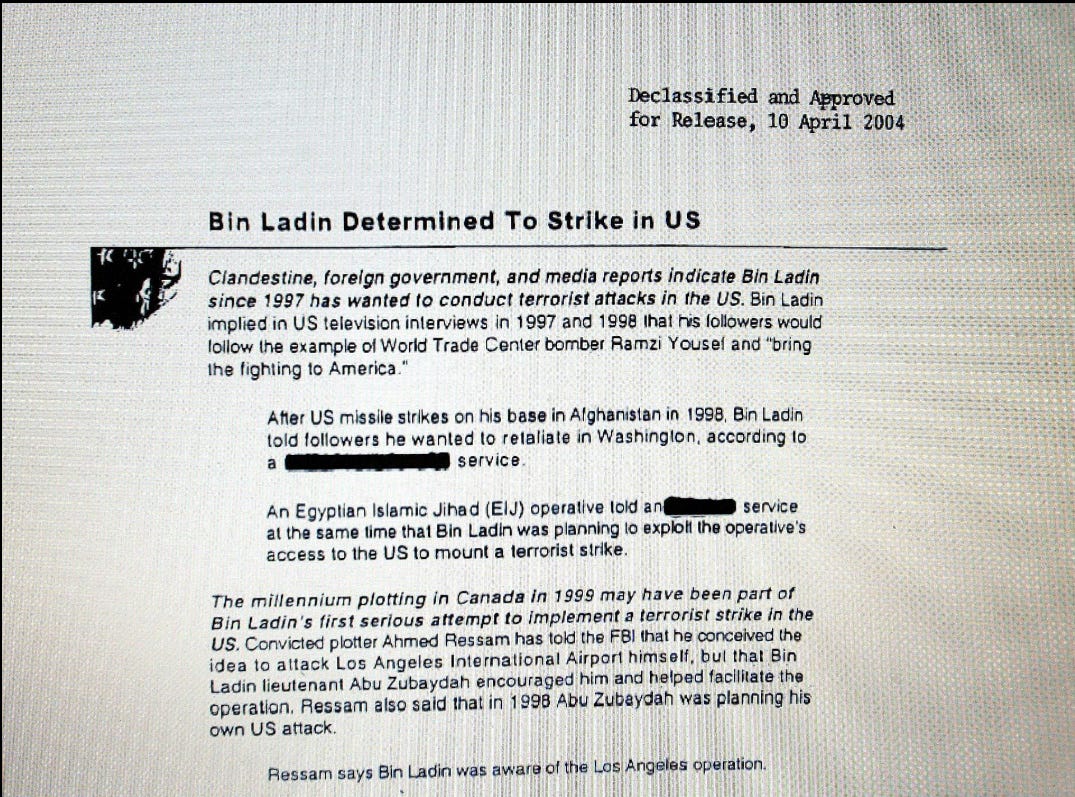
On August 6 President Bush received the Presidential Daily Brief whose title has become part of 9/11 infamy: “Bin Ladin Determined To Strike in US.” It discussed earlier reporting about hijacking, possible surveillance of federal buildings in New York, and suspicious activity inside the country. It didn’t identify the September 11 operation, flight numbers, targets, or names of the hijackers.
The threat wasn’t limited to an embassy somewhere overseas anymore.
Ten days later, Zacarias Moussaoui attracted attention at a Minnesota flight school. He wanted Boeing 747 simulator training despite limited qualifications. People at the school found his behavior strange enough to contact authorities. The FBI arrested him on an immigration violation on August 16, and Minneapolis agents wanted to search his laptop and belongings.
A fight followed between Minneapolis and FBI headquarters over whether there was enough information to obtain a FISA warrant. Headquarters concluded that agents hadn’t sufficiently established Moussaoui as an agent of a foreign power, and the search didn’t happen before September 11. Moussaoui was sitting in custody when the planes took off.
His case became one example of a larger problem the 9/11 Commission documented across the government. Intelligence and criminal investigations were divided by law, agency culture, bureaucracy, risk aversion, and an understanding of the intelligence/law-enforcement “wall” that often became stricter in practice than the law demanded. Information that legally could’ve been shared sometimes wasn’t, leaving different offices holding different pieces of the same problem.
Minnesota wasn’t the only FBI office looking at flight training before September 11. In July 2001 an agent in the Phoenix field office sent a memo to FBI headquarters warning about the possibility that bin Laden was sending people over to the States to attend civil aviation schools. His concern came from what he described as an “inordinate number of individuals of investigative interest” attending aviation schools in Arizona.
He recommended that the FBI compile a list of civil aviation schools across the country, establish relationships with them, compare his theory with intelligence community reporting, and review visa information for foreign students attending flight schools. None of those recommendations went anywhere before September 11. Managers in the FBI units responsible for bin Laden and radical Islamist investigations didn’t even see the memo until after the attacks.
Arizona already had another connection to the future plot. Hani Hanjour had spent years training there and earned his commercial pilot certificate in 1999. After returning to the United States in late 2000, he and Nawaf al-Hazmi settled in Mesa, where Hanjour resumed training at Arizona Aviation and practiced on a Boeing 737 simulator at Pan Am International Flight Academy. Some of the people he’d associated with in Arizona had also attracted counterterrorism attention.
The Phoenix memo wasn’t a prediction that terrorists were preparing to fly passenger jets into buildings, and the 9/11 Commission didn’t believe acting on it would necessarily have uncovered the plot. It might’ve done something almost as important, though. It could’ve made the FBI much more interested when another flight school called the following month about a strange student named Zacarias Moussaoui.