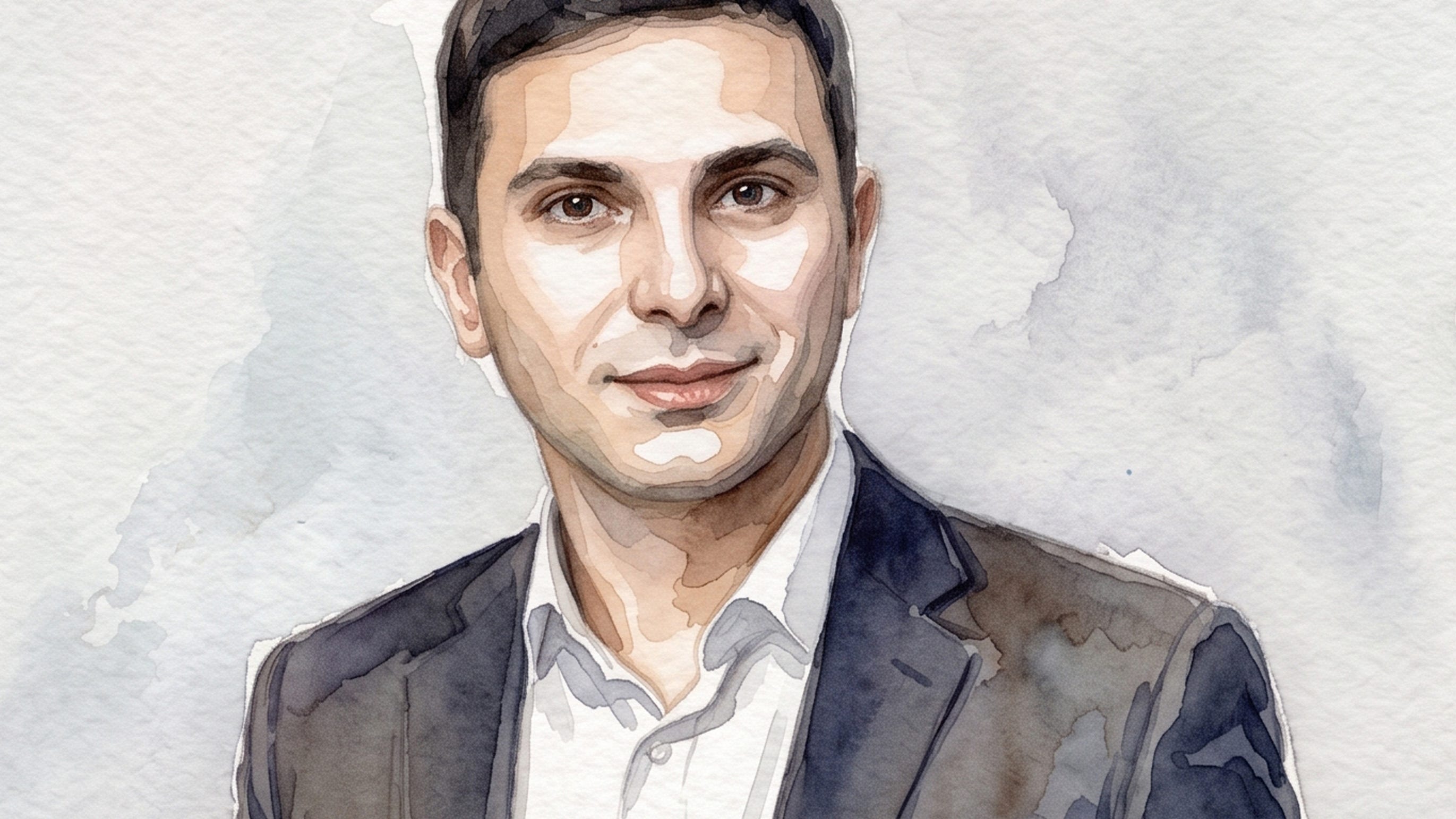
Welcome to Voices of the Fight— a Saturday Q&A series featuring the warriors, innovators, advocates, and volunteers standing under fire for free people.
My name is Cemil Kerimoğlu. I was born in Azerbaijan, but my parents and I moved to Turkey when I was a child. I grew up there, attended university, and later moved to Germany for my PhD. I have now lived in Germany for many years.
I wanted to use my knowledge of Russian history, language, and society to make Ukraine’s case and explain the character of the state attacking it.
My academic background is in molecular biology and genetics. I completed my PhD in neuroscience, remained in academia for a time as a senior research scientist, and later moved into bioinformatics and data analysis. Today, I work in industry as a data scientist.
We publish this newsletter every day at 9:05am NYC time / 4:05pm Kyiv.Your subscription fuels our work.
At the same time, I have always been interested in history and philosophy, particularly the history of Europe, Eastern Europe, and the different manifestations of the state we now call Russia. Since Russia’s full-scale invasion, my mission has been to explain the nature of the Russian state, Russian society, and Russian imperialism to Western audiences. I write independently on my Substack, * From Baltic to the Black Sea*, contribute to
The more closely you understand Russia’s history, political culture, and treatment of neighboring nations, the harder it becomes to accept the
romantic image of Russiathat still exists in parts of the West.
My connection to the subject is not merely academic. Russian was the first language I learned as a child. I also speak Azerbaijani, but Russian was the language initially spoken in our home. I grew up within a Russian-speaking cultural environment and watched Russian television, although my family never accepted its narratives uncritically. My parents have always supported Ukraine.
Ukraine first became a major focus for me during the Orange Revolution in 2004. After electoral fraud initially handed the presidency to Viktor Yanukovych, Ukrainians took to the streets and forced a new runoff, which Viktor Yushchenko won. What I remember particularly clearly is the reaction on Russian television. The hostility toward Ukraine and Ukrainian society was already extraordinary. This was ten years before the Revolution of Dignity and 18 years before the full-scale invasion.
Russia first tried to control Ukraine through propaganda, manipulation, economic pressure, and the infiltration of Ukrainian institutions and security services. For a time, it succeeded. Yanukovych eventually became president in 2010. But during the Revolution of Dignity in 2013 and 2014, Ukrainians once again demonstrated that a determined population could overthrow a corrupt government acting against the country’s interests.
Distrusting an institution does not excuse you from examining the evidence.
When Moscow realized that manipulation alone could no longer keep Ukraine within its orbit, it turned increasingly to military force. Russia began its invasion in 2014 and expanded it into a full-scale war in 2022.
That was when I decided I had to become more vocal. I was shocked by how little many people in Western Europe understood about the causes of the war. They treated the invasion as an isolated geopolitical dispute rather than the continuation of a much older imperial project. I wanted to use my knowledge of Russian history, language, and society to make Ukraine’s case and explain the character of the state attacking it.
It is not about whom you believe.
It is about what you know.
People sometimes ask why I am so hostile toward Russia when I grew up speaking Russian and know its culture so well. But that is precisely the point. I do not hold these views despite knowing Russia. I hold these views because I know Russia.
I did not encounter Russia as a distant foreign observer. I grew up inside its linguistic and cultural sphere. The more closely you understand its history, political culture, and treatment of neighboring nations, the harder it becomes to accept the romantic image of Russia that still exists in parts of the West.
Their argument was that the same media organizations that had supported COVID restrictions were now supporting Ukraine, so anything favorable to Ukraine had to be false.
That made no sense to me.
This also helps explain why so many Russian-speaking Ukrainians fight Russia. Some Westerners ask why people who speak Russian would resist a supposedly Russian state. Many resist precisely because they understand it. They know what the “Russian world” means when it arrives in their cities. Their language does not determine their political loyalty, national identity, or willingness to submit to Moscow.
My breaking point came inside Germany’s anti-lockdown protest movement.
During the final months of 2021 and the beginning of 2022, I was actively protesting Germany’s COVID restrictions and vaccination policies. I spoke at demonstrations and met many people whom I believed were genuinely committed to personal freedom and opposed to coercive government.
Then Russia launched its full-scale invasion.
To me, the moral question was completely unambiguous. Ukraine was the victim of aggression, and Russia was the aggressor. Yet many of the people beside whom I had protested either openly supported Russia or immediately began making excuses for Russia. They blamed NATO, repeated Moscow’s claims about Ukraine, or insisted that the situation was simply too complicated to judge.
Rejecting everything said by a source you dislike is just as intellectually lazy as believing everything it says.
If the BBC tells you that one plus one equals two, you do not have to conclude that the answer is five.
The massacre in Bucha exposed the contradiction beyond repair. When evidence of the killings emerged in early April 2022, I shared the images and reports in the Telegram groups used by people from the protest movement. The responses were immediate: Ukraine had staged it, the West had invented it, or the photographs were propaganda.
Their argument was that the same media organizations that had supported COVID restrictions were now supporting Ukraine, so anything favorable to Ukraine had to be false. That made no sense to me. A source can be wrong about one subject and correct about another. Distrusting an institution does not excuse you from examining the evidence.
Shortly afterward, I attended a large demonstration against the remaining COVID restrictions in Dresden. I also gave a speech there. Although the event had nothing to do with Russia or Ukraine, I saw more Russian flags than German flags.
I had already been disturbed by the movement’s response to the invasion and Bucha. But standing at a demonstration supposedly organized against authoritarianism while surrounded by the flags of one of the world’s most repressive states made the contradiction impossible to ignore.
I asked a friend recording my speech to frame the video so that none of the Russian flags appeared behind me. She managed it, but afterward I thought about the absurdity of what I had just done. I did not want to spend my time concealing the character of a movement with which I no longer belonged.
That was when I left.
I could have continued arguing in private Telegram groups, but I realized that it was a waste of time. I had knowledge of Russian history and society that could be more valuable in public. Instead of spending hours fighting with the same people in closed chats, I began writing openly and dedicating myself to making Ukraine’s case.
The experience taught me something important. Opposition to one form of government overreach does not necessarily mean that a person opposes authoritarianism as a principle. Some people were willing to denounce relatively limited restrictions in Germany while waving the flag of a state imprisoning its opponents, invading its neighbors, and murdering civilians.
People still ask me how I can distrust Western governments or media on certain issues while agreeing with them about Ukraine. My answer is that it is not about whom you believe. It is about what you know.
I do not support Ukraine because CNN or the BBC tells me to support Ukraine. Nor did I oppose COVID policies because an alternative Telegram channel told me to oppose them. I examine the evidence, use my own knowledge, and reach my own conclusions.
Rejecting everything said by a source you dislike is just as intellectually lazy as believing everything it says. If the BBC tells you that one plus one equals two, you do not have to conclude that the answer is five. If CNN tells you not to jump from the tenth floor, you do not prove your independence by jumping.
Independent thought means judging the claim, not merely reacting to the identity of the person making it.
Over time, my work also developed beyond supporting Ukraine’s immediate defense. I became convinced that simply containing Russia would not produce a durable peace. As long as the Russian Federation remains a centralized imperial entity, it will continue threatening its neighbors, manipulating Western societies, and attempting to rebuild its power for another war.
That led me to become involved with the Free Nations of Post-Russia Forum. It brings together national and regional movements seeking independence from the present Russian Federation and asks what a post-Russian political order could look like.
My position is that the Russian imperial state must ultimately be dismantled. Its constituent nations and regions should have the opportunity to form independent states based on their own identities. The process would also require demilitarization, denuclearization, and the rejection of the imperial identity that Moscow has imposed across that vast territory.
Stopping the current invasion is necessary. Helping Ukraine survive is necessary. But neither permanently solves the problem. If the Russian imperial system remains intact, it may return in twenty or fifty years. Even when it is not invading another country, it will continue using propaganda, political financing, intelligence operations, and social manipulation against Europe.
A lasting peace will require confronting the source of the aggression, not merely treating its latest manifestation.
Justice and moral clarity.
For me, this is among the most morally unambiguous conflicts in modern history. Ukraine is defending its people, its territory, its identity, and its right to exist. Russia is attempting to destroy them. The distinction is not complicated.
Western assistance has been essential. We have to acknowledge that Ukraine would have struggled to survive without weapons, financial support, intelligence, and humanitarian aid from Europe and the United States. But the support has never matched the scale of the crime or the sacrifices Ukrainians are making.
The least someone in my position can do is explain their case to Western audiences, challenge Russian narratives, and argue for stronger support.
That is shameful. Faced with such a clear case of aggression, much of the West still cannot commit fully to the side of the victim. Governments delay decisions, impose restrictions on weapons, fear escalation, and provide enough assistance to prevent Ukraine’s immediate defeat without providing what it needs to win decisively.
That injustice keeps me focused.
I live safely in Germany. I am not fighting at the front. I do not spend my nights under missile and drone attacks. I have not lost my home or a member of my family. Ukrainians are enduring all of that while defending not only their country, but the security of Europe.
The least someone in my position can do is explain their case to Western audiences, challenge Russian narratives, and argue for stronger support. What I do cannot be compared with the sacrifices of Ukrainian soldiers, their families, or the civilians who continue living through the war. But that does not make it meaningless.
When you recognize a profound injustice, you have a responsibility to do whatever lies within your ability to oppose it. That principle keeps me working.
4 | How can people support your work?
The most useful thing people can do is read and share it.
My Substack ( ) is free because my primary objective is to reach as many people as possible. I want more people in the West to understand Russian history, the nature of Russian imperialism, and why Ukraine’s victory is necessary for Europe.
Readers can share my articles on social media, send them to friends and colleagues, or use the arguments in their own discussions. Expanding the audience is more important to me than placing the work behind a paywall.
People who value my writing and want to support it financially can also make a voluntary contribution or become paid subscribers. I am grateful for that support, but my articles will remain publicly accessible. The ideas have to travel.
5 | Where can people follow you?
The main place to read my work is my Substack, * From Baltic to the Black Sea*. I am also active on
People can also read my contributions to Under Fire News. Wherever they choose to follow me, my request is the same: Read critically, think independently, and share the work if you believe it deserves a wider audience.
underfire.news | PayPal | X | Instagram | LinkedIn | Youtube | Facebook