With the disclosure of Anthropic’s financials yesterday, it continues to feel like we are rapidly approaching one of those moments in markets where everybody knows what everybody else knows, but nobody wants to be the first person to say it out loud.
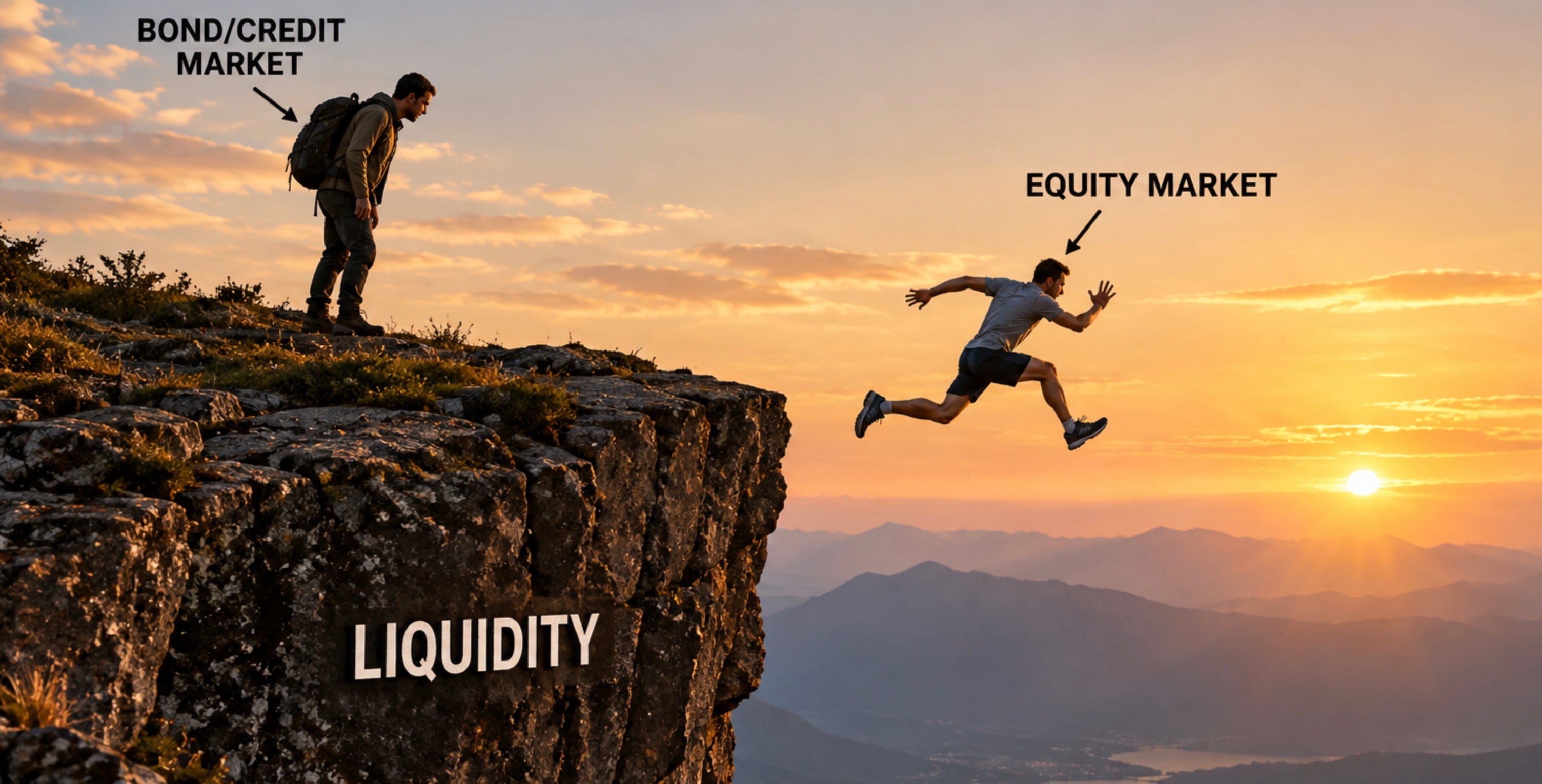
The bond and credit markets couldn’t be clearer: the AI buildout now appears to be a serious risk. The equity markets have yet to catch up.
For the better part of the last three years, the artificial intelligence trade has been built around an almost religious assumption that whatever amount of money gets thrown at AI today will eventually look trivial compared to the economic value it creates tomorrow.
Hundreds of billions of dollars for data centers, GPUs, power generation and infrastructure have been waved through with remarkably little concern, while trillion dollar valuations have been assigned to companies burning through extraordinary amounts of cash, because the answer for bulls to almost every uncomfortable question has essentially been the same: AI is different. Bears, on the other hand, have questioned whether or not the infrastructure buildout has overshot the mark.
Over the last several weeks something important has changed, because we are finally beginning to see what is underneath the hood, and the first look isn’t pretty.
Yesterday may wind up being remembered as an important moment in the AI bubble because Anthropic finally gave investors something they have been conspicuously missing throughout much of this mania: actual financial statements. And they were fucking atrocious.
According to an IPO prospectus reviewed by Reuters, Anthropic generated roughly $4.6 billion of revenue in 2025 while posting an operating loss of more than $8 billion.
Its reported net loss was nearly $42 billion, although roughly $34 billion of that was an accounting charge related largely to financing liabilities rather than cash burned running the business. Anthropic spent $7.33 billion on compute and infrastructure alone during 2025, roughly triple the previous year’s level, while total operating expenses reached approximately $12.65 billion. This is a company reportedly considering going public at a valuation north of $2 trillion.
Then there is the pièce de résistance. According to Reuters, Anthropic has laid out roughly $518 billion of future cloud, computing and infrastructure obligations. Half a trillion dollars. At some point investors need to stop staring at revenue growth percentages and start examining the actual machine required to produce that revenue.
Yes, Anthropic’s growth is enormous, with revenue reportedly increasing twelvefold in 2025, but the amount of capital required to participate in this arms race is equally enormous.
For years we have heard speculation about what the financial statements behind the great private AI companies might look like. We got some of an idea when the unprofitable SpaceX went public at its face-melting 100x sales valuation. The valuation was so insane I wrote an article I could only title *SpaceX And The Limits Of Human Belief. *Once again, investors finally got to look at financial statements that had previously been largely hidden from public markets, and once again the numbers raised questions that the valuation seemed to take for granted.
Now we have even more insight, and instead of resolving the central question surrounding AI economics, Anthropic’s filing amplifies it: how much money eventually has to be spent to make this industry sustainably profitable?
There are real businesses here, real revenue and unquestionably real technological progress, but there is also a gigantic furnace sitting underneath the AI story demanding increasingly large amounts of capital, and public markets are finally being allowed to see it.
Which brings us to last week and Oracle, where another piece of the AI story started to crumble publicly. Oracle issued a force majeure notice related to Project Jupiter, its enormous New Mexico AI data center project tied to the broader Stargate buildout, reportedly because of potential delays securing infrastructure necessary to power the facility.
Oracle subsequently assured investors that the project remained on schedule and argued that force majeure notices aren’t unusual for developments of this magnitude. Fine. Technically true. But, as I noted last week, companies also don’t issue force majeure notices because everything is going fantastic. The purpose of such a notice is to preserve contractual protections because circumstances have emerged that could interfere with performance, and this particular episode matters because the entire AI investment thesis has quietly migrated from software into one of the most capital intensive infrastructure projects in modern history.
The ethereal world of AI is colliding with the extremely physical realities of pipes, permits, electricity, financing and interest rates, and the credit markets appear to have noticed. As 𝕏Zero Hedge noted last week, Oracle’s credit default swaps recently surged to record levels while yields on some of its long dated debt moved above 8%.
And Oracle isn’t alone.
Apollo Chief Economist Torsten Slok recently highlighted widening CDS (credit default swaps) spreads across the hyperscalers, including Amazon, Google, Microsoft and Oracle, arguing that what credit markets are repricing is the fundamental reality of a debt financed AI capital expenditure cycle characterized by increasing leverage, deteriorating free cash flow and uncertain returns on assets that depreciate rapidly.
The volume of CDS trading may be even more interesting than the spreads themselves. LSEG recently noted that CDS trading among hyperscalers has exploded, with Oracle among the most actively traded names and Nvidia perhaps the most remarkable example. According to LSEG, Nvidia single name CDS volume increased from roughly $640 million during one six month period to approximately $6.9 billion during the following six months, while Broadcom CDS volume jumped from around $1.5 billion to $8.2 billion.
Zero Hedge 𝕏joked last month that the “top job on Wall Street in 2027 will be CDS traders”. As the entire indsutry rushes into insurance, I’m not sure that it won’t be the top job by the end of 2026, to be honest.
Credit default swaps are insurance. In the years leading up to the 2008 financial crisis, trading in credit default swaps exploded alongside the housing and mortgage credit boom, turning what had once been a relatively obscure hedging instrument into a multitrillion dollar market.
So their sudden popularity is very much worth noting. Some of this activity could be hedging, some may simply reflect the natural maturation of the credit market surrounding companies issuing tremendous quantities of debt, and some buyers will inevitably be wrong. But the direction is becoming difficult to ignore because while equity investors remain hypnotized by AI revenue projections stretching years into the future, the credit market (and the bond market) is increasingly asking the far less glamorous question of who is actually going to pay for all of this.
This is a “the equity market has gone off the cliff but is still running as if it hasn’t” type of situation. Zero Hedge 𝕏did a great job of showing this by inverting Oracle’s CDS and showing how it has led the equity lower. If the trend in this chart held, Oracle equity would be well into the double digits:
While all this is taking place, the lowest quality portion of the credit market is beginning to flash another warning. The ICE BofA index tracking CCC and lower US high yield bonds reached an effective yield of 16.14% on September 25, up from 11.77% a year earlier and above its long term average of roughly 14.1%.
Whether 17% itself represents some magical line in the sand isn’t particularly important. What matters is the direction of travel and the fact that financing conditions are deteriorating first where they almost always deteriorate first, at the bottom of the capital structure. A credit crisis doesn’t generally begin with Microsoft missing payroll. It begins with companies nobody gives a shit about, after which weaker borrowers discover refinancing isn’t available, lenders tighten standards, spreads widen, marginal projects stop making economic sense and everybody suddenly remembers that the cost of capital matters.
Crises have a nasty habit of beginning from the ground up and working their way toward the assets everyone previously assumed were untouchable.
On top of all of this, there is market breadth, where the headline indexes have done a remarkable job disguising what has been happening underneath them. Technical analyst Jason Goepfert 𝕏recently highlighted just how bizarre the divergence has become, with the S&P 500 hovering near record territory while an extraordinary percentage of its individual components remain far below their own highs.
As of last week, roughly 52% of S&P 500 components were below their 200 day moving averages even while the index itself sat less than half a percent from an all time high, while more than 60% of components were more than 20% below their individual historical peaks.
That is an extraordinary degree of concentration for an index sitting near records, and it means the average stock has already been having a much worse time than the S&P 500 would lead you to believe.
Breadth tells you something the index level can’t, which is how narrow the foundation underneath those record highs has become, and that becomes considerably more interesting when it is happening at the same time that credit conditions are deteriorating.
Put all of this together and the picture starts becoming difficult to dismiss as a collection of unrelated curiosities.
Anthropic finally opens its books and reveals astonishing revenue growth sitting alongside staggering losses, enormous compute spending and more than half a trillion dollars of future infrastructure obligations.
SpaceX goes public at a roughly $1.8 trillion valuation despite having lost almost $5 billion the previous year and another $4.3 billion during the first quarter of 2026.
Oracle issues a force majeure notice on one of the flagship infrastructure projects underpinning the AI buildout just as its CDS spreads blow out.
Hyperscaler CDS activity explodes, CCC junk yields push above 16%, Treasury yields surge, and underneath an index still flirting with its highs, market breadth looks awful.
And while the financial world loves to jerk each other off with narratives, excuses and outright bullshit, at some point it becomes unreasonable to pretend that all of these things exist in separate universes.
The question under this AI bubble is what price investors were willing to pay for the future before that future actually arrives, and whether the economics eventually produced by the technology could justify the enormous amount of capital committed to it along the way.
For the first time during this cycle, we’re beginning to get enough information to actually run those numbers and the credit markets and bond markets are puking them back up at record speed. The cost of capital is rising while the financial statements behind some of the most celebrated companies in the world are finally being laid bare, forcing investors to confront the possibility that enormous technological importance and enormous economic profitability may not necessarily arrive on the same timetable.
Underneath all of the breathless talk about trillion dollar addressable markets and civilization changing productivity, the uncomfortable possibility is that there may not be nearly as much “there” there economically as current valuations have already priced in…at least for this credit cycle.
Investors can now see the financial statements, the credit spreads, the bond yields, the deterioration in market breadth and the extraordinary capital requirements necessary to keep the AI machine running for themselves. The information isn’t hidden anymore. What remains unclear is who will be the first person willing to look at all of it together and simply proclaim that the AI emperor has no clothes…and what happens when everybody else realizes they were just sitting around waiting for someone else to say it first.
QTR’s Disclaimer**:** Please read my full legal disclaimer on my About page here.
I also may or may not own names I write about and are watching. Sometimes I’m bullish without owning things, sometimes I’m bearish and own things I’m bearish on. Just assume my positions could be exactly the opposite of what you think they are just in case. If I’m long I could quickly be short and vice versa. I won’t update my positions.
I cannot guarantee the accuracy of any or all facts and figures included in this article though I made an effort to get them right. I have been wrong before and will be wrong again, and encourage you to always double check, do your own research and speak to a licensed financial professional, which I am not.
Contributor posts, guest posts and curated posts have been hand selected by me, but have not been fact checked and are the opinions of their authors. They are either submitted to QTR by their author or reprinted under a Creative Commons license with my best effort to uphold what the license asks, or with the permission of the author.
Since 2026, I have been making an attempt to no longer actively trade as much as I once did ( read my story here). In an attempt to lead a healthier lifestyle, I’ve also excluded myself from most fantasy sports, sports betting, online and in-person casinos and prediction markets.
My goal is for my investing/saving to be done by recurring contributions mostly to sector ETFs and a few select equities, trusted third parties who oversee my accounts, and advisors. Such advisors or funds, through individual equities, options, index funds, mutual funds, ETFs, or other securities, may have positions in, exposure to, or holdings of names mentioned herein that I know nothing about. Basically, it is possible I could own, have exposure to, or not own anything, at any point.
*You are on your own. Do not make decisions based on my blog. I exist on the fringe. Again, I get shit wrong a lot, both in the market and in life, but am trying my best. If you see numbers and calculations of any sort, assume they are wrong and double check them. I failed Algebra in 8th grade and topped off my high school math accolades by getting a D- in remedial Calculus my senior year, before becoming an English major in college so I could bullshit my way through things easier. Hence, I am a writer. I write these posts after a couple beers sometimes. Many times I edit after my posts are published because I’m impatient and lazy, so if you see a typo, check back in a half hour. Thanks, you’ve been a grea…