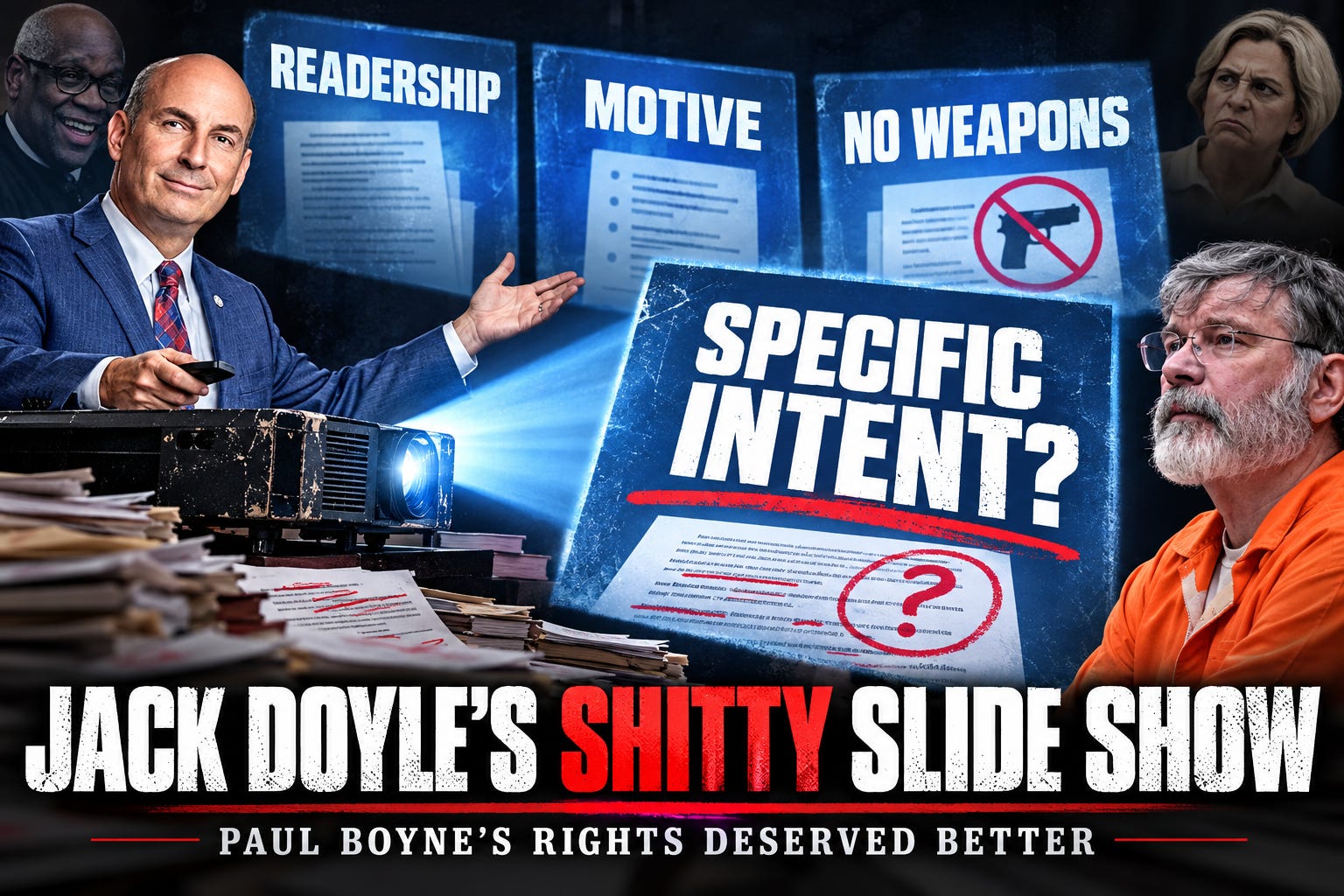
LUTHMANN NOTE: Jack Doyle’s presentation wasn’t just an abuse of prosecutorial responsibility. It was wholesale prosecutorial misconduct, plain and simple. Jack Doyle is a serial offender; the Connecticut Supreme Court admonished him in State v. Parris for doing the SAME THING. In the Boyne railroad job, Jack put the specific-intent requirement before the jury, then used headings that treated disputed intent as established. His treatment of Boyne’s censorship objection is especially revealing: a complaint about punishing speech becomes evidence that the publisher knows his blog threatens people. That reasoning should concern anyone who investigates judges or challenges government power. Boyne’s language gave the State material to inflame a jury. Doyle remained responsible for establishing every required element. His argument failed to meet that obligation, beginning with the statements on his own shitty slides. This piece is “Jack Doyle’s Shitty Slideshow,” first available on The Family Court Circus.
A recently acquired PowerPoint presentation in State v. Boyne reveals how the New Haven State Attorney’s office disregarded the law, hoodwinked a jury, and shat on the Constitution, all in one fell swoop.
Serial offender State Attorney Jack Doyle is fresh off last year’s admonishment by the Connecticut Supreme Court in State v. Parris. His closing presentation convicted Virginia family court journalist Paul Boyne is more prosecutorial misconduct. It contains the standard by which his own conduct deserves to be judged: “Every charged crime requires the state to prove specific intent to threaten.”
“Jack pays lip service to the legal requirements in one slide, and then takes a hot, steamy diarrhea on the Constitution for the next twenty,” Paul Boyne said. “It’s all right there. It’s blatant. Jack sold it to the New Haven jury, and Todd [Bussert], his hug-buddy, let him do it.”
The New Haven prosecutor put those words on slide 24, alongside an acknowledgment that Boyne was not accused of directly threatening the judges who became the complainants. Doyle understood that the prosecution had to establish what Boyne intended his publications to communicate.
The fatal problem with Connecticut’s prosecution is that Boyne was never charged with making true threats. He was charged with stalking and cyberstalking. The State blurred the charges and the rules to bootstrap a discussion of threats, weapons, and danger.
Ask yourself: How does the presence or absence of a weapon relate to cyberstalking? Was Boyne going to launch anti-aircraft missiles through a USB port? It doesn’t. It’s absurd. And it was the heart of Jack Doyle’s presentation.
And yet Boyne’s lawyers from the Connecticut Office of the Public Defender, led by Bussert (whom Boyne asked Judge Brown to fire and allow him to proceed pro se at least three times prior to trial), allowed Jack Doyle to march this evidence in to establish Boyne as a “danger” and a “threat” from behind a keyboard eight states away, south of the Mason-Dixon Line.
“The Polaks put up more of a fight in September 1939,” Boyne said.
Much of Doyle’s presentation twists what Boyne admitted: that Boyne previously operated The Family Court Circus website, worked on its posts, and knew judicial officials read it. Those facts are relevant to authorship and readership. Doyle repeatedly misappropriated their import, placing them beneath headings announcing threatening intent, giving the accusation a certainty the displayed evidence had not earned.
It works to mislead an uninformed jury, and it is dishonest to its core. Publishing an attack on a judge is deliberate conduct. Establishing that the publisher meant to communicate a serious threat of unlawful violence requires a specific and rigorous examination of the charged words and the circumstances in which Boyne used them.
Doyle cut corners and sold the jury a bill of goods. He failed to zero in on specific language, and the State’s prosecution and jury verdict rest on specific prosecutable conduct that remains constitutionally protected.
“I still don’t know what language was the basis of the stalking and cyberstalking convictions,” Boyne said. “All I have is ‘Eight Blog Posts,’ and as you can see in the PowerPoint, Jackass showed the jury pictures and titles, not specific language that crossed the line from harsh criticism to crimes against the Jewdicial Branch.”
Publishing is an intentional act even when the publication contains protected invective. A person can deliberately attack a judge’s competence, expose a court’s conduct, or write something calculated to offend without intending a serious threat of unlawful violence. Doyle’s presentation needed to establish where the charged publications crossed that boundary. Instead, its repeated declarations that Boyne wrote the posts make authorship seem to answer the separate questions Doyle poses of danger and threatening intent.
That distinction was already central to Judge Peter Brown’s jury instructions. The 145-page instruction document marked “FINAL DRAFT” addresses subjective intent, and Doyle repeats the requirement himself. Under * Counterman v. Colorado*, recklessness concerning a communication’s threatening nature is the constitutional minimum.
Doyle’s presentation states a stronger specific-intent requirement for this prosecution. His familiarity with that burden also makes the shortcuts elsewhere in the PowerPoint deck indefensible.
“The PowerPoint is garbage. The conviction is garbage. And Jack Doyle is garbage,” Boyne said. “He’s a domestic terrorist.”
An editor’s note identifying Connecticut Judicial Branch servers as “the blog’s largest source of readership” becomes, in Doyle’s presentation, a declaration that Boyne knew “Exactly” who was receiving his “Threats.” For Doyle, the Blog’s “institutional traffic” supports an inference that people within the judicial system read the website. And the sick part is that inference is exculpatory.
Boyne can not be said to have “targeted” anyone in the Connecticut Judiciary if the penguins were the ones seeking out his publication.
Doyle’s heading adds a precision the server information cannot supply, while labeling the publications “threats” before the displayed material establishes that conclusion.
“What do the IP addresses prove? That the Connecticut Jewdicial elite spend their taxpayer-funded days reading the blog in between selling children to pedophiles like Christopher Ambrose,” Boyne said.
The treatment of Boyne’s email to Professor Eugene Volokh is even more revealing. Boyne wrote: “as long as someone claims fear there will be no free speech….the new world order.”
Doyle displays that objection beneath “Knows THIS Blog Threatens People.”
The written words challenge the use of claimed fear to suppress speech; the heading presents them as knowledge that the blog threatens people. An objection to criminalizing expression becomes another incriminating statement.
Boyne’s explanation that a Connecticut-based website operator would end up in jail receives the same treatment under “SPECIFIC INTENT TO THREATEN OTHERS.” Doyle invites jurors to infer consciousness of criminality from an expectation of prosecution.
The statement also fits Boyne’s position that Connecticut would punish the person responsible for publishing the criticism. A heading cannot resolve that dispute.
These examples expose the danger at the center of the speech-as-stalking controversy surrounding Boyne’s case. Officials seek out and read a critic, the critic knows they read him, and his resistance to prosecution becomes evidence against him.
The PowerPoint presentation already shows how readily Doyle turns the publisher’s objections into support for the accusation he is contesting. This is Lawfare 101, and the PowerPoint is the smoking gun of Weaponized Justice.
Does Professor Volokh have anything to say? No. Why? Simple, according to Boyne: “The Jews got to him.”
Slide 20 identifies a requirement for the first two stalking counts: intentional targeting, at least partly, because of the complainants’ actual or perceived religion, sex, or sexual orientation. Ten slides later, Doyle does the bait-and-switch. He announces that the State “does NOT have to prove a motive,” then directs jurors toward Boyne’s anger at the system that took his children and his involvement in cases to which he was not a party.
The State need not legally establish any “additional motive” beyond the statutory elements. However, it must establish the discriminatory reason for targeting that its own elements slide identifies. Doyle’s broad declaration blurred that distinction. Without the explanation, jurors receive an emphatic statement that motive is unnecessary in a presentation that also tells them a particular reason for targeting matters.
“The whole thing was a mind-fuck,” Boyne said. “Jack Doyle took a shit on the First Amendment, and Brownboy in the black robe let him do it because he got the memo from Joette Katz and Jonathan Greenblatt.”
The religious slurs in the excerpts can bear on that question. * Wisconsin v. Mitchell* permits relevant speech to establish motive and intent. But its relevance depends on connecting the statements to the charged conduct, a task that requires more than displaying language jurors will despise. But that is all Jack Doyle did. The prosecution’s formula was BOYNE’S HATEFUL SPEECH = GUILTY VERDICT, because Boyne is offensive. In reality, Connecticut’s move is constitutionally offensive.
Doyle’s reference to other people’s litigation deserves particular attention from anyone covering the courts. Reporters and advocates examine cases involving families they have never met all the time. Boyne’s grievance that the family-court system is run by “the Jews” and serves “the Pedophiles” also supplies a readily understandable reason for sustained coverage.
The prosecution was free to examine that history, but it still had to explain how the history supported the required criminal intent. Presenting Boyne’s reasons for writing as incriminating circumstances risks making his commitment to the subject of exposing the “designer child trafficking” of a “rabbinical court” part of the offense.
Doyle’s rebuttal declares the absence of weapons at Boyne’s residence irrelevant because he did not have to carry out a threat. The preceding slide similarly dismisses actual violence associated with the blog. Earlier, the presentation directed jurors to consider the entire factual context. By rebuttal, Doyle is categorically excluding circumstances that could complicate his account.
A “true threat” can be punishable without intent to carry it out. The problem with Connecticut’s prosecution charged Boyne with stalking and cyberstalking, not true threats. The State blurred the charges and the rules to bootstrap a discussion of threats, weapons, and danger. How does the presence of a weapon relate to cyberstalking?
Moreover, even if the absence of weapons was relevant to the charge, an inquiry into meaning or intent requires a separate examination of the circumstances, including timing and the information available to the listener. Doyle’s blanket dismissal avoids that examination even as ammunition, targeting imagery, and homes help the presentation convey imaginary danger.
The constitutional requirement survives the language’s ugliness. * Brown v. Entertainment Merchants Association* rejects creating new categories of unprotected speech based on a judgment that expression is excessively harmful. In
Doyle’s own presentation makes ignorance an untenable excuse for overlooking the distinction between publishing and threatening. His repeated use of accusatory headings, his treatment of the censorship objection, and his dismissal of potentially favorable circumstances support the charge that he approached Boyne’s rights with calculated disregard. The closing itself warrants reversal, even without looking at the complete trial record. Public accountability starts with Jack’s choices visible in the PowerPoint document.
For anyone investigating Connecticut’s courts, the consequences are plain. A publisher’s knowledge of his audience, interest in other families’ cases, and expectation of retaliation can all be assembled into a prosecution narrative. Doyle’s responsibility was to establish how the charged communications satisfied the specific-intent requirement he displayed. He should now answer for a presentation that repeatedly encouraged jurors to accept the accusation before completing that inquiry.
Paul Boyne’s liberty demands more care than Jack Doyle’s shitty slideshow.