Your mind and soul need to look at the Damien Jalet choreographed performance for GENER8ION & Yung Lean’s “Storm.” In experiencing it, you can also understand why the inexplicable is so essential to well-being.
What are you feeling? You’ve been in your body longer than you’ve been alive (arguably). Self-care books love to help you learn to take stock of yourself. Given we’re all unified by having bodies, you’d think this would be an inherent skill. Dogs and cats often spend time just checking their bodies. But do most people?
Our intellect is both the strength of our species and, at times, our downfall. Some of our failures as beings stem from our overestimation of ourselves, concomitant with a diminishing understanding of our physical selves.
Feeling itself is a terribly unspecific word. The term can encompass emotional and physical sensations. Of course, feelings like heartache highlight why. Emotions can create physical sensations. The relationship between the two is idiosyncratic. What is sometimes true physical pain, a loss of love, another time might feel completely in your head. To map the relationship between feelings and sensations would be a lifelong personal task, and one that might completely contradict everyone else’s map.
But, is this not the essence of humanity? We’re at once unique and similar. We’re ourselves and every person in our line. We are a we and an I.
When in society there are forces trying to either enforce rigid intellectual barriers, like* this is the canonical reading of x*, or deny intellectualism, it’s not that deep, you’re actually seeing someone who cannot handle the nuance of humanity. There is not just one right answer; there are answers that are fairly wrong, and there is everything in between. Additionally, intellectualism like this often negates anything emotional. Why? Emotions, as I’ve said, are not easily understood and not universal. To acknowledge them as part of an argument turns the conversation from the provable to something you’ll just need to accept.
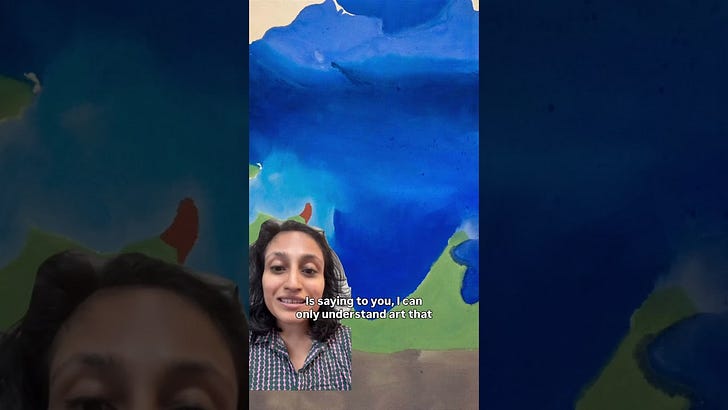
Abstract art is often a map of an artist’s feelings and sensations. Helen Frankenthaler threw great gallons of paint to soak unfinished canvas. She splattered. She observed. She certainly felt what “worked” and didn’t. The painting serves as an artifact of her phenomenological experience. In viewing it, though, we’re meant to have our own feelings, not try to understand how she got there. Frankenthaler said, “A really good picture looks as if it’s happened at once.” We should not delve into her moments; instead, we should focus on being moved.
If you’ve stood in front of a Frankenthaler and felt nothing, are you broken? Not at all.
Many of the artists often maligned online are the ones who are doing us this service. Mark Rothko believed: “I'm interested only in expressing basic human emotions — tragedy, ecstasy, doom, and so on. The people who weep before my pictures are having the same religious experience I had when I painted them." He wanted to invite us to feel in a world that is framed to diminish the importance of emotions.
Color, in this case, is a universal conduit in comparison to depictions of objects. In reality, our mind immediately goes to the commonly used tools of recognizing and assigning. Looking at a realistic painting is not so different from looking at your lived experience. Our mind works so fast that you can’t feel the frame recognition process, table, chair, dog, but it’s happening. So, when looking at a realistic artwork, you immediately fall into comfortable territory. Abstraction is inviting the viewer into uncertainty. The colors, though, are your entry point. You can name them and recognize them. But, from there, you can go to ideas only you can have. As Kandinsky said, “Color is a power which directly influences the soul.”
Abstraction invites the viewer to engage in abstract thought. Realism invites words and shared interpretation, but those tools are not useful in understanding non-objective art. Even words are often too much. Wittgenstein said in Tractatus: “Whereof one cannot speak, thereof one must be silent.” In abstract art, you can sit in silence and yet find yourself full of feelings. Words are not the only way to understand the world.
Often, these thoughts are emotional and hard to articulate. But, they’re also incredibly valuable. Being able to confront abstract ideas helps you focus yourself and your thoughts beyond flight or fright. We as a society don’t value emotional sensibilities, largely because our economy does better when everyone is in mindless reaction mode.
Starting in the 19th century, artists broke from the system to create individual styles and expressions. Historically, though, so did so many other people. We moved out of community homes to nuclear ones. We knew more about celebrities. We got cameras and took snapshots. Art is always in reaction to society, but also as a way for society to make sense of changes. Frankenthaler was breaking the rules of art just as people were trying to break down the right barriers in American life. Her art, therefore, is a great counterpoint to our own transformed sense of self. She is showing us how to reclaim our somatic connection to art.
But, as art has become more of a commodity, it’s also become more rarified. For those Frankenthalers to remain museum-worthy, they have to feel inaccessible to most people. If instead we framed Frankenthalers as a chance for you to enjoy the colors, the intelligentsia would balk. At essence, that’s true. By enjoying those colors, you ideally open yourself to relaxing into focusing on color rather than your worries. Your mind becomes still. You might then even feel your tension dissolve. You might notice your toes are a little snug in those shoes. You might realize you’re standing a bit unevenly. Your body and mind get to know each other again.
Abstraction can help you see other people’s maps of their emotions and sensations. But, how do you get to your own?
Watch “Storm”. I’m serious. Go watch it silently and come back to this. What did you feel? Were you amazed? Hopeful? Sad you can’t do that? There’s no single way to enjoy something that exciting, certainly, but I would guess most of you had a reaction.
Jalet’s choreography harnesses your attention. Damien Jalet is a Belgian-French choreographer who creates performances that make you question bodily forms and human capacity. In them, you question how a body can do that. He's worked extensively with Marina Abramović, including the staging of her opera 7 Deaths of Maria Callas.
His choreography in “Storm” brings bodies together, sometimes in unison and sometimes in complementary ways. They move as a collective, while one figure stands out. You’re seeing the dance equivalent of an abstract painting. Your reactions will be similarly hard to articulate. In this inexpressible, you’re having an excellent moment with yourself. You’re escaping words and rational thought to enjoy sensations.
Movement can be a language independent of words, just as color can be. Martha Graham put it as bluntly as anyone has: “The body says what words cannot.” In feeling and moving, you’re expressing but not saying.
Our human need for more than just dopamine and actionable ideas is enormous, and yet our society profits most by depriving us of emotional and somatic connection. Automatons make great employees, but feelings make good people.
We think we’re good people, yet we’re often crap at understanding feelings well. Studies show many people assume they’re one of the good ones. The Dunning-Krueger effect also highlights how people often feel very confident when they’re not terribly well informed. As a group, humans are overconfident about their knowledge and their morality. Education helps us train our intellect, but rarely helps us stabilize our body’s relationship to our mind. We’re all basically Dunning-Kreuger about ourselves, making decisions based on incomplete knowledge. As neuroscientist Antonio Damasio says, “We are not thinking machines that feel; we are feeling machines that think.”
Every time you step away from forgetting your feelings or depriving your body, you reconnect with your real self. As Eugene T Gendlin said, “Focusing is spending time sensing something as yet undefined that comes in one’s body.” Arts, in the broadest sense, is a way that people who have found connections between feelings and self, who have broken out of words, help us all get there. They’re inviting you to move closer to yourself. You are the only cartographer who can map your connection to your body and feelings. Allow yourself the experience.