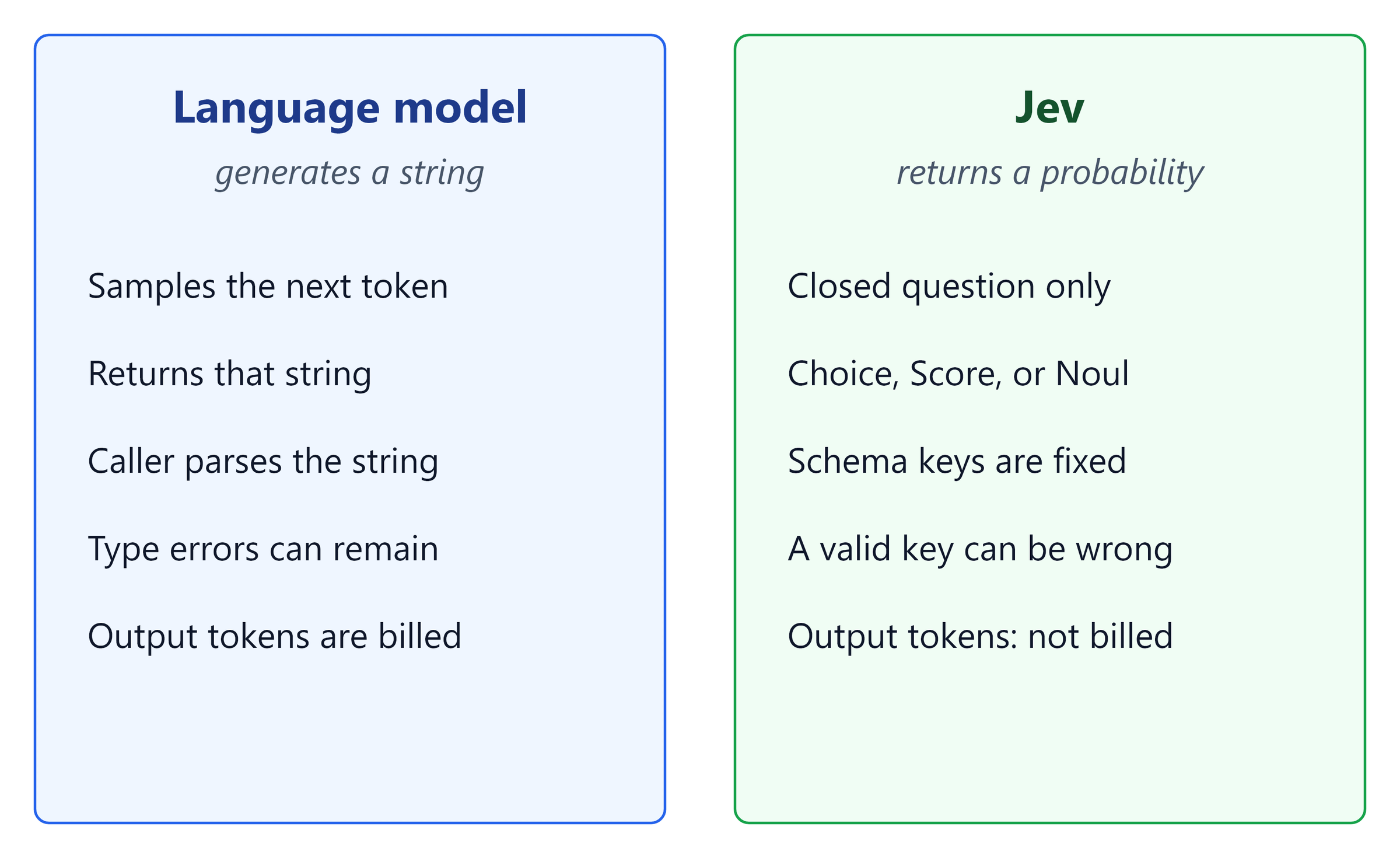
Jev, the first System One model from TypeSafe, returns a Choice, Score, or Noul probability instead of a chat string. Diogo Almeida published the model on 15 September 2026. TypeSafe prices input at USD 0.042 per million tokens, does not bill output tokens, and states an end-to-end time of 70 to 500 milliseconds, against 3 to 329 seconds for the chat models they timed on the same task.
I implemented 30 decision runners against that API, plus seven Agentic SOC runners that return action names and do not execute them. The 27 runners that call only Jev each returned a typed answer from model jev-1.13.0. That run checks the call shape. It does not measure whether the label is correct. A closed decision at that price can sit on a branch that today waits on a person or on a parsed chat string. I still keep money movement, host isolation, and rejection in caller code until the false-positive rate is measured.
The paid section is the implementation record. You can judge the stake from six facts before you continue: the price, the stated latency, the 27 successful Jev-only fixture returns, the three security runners that did not complete a live call, the starting thresholds 0.45, 0.72, and 0.88, and the eval reference pair GPT-6 Astra and Claude Fable 5.1.
The paid section separates what TypeSafe published from what I ran: 27 typed returns from jev-1.13.0, and a failed live run of the three runners that also call a language model. It also names the jobs I left in code, including counting, date order, image input, and any action that moves money or changes a host. The launch note already states the price and the 70 to 500 millisecond range. The reason to continue is the initial Python implementation, the thresholds I would not ship unattended, and the call order that keeps Claude or OpenAI behind a Jev check. The SOC runners do not read a chat reply and then isolate a host. Triage sends one alert as state, asks eight closed questions, and returns close, notify, queue, or contain. On the committed fixture, triage returned containnow from jev-1.13.0, mitigation returned hold:containment, and the pipeline did not publish isolatehost. Recovery stayed isolated at two hours with monitoring still unclean. Closeout stayed on monitor. The paid section shows those calls, the branch that owns isolation, and the step that lets a language model write the analyst brief only after the branch has already decided.
Today the paid section covers:
System One return values: Choice allows 1 to 255 options, Noul is one probability from 0 to 1, and a schema-valid key can still be the wrong key. The stake is whether you trust TypeSafe's type-error claim without also trusting every label.
Call sequence: the program sends state and questions, Jev returns probabilities, and the caller executes the action. The stake is who moves money. In this design, Jev does not.
The 30 runners: routing, verification, records, research, and three security runners that add a language model. The stake is scope. The repository is an initial implementation, not an unattended policy.
Action bands: confidence under 0.45 goes to a person, the auto floor is 0.72, and high-stakes actions use 0.88. The stake is a refund or a host isolation running on a number I have not fitted to labeled traffic.
Security path: Jev screens the prompt before Claude or OpenAI writes, then screens the draft. The stake is a blocked prompt. That path never calls the language model. I have not measured the block rate live.
Limits: no image input, no counting inside Jev, and workflow evals that score agreement with GPT-6 Astra and Claude Fable 5.1 rather than with a human label set. The stake is treating that vendor comparison as your incident policy.
Agentic SOC: triage, mitigation, investigation, escalation, recovery, and closeout. The stake is isolation. On the committed fixture, mitigation returned hold:containment, and the pipeline did not publish isolate_host.