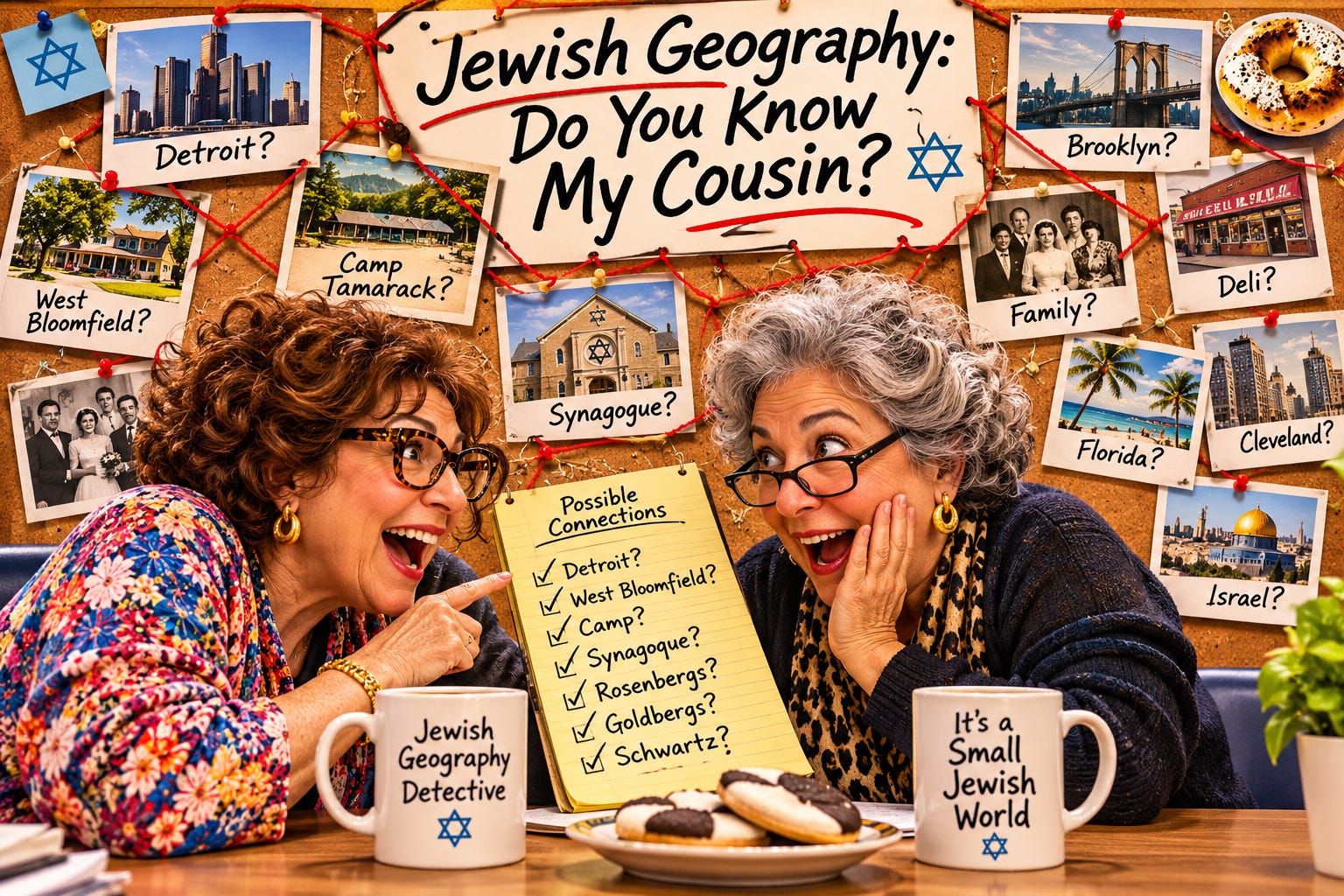
I think there is one thing almost every Jew has in common regardless of where we grew up, how observant we are, or whether we know a single word of Hebrew beyond l’chaim. We all play Jewish geography, and with the intensity of homicide detectives who only have forty-eight hours before the trail goes cold.
You can put two Jews in a room who have never met—different generations, opposite coasts, nothing in common—and within five minutes they will be constructing a corkboard with pushpins, red yarn, and victims in their heads. All it takes is one innocent question about where somebody grew up, and the interrogation begins.
“Oh, you’re from Detroit? Do you know the Goldbergs?”
Which Goldbergs? There are enough Goldbergs in metropolitan Detroit to field a minor-league baseball team and an entire orchestra, but nobody cares. We have a scent, and we are not letting go.
“Well, what part of Detroit?”
“West Bloomfield.”
“OMG! My cousin lives in West Bloomfield! Do you know the Rosenbergs?”
“Which Rosenbergs?”
“Her husband was a dentist. Or maybe an orthodontist. Something with teeth. They had a daughter named Susan.”
“Susan Rosenberg? Did she go to North Farmington?”
“No, no, I think she went to Andover. Wait—her mother was a Schwartz before she got married. Very petite. Always wore scarves.”
Now we’re cooking. We have established a possible link to a woman named Susan whose father may or may not have adjusted someone’s overbite in 1984.
By the time we’re finished, we’ve discovered that Susan’s ex-husband went to summer camp with somebody’s brother, whose college roommate married a woman whose mother used to play mahjong with our aunt.
JACKPOT.
We don’t know Susan. We don’t know her ex-husband. Honestly, based on what we just heard, we’re not even sure we’d invite him to dinner. None of that matters. We have found the bridge across the chasm of human existence, and we are triumphant.
Now we get to go home and hold our families hostage while we recount this miracle.
“You are never going to believe who I met at Publix today!”
And they are going to sit there and listen to all seven degrees of Susan Rosenberg, because we put twenty minutes of hard investigative labor into this, and somebody is going to appreciate it.
Related reading:
There is actually fantabulous history behind our collective inability to meet another Jew without launching a full-scale forensic audit of their family tree. Long before anyone gave it a cute name, Jewish geography wasn’t a parlor game. It was a survival mechanism.
For centuries, Jews lived as a scattered minority across empires that were not always thrilled to have them. If you were a traveler, a scholar, or a merchant arriving in an unfamiliar city, you didn’t have a passport office or an embassy to bail you out. What you had was a cousin, a rabbi’s letter of introduction, and a global network of people who kept track of one another across oceans and borders.
The Cairo Geniza—a staggering trove of medieval Jewish documents preserved in a synagogue storeroom in Old Cairo—contains thousands of letters from the eleventh and twelfth centuries. They show Jewish merchants communicating throughout the entire Mediterranean world and as far as India. And these letters read like a medieval blend of LinkedIn, Venmo, and your mother’s group chat.
In fact, medieval Jewish merchants relied on an early financial instrument called a suftaja—essentially a medieval letter of credit or check that let you deposit money in one city and collect it hundreds of miles away without hauling bags of silver past highway robbers. The entire system ran on reputation and mutual acquaintance. You couldn’t just walk into Alexandria and expect someone to honor your paper unless they knew who your father was, who your uncle traded with in Tunisia, and whether your family was good for it.
In the very same letters where merchants report the plummeting price of silk robes or warn a partner not to ship olive oil, they seamlessly pivot to family roll calls: sending greetings to a wife, her mother, a paternal aunt’s son, and complaining that a package was missing the resin they asked for. You just know half those letters had a postscript that boiled down to: When you get to Fustat, look up Isaac. His mother is your father’s sister’s friend from Baghdad. Also, he has an unmarried daughter—just saying, boobala.
Meanwhile, rabbis across Europe, North Africa, and the Middle East maintained the responsa network—thousands of written legal questions and answers crisscrossing empires. A dispute over a business contract in Spain or a marriage question in Yemen could end up on Maimonides’s desk in Egypt. Knowing who knew whom wasn’t small talk. It was how a scattered people stayed legally, financially, and emotionally tethered to one another.