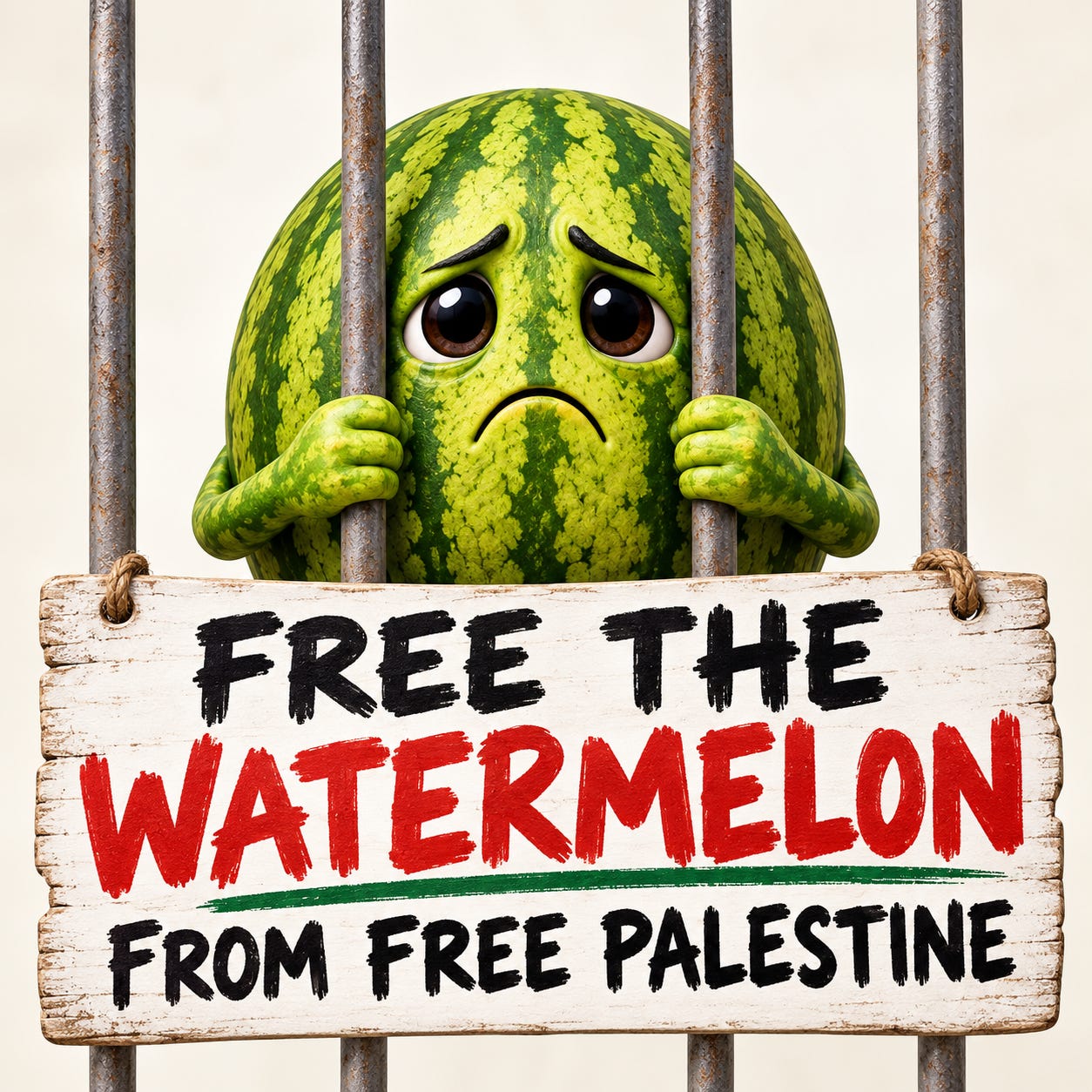
I know…I promised no articles today. But I got into a conversation about this and had to come out in defense of one of my favorite fruits. The poor watermelon. It did absolutely nothing wrong. For thousands of years, it managed to stay out of Middle Eastern politics. It grew on vines, showed up at picnics and summer cookouts, and gave kids everywhere something to spit at their siblings. There is barely a dignified way to eat a good, sugary sweet, juicy slice of watermelon, which may be part of its charm.
Somewhere along the way, that poor Cucurbitaceae (the name for the gourd family) got drafted into the “Free Palestine” movement, had a political identity slapped on it, and was given this history stretching all the way back to 1967. Today, the watermelon appears on protest signs, shirts, jewelry, social media profiles, and, of course… the 🍉 emoji. It’s become one of the most recognizable symbols of the pro-Pally movement.
The history attached to it goes a bit like this: after the Six-Day War, Israel banned or restricted displays of the Palestinian flag, so Palestinians discovered a clever workaround. They carried slices of watermelon because the red flesh, green rind, white pith, and black seeds matched the colors of the flag. Some versions go further and claim Palestinians were arrested simply for carrying the fruit.
It’s quite a story. Finding evidence for…well, that’s another matter.
Israel issued Military Order No. 101 on August 27, 1967, less than three months after the Six-Day War, while it was administering territory it had just captured in a war with its Arab neighbors. The order addressed incitement, hostile propaganda, unauthorized political gatherings, and activities deemed threats to public safety or public order. It required permission for certain political assemblies and demonstrations and restricted the unauthorized display of flags and political symbols.
That context tends to disappear from the watermelon story. Order 101 did not declare war on Palestinian flags, and it certainly didn’t mention watermelons. The actual text broadly refers to “flags or political symbols” and grants the military commander authority over their display. Other provisions address incitement and attempts to influence public opinion in ways considered harmful to public safety or public order. The order was broad and has been criticized for restricting peaceful political expression, as well as conduct that authorities consider dangerous.
What it does not say anywhere is “Palestinian flag,” “Palestinian colors,” or “watermelon.”
Yet the story told today usually begins with a claim that Israel banned the Palestinian flag in 1967 so Palestinians began carrying watermelon slices because the red flesh, green rind, white pith, and black seeds matched its colors.
That is where our poor fruit gets dragged into this.
The documentation for Palestinians responding to Order 101 by carrying watermelon slices as substitute flags is missing. Searches have not produced the photographs, contemporary newspaper accounts, arrest records, or other evidence one would expect from a supposedly recognizable resistance practice stretching across decades.
Even Decolonize Palestine, a Palestinian website devoted to challenging narratives it considers favorable to Israel, went looking for the watermelon and couldn’t establish the story. Its researchers searched Arabic and English literature about the First Intifada and contacted people who participated in popular committees. They reported that nobody they contacted remembered watermelons being used as resistance symbols and concluded there was very little evidence for the familiar claim.
The watermelon apparently missed the resistance meeting.
Around 1980, Palestinian artists Sliman Mansour, Nabil Anani, and Issam Badr held an exhibition at Gallery 79 in Ramallah. Israeli authorities shut it down, and according to Mansour’s later recollection, the artists were subsequently warned about political artwork and using the colors of the Palestinian flag.
During that conversation, Badr reportedly asked what would happen if he painted a flower using red, green, black, and white. According to Mansour, the Israeli officer said it would be confiscated and added that even a watermelon would be confiscated.
At last…we have a watermelon. Unfortunately for the legend, nobody was carrying it through the streets. Nobody was waving it at a demonstration. Nobody was arrested for possessing a nice little fruit snack. The watermelon appears in Mansour’s recollection as a hypothetical example during a discussion about political artwork.
That becomes even more interesting because Mansour told The National in 2021 that he did not remember Palestinian artists subsequently using watermelon as a political motif during that period. The National described the familiar origin story as a “contemporary myth” whose beginnings had become obscured through years of retelling.
Our poor watermelon had finally entered the story, and it wasn’t even physically there.
By 1987, watermelon imagery really does appear in Palestinian art. Mansour created a work known as Watermelon Boy, which establishes that the fruit was being used artistically by the time of the First Intifada.
What it doesn’t establish is the story now told about Palestinians carrying watermelon slices as clandestine flags beginning in 1967. A Palestinian artist painting a watermelon in 1987 and Palestinians marching around with watermelon slices for the previous twenty years are two totally different claims.
The innocent, unsuspecting watermelon had finally landed a legitimate role. There was no reason to pad its résumé.
The earliest published report I have found stating that Palestinians were actually arrested for carrying sliced watermelons appeared in * The New York Times* on October 16, 1993. Reporter John Kifner wrote that young men in Gaza had once been arrested for carrying sliced watermelons because the fruit displayed the Palestinian national colors.
This was exactly the detail this urban legend needed: real people, real watermelon slices, and real arrests. There was only one problem. The New York Times couldn’t substantiate it.
The Israeli Government Press Office challenged the assertion and the Times later added an editor’s note addressing the dispute. The newspaper acknowledged that the watermelon incident could not be confirmed and said the anecdote should have been omitted or identified as unconfirmed.
That should have created a fairly serious problem for anyone trying to turn the story into established history. Instead, the 1993 anecdote kept traveling. Later writers repeated it, other articles cited those retellings, and the warning attached to the original claim slowly disappeared.
The watermelon’s big break had arrived, and it failed its first fact-check.
Decolonize Palestine eventually investigated the First Intifada watermelon story and titled its piece “Myth: Palestinians used watermelons as symbols during first Intifada.” Its researchers found the story about the artists and the forbidden color combination. They found the 1993 New York Times anecdote. What they did not find was documentation showing widespread use of actual watermelon slices as political substitutes for the flag.
They searched the literature and talked to people involved in the First Intifada, but the famous watermelon resistance tradition was nowhere to be found. They also noticed that articles repeating the claim tended to lead back to that same unconfirmed 1993 report.
The watermelon was being cited in circles, which is a marvelous way to turn a story into history without ever finding the history.
Now we reach Palestinian artist Khaled Hourani. In 2007, Hourani participated in the Subjective Atlas of Palestine project and created the now-familiar image of a watermelon slice functioning as the Palestinian flag.
Hourani has described hearing the older watermelon story in the 1990s. He returned to it for the 2007 project and transformed the fruit into an unmistakable visual representation of the flag. This part of the watermelon’s biography has an actual date, an artist, and a work that can be documented.
After forty years of alleged resistance, the watermelon finally got its uniform.
Hourani’s image gained much wider international attention during the Israeli-Palestinian violence and protests of 2021. Social media did what social media does best: it took an easily recognizable image, stripped away most of the complicated history, and sent it around the world at warp speed.
The watermelon was no longer merely artwork. It was becoming a global political logo.
As the symbol became more popular, its biography somehow became more detailed. By 2023, major media outlets were confidently telling readers that the watermelon symbol originated after the Six-Day War in 1967 and that Palestinians used the fruit to circumvent restrictions on their flag.
Other accounts added Palestinians carrying watermelon slices during demonstrations. Some pushed the practice through the First Intifada. Others connected the 1980 artists’ encounter directly to people publicly waving fruit. The farther the story traveled from the events it described, the more information it seemed to acquire.
An alleged remark about a hypothetical watermelon became Palestinians using watermelons. Using watermelons became carrying them. Carrying them became carrying them at demonstrations. Demonstrations became a resistance tradition stretching back to 1967.
The watermelon had acquired memories.
The story's ingredients are easy to identify because several of them are real. Israel restricted Palestinian political symbols after 1967. Palestinian artists encountered censorship around 1980, and according to Mansour’s later recollection, a watermelon was mentioned during one of those encounters. Mansour painted Watermelon Boy in 1987. The New York Times published the watermelon-arrest anecdote in 1993 and later acknowledged it couldn’t confirm it. Hourani created his watermelon flag image in 2007.
Those events happened at different times, involved different people, and establish different things. Over time, they were stitched together into a continuous story in which Palestinians responded to Israeli restrictions beginning in 1967 by carrying watermelon slices through the streets as substitute flags.
That continuous story is the part nobody seems able to document.
And somehow it is also the version now repeated with way too much confidence. The farther we get from 1967, the more detailed 1967 becomes. Apparently fruit isn’t the only thing that ripens with age.
Someone needs to speak for the actual victim here. The watermelon did not ask to become an emoji for a geopolitical movement, and it certainly didn’t ask journalists to assign it adventures decades before the surviving evidence places them there.
Watermelon has been cultivated for thousands of years and eaten across Africa, Asia, Europe, the Middle East, and the Americas. Israelis eat it. Palestinians eat it. Jews eat it. Muslims eat it. Christians eat it. Americans buy mountains of it every summer, cut it into enormous wedges, and spend the next ten minutes trying not to drip juice down the front of their shirts.
This fruit had international relations figured out long before the activists arrived.
I’ll never boycott watermelon. The fruit is innocent. After thousands of years of faithfully showing up at picnics, cookouts, beaches, family tables, and refrigerators around the world, it’s been conscripted into somebody else’s cause and handed a resistance biography that gets more impressive every time the story is told.
The entire gourd family demands the watermelon’s immediate release. Cucumbers, pumpkins, and squash have all declined to comment but are believed to be very concerned.
Free the watermelon. After everything it has been put through, the poor thing doesn’t need liberating nearly as much as it needs an attorney.
A FEW SOURCES KEEPING THE WATERMELON URBAN LEGEND ALIVE