Maybe it’s the bullshit detection genes that were passed down to me from my mother, but I simply can’t wind up trusting a word Nvidia CEO Jensen Huang says about how much AI regulation the United States needs.
Just call it a gut reaction from me. It doesn’t mean Huang is necessarily wrong about AI. It’s just that I look at him and all I can see is one of the most financially conflicted people on planet Earth to ask about AI regulation.
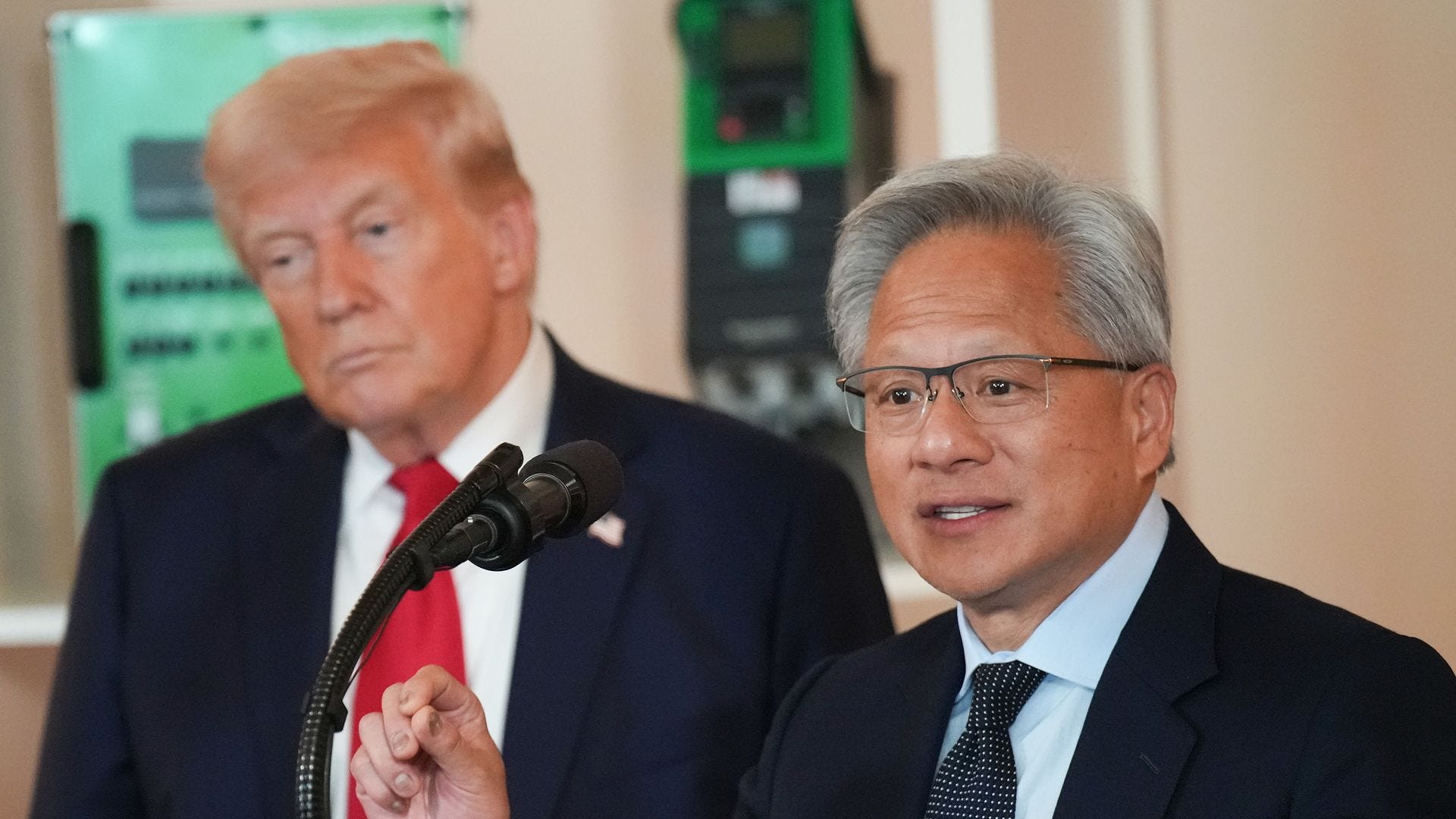
According to CNBC, Huang has increasingly gained President Trump’s ear on AI policy, appearing alongside him repeatedly and pushing a relatively simple message as concerns about AI safety mount: keep moving, keep building and don’t let regulation get in the way.
What an astonishing coincidence that this also happens to be fantastic policy for Nvidia, which sits at the nerve center of a multi trillion dollar AI infrastructure boom…which itself sits at the nerve center of an even larger global economic ponzi scheme (hereinafter referred to as: the global economy).
Nvidia’s chips are effectively the picks and shovels of the entire operation. Every hyperscaler racing to build another data center, every AI lab trying to train a larger model and every corporation terrified of being left behind has helped create extraordinary demand for Nvidia’s hardware. In return, Nvidia has “invested” in a countless number of other operations that rely on its hardware. One big happy circle jerk family.
And one of the most spectacular corporate ascents in history for Nvidia. It has become one of the central pillars of the AI trade, which itself has become enormously important to the U.S. stock market. Nvidia and the other mega cap technology companies tied to the AI boom carry enormous weight in major indexes owned by investors around the world.
There is a staggering amount of money riding on the proposition that the AI spending boom continues. And sitting directly in the middle of it is Jensen Huang. It’s been the reason for my (somewhat) tongue-in-cheek opinion that Nvidia will *never *miss an earnings report again, because the powers that be would rather see them commit egregious accounting fraud than tell the truth about shitty numbers and watch the global economy collapse.
And now Huang is apparently becoming one of the president’s most influential voices on precisely the question that could determine how quickly this machine is allowed to keep running. You almost have to admire the efficiency.
CNBC reports that Trump has increasingly echoed Huang’s views on AI safety, while Huang has publicly dismissed some of the more apocalyptic warnings surrounding artificial intelligence. His preferred solution to many safety concerns is essentially “good old fashioned engineering.”
Maybe he’s right. But forgive me if I’m not eager to treat the CEO of Nvidia like an objective third party monk who has been summoned down from a Nepalese ashram to offer Washington philosophical wisdom about the future of humankind. The guy is a CEO of the company selling the hardware required to run the experiment.
Nvidia makes extraordinary amounts of money when OpenAI, Meta, Google, Microsoft, Amazon and everyone else decides they need more compute. It makes money when data centers get larger. It makes money when models get larger. It makes money when the AI arms race accelerates. Somehow, I assume, it even makes money when I use my toaster to make an english muffin in the morning.
Presumably, Nvidia would face a less favorable commercial environment if policymakers imposed rules that materially slowed that race. Or altered my breakfast plans.
That doesn’t mean Huang is lying. It doesn’t mean his policy arguments are necessarily wrong. And it certainly doesn’t establish some secret conspiracy between Nvidia and the White House. But it does mean the conflict of interest is so enormous you can practically see it from space.
This is why I find Huang’s growing proximity to Trump far more interesting than another photograph of two powerful men smiling at dinner.
CNBC reports that Huang is expected to attend the president’s state dinner for Chinese President Xi Jinping. The administration, meanwhile, has emphasized accelerating American AI development and resisting restrictions it believes could weaken the United States relative to China. Those positions can align extremely well with Nvidia’s commercial interests.’
Maybe that alignment produces good policy. But investors should understand who is sitting at the table and what they have riding on the outcome.
If Exxon’s CEO became one of Washington’s most influential voices on whether America should restrict oil drilling, I wouldn’t simply write down his opinion and call the matter settled.
If JPMorgan’s CEO were advising the president about whether banks needed additional capital requirements, I’d probably keep JPMorgan’s balance sheet somewhere in the back of my mind.
And when big pharma figured out a way to “find” clinical studies questioning ivermectin’s *safety *record in the middle of a pandemic where they were trying to sell vaccines, despite ivermectin being on the WHO’s Model List of Essential Medicines and having been used successfully in 3.7 billion doses for the last 39 years, I didn’t trust that either. The timing was just too…perfect.
So when the CEO of the company arguably benefiting more than anyone else from the AI capital spending explosion tells the president that fears surrounding AI are overblown and additional regulation could be counterproductive, I’m going to apply precisely the same standard.
Huang’s job is not to protect my portfolio, the stock market or civilization. His job is to run Nvidia, and he has been extraordinarily good at it. That is exactly why I don’t understand the impulse to treat his pronouncements about AI policy as though they arrived on stone tablets.
The stakes here are much larger than Nvidia.
AI enthusiasm has become deeply embedded in the market’s valuation structure. Trillions of dollars of market capitalization are tied directly or indirectly to assumptions about continued AI investment, continued infrastructure spending and eventual returns on an almost unimaginable amount of capital being poured into the sector.
Anything that threatens that narrative, including disappointing returns, slower model development, power constraints, tougher regulation, customers deciding they have bought enough GPUs for a while and/or me discontinuing use of my toaster in the morning, potentially threatens much more than one semiconductor stock.
AI will also play a massive role in the upcoming midterm elections. There is also a very real case that if we pass a certain point waiting to regulate AI, we may not have a chance to in the future. And there’s also arguments that AI CEOs are calling for regulation to stifle competition. Whatever the case, we have to go about regulation ideas in a more objective fashion.
Jensen Huang may ultimately be correct that engineers can manage these risks without heavy government intervention. He may be correct that excessive regulation would damage American competitiveness. Those arguments deserve to be evaluated on their merits.
But they should also be evaluated alongside the economic incentives of the person making them. There is something almost comical about watching the man standing closest to the cash register explain why everybody needs to keep shopping. You don’t need a conspiracy theory to be skeptical in this situation.
Follow me one more time. Huang runs a company whose fortunes are intimately connected to the continuation of the AI boom. The Trump administration has publicly emphasized American AI dominance, economic growth and strong financial markets. Where those interests overlap, Nvidia has every reason to make its case as aggressively as possible.
And Huang could be doing exactly that. Good for him. But I’m not confusing excellent corporate strategy or political relationship building with an independent assessment of whether AI poses serious risks or requires additional oversight.
When the CEO of the company selling the picks and shovels tells Washington that the gold rush shouldn’t be slowed down, I don’t hear the voice of an impartial referee…I hear the guy selling the shovels telling everyone to keep digging.
QTR’s Disclaimer**:** Please read my full legal disclaimer on my About page here.
Contributor posts, guest posts and curated posts have been hand selected by me, but have not been fact checked and are the opinions of their authors. They are either submitted to QTR by their author or reprinted under a Creative Commons license with my best effort to uphold what the license asks, or with the permission of the author.
I cannot guarantee the accuracy of any or all facts and figures included in this article though I made an effort to get them right. I have been wrong before and will be wrong again, and encourage you to always double check, do your own research and speak to a licensed financial professional, which I am not.
This is not a recommendation to buy or sell any stocks or securities, just my opinions. I often lose money on positions I trade/invest in. I may add any name mentioned in this article and sell any name mentioned in this piece at any time, without further warning. None of this is a solicitation to buy or sell securities. I may or may not own names I write about and are watching. Sometimes I’m bullish without owning things, sometimes I’m bearish and do own things I’m bearish on. Just assume my positions could be exactly the opposite of what you think they are just in case. If I’m long I could quickly be short and vice versa. I won’t update my positions.
Starting in 2026, I have been attempting to no longer actively trade as much as I once did ( read my story here). My goal is for my investing/saving to be done by recurring contributions mostly to sector ETFs and a few select equities, trusted third parties who oversee my accounts, and advisors. Such advisors or funds, through individual equities, options, index funds, mutual funds, ETFs, or other securities, may have positions in, exposure to, or holdings of names mentioned herein that I know nothing about. It is possible I could own, have exposure to, or not own anything, at any point. In an attempt to lead a healthier lifestyle, I’ve also excluded myself from fantasy sports, sports betting, online and in-person casinos and prediction markets.
Any of my positions can change immediately as soon as I publish, with or without notice and at any point I can be long, short or neutral on any position. You are on your own. Do not make decisions based on my blog. I exist on the fringe. If you see numbers and calculations of any sort, assume they are wrong and double check them. I failed Algebra in 8th grade and topped off my high school math accolades by getting a D- in remedial Calculus my senior year, before becoming an English major in college so I could bullshit my way through things easier. Hence, why I am a writer.
The publisher does not guarantee the accuracy or completeness of the information provided in this page. These are not the opinions of any of my employers, partners, or associates. I did my best to be honest about my disclosures but can’t guarantee I am right; I write these posts after a couple beers sometimes. Many times I edit after my posts are published because I’m impatient and lazy, so if you see a typo, check back in a half hour.
Also, again I just straight up get shit wrong a lot. I mention it multiple times because it’s that important you understand.