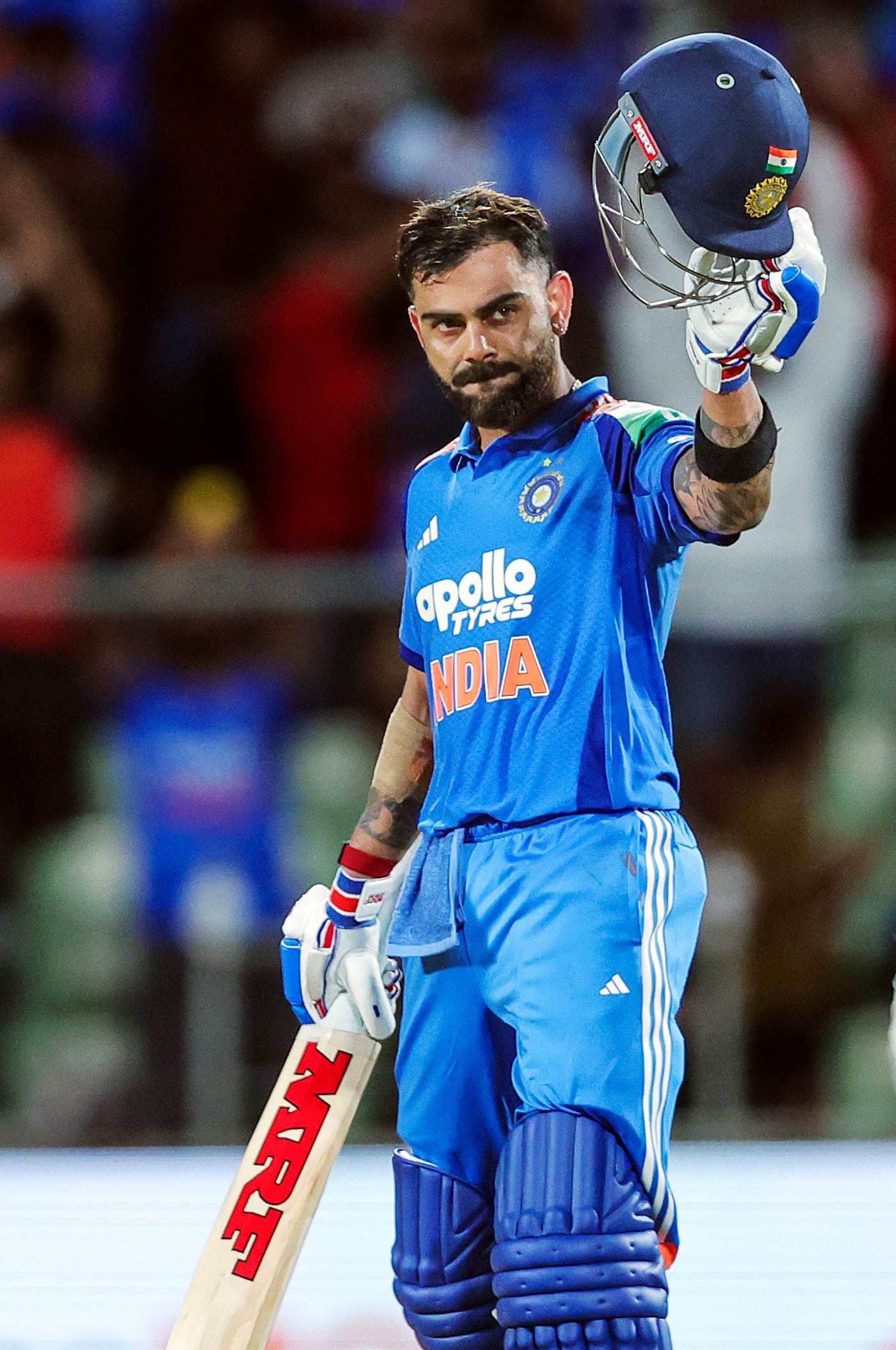
Virat Kohli’s 55th ODI century arrived with all the historical furniture one expects from him now. He became only the second man to cross 15,000 ODI runs, reached the landmark faster than anyone before him and finished unbeaten on 139 from just 88 deliveries as India chased 296 against West Indies in Thiruvananthapuram.
But forget 15,000 for a moment. Forget 55 hundreds too. The more revealing number from Sunday night was nine - the number of sixes Kohli struck, the most he has ever hit in an ODI innings.
At 37, Kohli is not merely hanging around at the level of his prime. There is mounting statistical evidence that the current version of him is scoring faster, attacking earlier and clearing the boundary considerably more frequently than the Kohli who produced one of the greatest three-year stretches ODI cricket has ever seen between 2016 and 2018. That sounds almost sacrilegious until the numbers arrive.
From 2016 to 2018, Kohli scored 3,401 ODI runs from 50 innings at an extraordinary average of 94.47. He struck at 100.50 and made 15 centuries, including the ridiculous 2018 season in which he averaged 133.55. Now take Kohli’s latest 10 ODI innings, beginning with the South Africa series last November: 135, 102, 65, 93, 23, 124, 5, 65, 74 and 139. They have produced 825 runs at an average of 103.13 and, crucially, a strike rate of 116.86.
The sample sizes are obviously different, and nobody should use ten innings to erase three years of sustained greatness. But that is precisely why the change in how Kohli is scoring is more interesting than a simplistic argument over which version is better.
For much of Kohli’s ODI career, there was an understood bargain. Give him a few deliveries to establish himself and the repayment would arrive later, often with brutal interest. Peak Kohli could afford that investment because his wicket was so difficult to obtain. He would absorb information, collect singles, manipulate fields and gradually reach the stage where a chase seemed to bend around him.
The recent Kohli is increasingly unwilling to wait. By the New Zealand series earlier this year, a striking change had already emerged in his first 10 deliveries. Since the beginning of the South Africa series, Kohli was scoring at a strike rate of 104.00 during his first 10 balls and finding a boundary approximately once every six deliveries. Between the 2023 World Cup and that South Africa series, the corresponding strike rate had been only 60.71, with roughly one boundary every 11 balls. The change is even clearer after the South Africa series. Across his next seven ODIs, Kohli has scored 77 runs from the first 66 balls he faced, striking at 116.67 and finding a boundary every 5.50 deliveries.
That comparison is with Kohli’s immediate pre-transformation period rather than his 2016-18 peak, but it identifies something an overall strike rate cannot: his innings are now starting differently. There is less reconnaissance. Less willingness to allow a bowler six or seven deliveries of control simply because Kohli has only just arrived.
It changes the geometry of an ODI innings. If a batter who traditionally became progressively more dangerous can begin around run-a-ball rather than spending his opening exchanges at 60 or 70, the bowling side loses one of its few relatively quiet windows against him.
The six-hitting numbers make the transformation even harder to ignore. During the entirety of 2016-18, Kohli struck 43 sixes from 3,384 deliveries. That works out to approximately one six every 78.7 balls. Across his latest 10 ODIs, he has hit 28 sixes from 706 balls. That is one every 25.2 deliveries - more than three times as frequently as during his statistical prime. His nine sixes against West Indies were therefore not an isolated explosion; they were the extreme expression of a trend that has been developing for months.
The composition of his runs has changed with it. Roughly 45.3 percent of Kohli’s runs during 2016-18 came through fours and sixes; across these latest 10 innings, that figure has climbed to approximately 52.8 percent. And yet the fascinating part is what has not disappeared. This is not an ageing accumulator desperately replacing lost running with slogging.
Kohli still converts starts. Eight of his latest 10 ODI innings have crossed fifty and four have become centuries, while his average across the stretch remains above 100. The violence has been added without destroying the fundamental characteristic that made peak Kohli terrifying: once he gets in, removing him remains extraordinarily difficult.
That is why Sunday’s 139 matters beyond century No.55. Peak Kohli’s greatest weapon was inevitability. He could spend time solving an innings because he backed himself to be there when the equation needed to be solved. The 37-year-old version appears to have altered the bargain. He is attacking before the innings reaches that familiar inflection point, hitting sixes at a frequency his younger self never approached and carrying a strike rate across his latest 10 innings that sits more than 16 runs per 100 balls above his 2016-18 peak. Peak Virat Kohli made bowlers wonder how they were ever going to dismiss him. The frightening thing about this version is that he is giving them considerably less time to work it out.