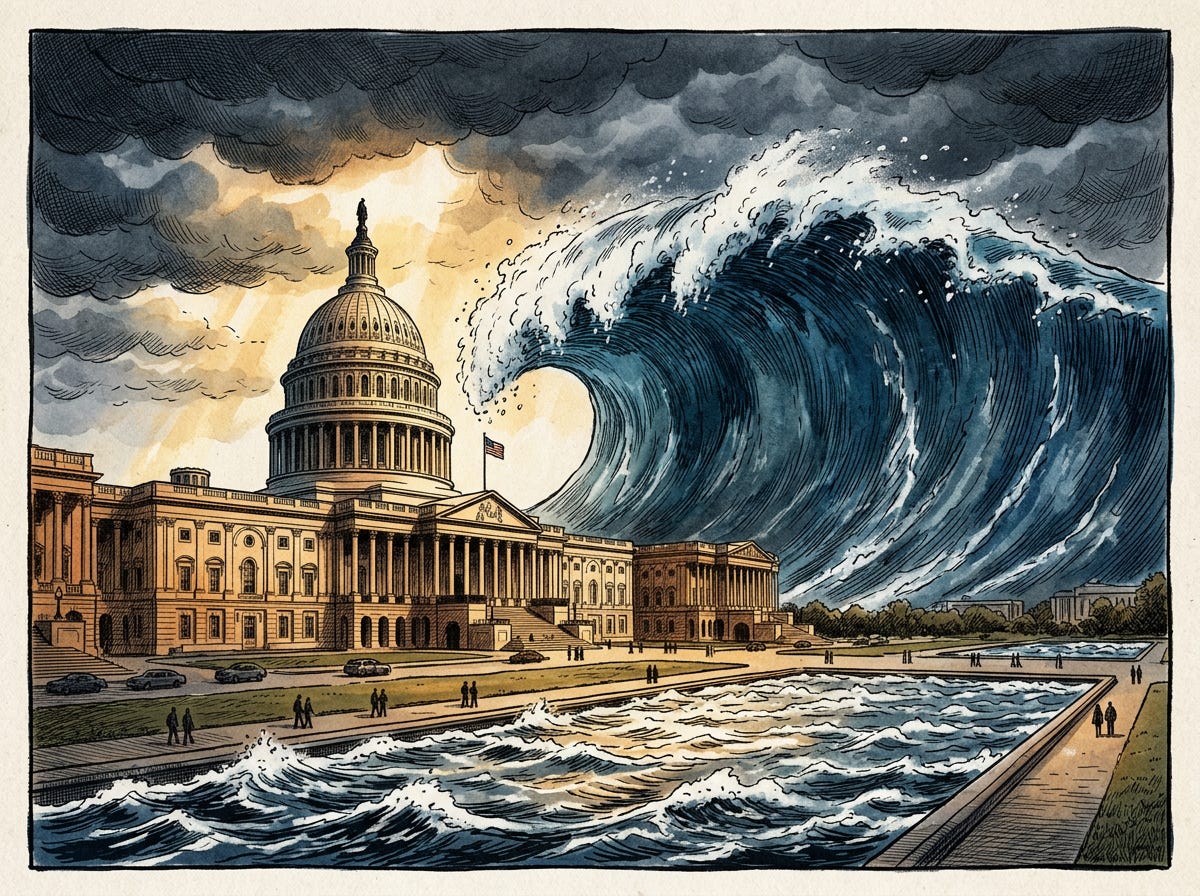
After the Bourbons were restored to the French throne, Talleyrand is credited with saying they had learned nothing and forgotten nothing. The family had been driven from power, watched a king lose his head, and spent a quarter century in exile, yet it came back to Paris determined to govern exactly as it had before the deluge. Within fifteen years, the senior Bourbon line was gone again, this time for good.
Much the same could be said of the Trump Administration one week after the midterms. We now have the full exit polling, and reviewing that polling can show the GOP a path forward. To move forward, let’s all understand what the voters said on Tuesday night and during early voting as they cast their votes.
The scale of the loss is hard to overstate. According to Bruce Mehlman’s post-election analysis, Democrats are on track for a House majority of roughly two hundred fifty-nine seats to one hundred seventy-six, the largest for either party since 1991, along with a Senate majority and thirty governorships. They won the national House vote by nearly thirteen points, the widest margin since 1976. For the first time since at least Reconstruction, not a single Republican will represent a House district that voted for the other party’s presidential nominee. The exit polling explains why, and it reads like an itemized bill. Voters rejected the war, the tariffs, the immigration crackdown, and the corruption, and they said so plainly.
President Trump’s response has been to push out the person rumored to want a change and promote the person most responsible for what voters rejected. Susie Wiles is out as Chief of Staff. She reportedly wanted Pete Hegseth to take the fall for the war in Iran, which suggests at least someone in the West Wing understood the war was a political problem. Hegseth stays, and he greeted the news of her departure by posting “Patriots in control.” Stephen Miller, the architect of this Administration’s incompetence, becomes Chief of Staff effective today.
Sixty-three percent of voters said taking military action against Iran was the wrong decision, and those voters went for Democrats eighty-three to fifteen. Nearly three in four voters said the war was a crucial or major factor in their vote, and they broke for Democrats by thirty points. Only four percent named foreign policy as the most important issue facing the country, but the war did its damage through everything else. The average price of gas was about three dollars a gallon in February and nearly four and a half dollars by October, and the President’s net approval slid right along with it. Eighty-seven percent of voters told exit pollsters they were concerned about the price of gas. Had the President not started the war, or had he seen it through to a conclusion months ago, voters might not have turned so hard against the GOP. He did neither, and voters punished the party that owned it.
The same pattern holds for tariffs.
Two-thirds of voters said the President’s tariffs hurt the national economy, and sixty-four percent said they hurt their local economy. Sixty-three percent blamed higher prices on the President’s policies rather than on forces outside his control. Had the President chosen from the start not to tariff bananas, coffee, beef, and the other staples of the grocery cart, voters might have given the rest of his trade agenda a chance. He eventually backed off on many of those goods, but by then voters had already concluded that tariffs meant higher prices at the checkout line, and nothing since has changed their minds.
Immigration should have been the Republicans’ safest issue, and in a narrow sense it still is. It was the only issue on which voters trusted Republicans more than Democrats, but only by forty-three to forty-one. Fifty-eight percent of voters said the Administration’s immigration actions had gone too far, and sixty percent disapproved of ICE. Had the President directed ICE to go after hardened criminals first, rather than day laborers and grandmothers concurrently, the public would have stayed with him. The Administration even tried it briefly.
In late September, ICE officers were given verbal guidance to focus on illegal immigrants with criminal records. When word leaked, the President called Homeland Security Secretary Markwayne Mullin at midnight and again at six in the morning, and the department retreated, branding the reports “false” and insisting “no one is off the table.” It was not the first time. Over the summer, after two deadly ICE shootings in less than a week, Mullin paused most traffic stops, and the President overruled him the next day. The White House won both fights, Stephen Miller’s general roundup continued, the public recoiled, and Miller just got the biggest promotion in the West Wing. Bad process produced incompetent policy, and the people responsible for both are the ones being rewarded.
Last night, the President admitted his administration had been too harsh on immigration and pivoted on the whole subject of immigration, suggesting an amnesty program of sorts to Ross Douthat on 60 Minutes. He seems to think a deal is possible. After the interview, some of his base were already calling for his impeachment.
TRUMP: "I think it both helped and hurt. I think I got an A+ for closing up the border. I get very high marks for getting the bad ones out. But I get hurt because we also took people that had good jobs that created one violation of breaking of the law. That is that they came into the country illegally. Now, there’s a large part of the country that think that they should be put out, and there’s a large part of the country that think that they should be allowed to stay. If they are good people working in a landscaping company or working in a hotel or doing something, right, and in some cases paying taxes, and there’s a large group of people think that they should be allowed to stay -- "
DOUTHAT: "So you think your deportation policy went too far?"
TRUMP: "It was too tough."
DOUTHAT: "It was too tough?"
TRUMP: "I think it might be too tough. Yeah. I think ultimately that hurt me."….
TRUMP: "But there’s a group of people that I would say are on the sort of pretty far right that would like everybody taken out. There’s a group of people on the -- "
DOUTHAT: "Do any of those people work in your administration?"
TRUMP: "Yes."
DOUTHAT: "Are they in the building with us right now?"
TRUMP: "Well, there are a lot of those people. Then there's also people that are more modified on that. In other words, get the killers out, get all the rough ones out, get the drug dealers out, but let the people that are here -- and in some cases here for 10 and 15 years -- work a deal for them."
Real credit to Ross Douthat for that interview. It was a master class in interviewing a prickly, sometimes difficult subject.
Republicans were warned about the electorate going back to 2024. The Trump coalition was built on lower-propensity voters who show up for Donald Trump and stay home when he is not on the ballot, while Democratic voters reliably turn out in midterms. Turnout this year was the second highest for a midterm since 1914, so the problem was not empty polling places. The problem was who went to vote. Democrats enjoyed their largest turnout advantage since 1976, and ninety-eight percent of them voted for Democratic candidates. The electorate was seventy-three percent white, and Latinos, who helped carry the President in 2024, were a smaller share of it than they were two years ago. The people who voted this year recalled backing Kamala Harris over Donald Trump by five points in 2024.
The President’s base did turn out. Self-described MAGA Republicans were nearly one in five voters, and they voted Republican at ninety-nine percent. It was not enough, because the rest of the coalition left. Fifteen percent of Republicans who do not consider themselves MAGA crossed over to vote for Democrats, as did seven percent of the President’s own 2024 voters. Independents, a third of the electorate, went Democratic fifty-eight to thirty-eight, a seventeen-point swing in the Democrats’ favor from two years ago. The only voters Republicans won decisively were those who said the President was not a factor in their vote.
The erosion reached into the heart of the coalition. Scott Rasmussen, whose final generic ballot in mid-October showed Democrats up eleven points among likely voters and came closer to the result than most, has asked voters every month since January 2025 whether they would prefer a Republican who supports President Trump’s policies, a more traditional Republican, a Democrat who supports the policies of Alexandria Ocasio-Cortez, or a more traditional Democrat. Among white men, the share preferring a candidate with Trump’s policies 𝕏fell from forty-nine percent to thirty-two percent. Roughly half of the white men who left went to a traditional Republican, and the other half to a traditional Democrat, not to the socialist left. Among white men without a college degree, the decline was twenty-five points. Among white evangelical men, support for Trump’s policies fell from sixty-nine percent to forty-four percent, and among white men who describe themselves as Bible-believing Christians, it fell from sixty-seven percent to thirty-nine percent. These are not voters who were seduced by Democrats. They are Republicans who wanted a more traditional Republican Party than the one the White House was offering.
None of this has registered with the President. Rather than revisit the policies voters rejected, he has doubled down on them, and his base has split into two camps, each with a single explanation for the loss. One camp blames the war alone, but the slide began long before the first strike on Iran. In Rasmussen’s tracking, thirty-eight percent of all voters preferred a candidate with Trump’s policies in January 2025. By February 2026, before the war began, that number had already fallen to thirty-one percent, and it 𝕏stood at twenty-six percent in October. Seven of the twelve points were gone before the war, and the war cost five more. Over the same stretch, the share preferring a traditional Republican grew, while support for Ocasio-Cortez’s policies never moved. The war accelerated a decline that tariffs, prices, and the roundups had already set in motion.
The other camp insists the election was stolen, and the exit polls show where that camp came from: thirty-five percent of voters were not confident that ineligible voters would be kept from voting, and those voters went Republican by better than three to one. Nobody can blame money, either. Republicans outspent Democrats in the top Senate races by more than three hundred million dollars. Neither the Republicans who simply blame the war or Republicans who are blaming fraud have much interest in the possibility that voters simply rejected MAGA.
What voters actually said was broader and more damning than either monocausal explanation. In 2024, Donald Trump promised to stop wars, to drive down prices, and to end the self-dealing he accused the Biden family of. In 2026, sixty-three percent of voters said the war was a mistake, sixty-three percent blamed his policies for higher prices, and sixty-two percent said he puts his personal interests ahead of the country’s. Fifty-five percent called government corruption crucial to their vote, and * ninety percent* said it was at least a major factor. Seventy-one percent said Congress was not doing enough to check the presidency.
That last number should keep every Republican in Congress awake at night. Gallup found a record-low forty-three percent of Americans believed their own member of Congress deserved reelection. Voters did not just reject the Administration. They rejected a Republican Congress that would not hold it accountable.
Some Republicans have noticed. On Saturday, Senator Ron Johnson, as loyal an ally as the President has in the Senate, went on Fox News and said the corruption in Washington reached into the Trump Administration itself, lamenting that Republican voters expected the party to drain the swamp and instead “the swamp won.” He has since tried to spread that charge across every administration, but he said what he said, and he faces voters in 2028 in a Wisconsin that just elected a Democratic governor by eight points. On Sunday, Congressman Marlin Stutzman of Indiana, whose own share of the vote fell from sixty-five percent in 2024 to under fifty-five percent, told CNN that promoting Miller was “a bad mistake.” When your team takes a beating like that, Stutzman said, “you have to fire people.” He spoke for a good many of his surviving colleagues, even if most of them will not say so on camera.
The question now belongs to Republicans in the House and Senate. They can rebuild, which means doing the very thing voters said was missing and holding this Administration accountable on the war, the tariffs, the roundups, and the corruption. Alternatively, they can double down on the posture that cost so many of their colleagues their seats. The Bourbons came back to the throne in 1815 and lost it for good in 1830 because they would not change. The Executive Branch has already chosen the Bourbon path. Congressional Republicans still have a choice, and they have two years to make it.