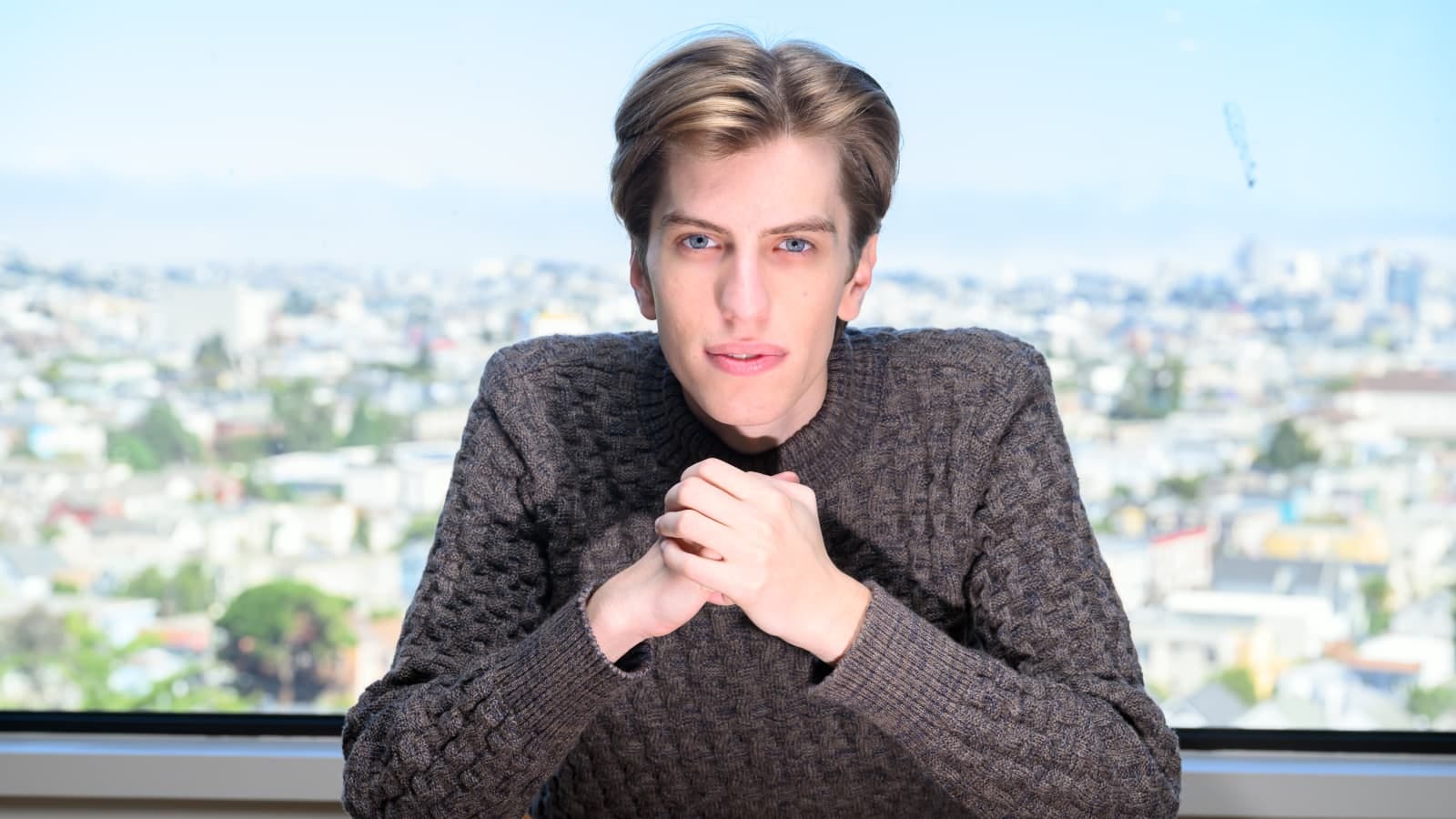
Leopold Aschenbrenner became one of the strangest stars of the AI boom almost overnight. The former OpenAI researcher built a following after publishing his sprawling Situational Awareness essays, which laid out an extraordinarily aggressive vision for the development of artificial intelligence and superintelligence.
He then did what comes naturally during the terminal stages of a speculative mania: he turned the thesis into a hedge fund. Situational Awareness launched in 2024 with backing from some extremely sophisticated people and quickly became one of the most closely watched AI investment vehicles on Wall Street.
Aschenbrenner was young, articulate, credentialed and spectacularly bullish at precisely the moment the market was willing to treat all four of those things as evidence of investing genius.
And for a while, he looked like a genius. But then again, with the market going straight up, and memory stocks following in tow, so did the 18 year old trading one SanDisk call option at a time on his 15 minute smoke break during his shift at *Burger King. *Bull markets make “geniuses” out of us all. Look at Cathie Wood, for example.
Then July happened. Situational Awareness’s portfolio plunged 67% in a single month as a concentrated collection of AI-related stocks moved violently against it.
The fund had grown to roughly $45 billion at the beginning of July before its assets fell toward $10 billion, forcing Aschenbrenner to unload most of his public-equity portfolio, with Citadel ultimately taking down a large chunk of the book. In other words, $35 billion in value simply went “poof” into thin air. For comparison, Cathie Wood’s ARKK was named one of the Top 15 Wealth Destroying Funds Over the Past 10 Years in 2024 after it had destroyed about $14 billion in value.
It was reported that leverage was removed after the rout and that Aschenbrenner acknowledged the fund had come uncomfortably close to permanent capital impairment (which is fancy Wall Street speak for ‘fucked beyond repair’).
The remarkable footnote is that the fund was still up about 80% for the year because the preceding gains had been so enormous. But make no mistake about what happened operationally: a massively concentrated, leveraged book ran into the wrong market and had to be dismantled under duress…quickly.
I wrote about the collapse at the time, and what bothered me almost as much as the risk management was Aschenbrenner blaming his insanely irresponsible risk management on short sellers. Obviously, short sellers did not force anyone to assemble a concentrated AI portfolio and lever it up. They did not create the liquidity mismatch. They did not decide the position sizing.
For a huge-brained AI dork relying on crap like advanced algorithms and differential geometry (or whatever the fuck these guys do) to try and outsmart the market, Aschenbrenner somehow missed the first lesson in the E*TRADE intro to trading course: if your investment strategy only works as long as nobody notices what you own and bets against you, the problem isn’t the short sellers. The problem is that your investment strategy sucks.
And get this: because Wall Street apparently exists to prove that no amount of spectacular failure is disqualifying when enough rich people are licking your balls because your resume says “OpenAI” on it, barely six weeks after incinerating tens of billions of dollars, Leopold’s back at the table.
CNBC reported Thursday that Situational Awareness was once again active in the options market. Not the equity market. Not the Treasury market. Ole’ Leopold is back…and he’s going right for the leverage jugular again.
According to the report, the firm recently bought options tied to Advanced Micro Devices, Bloom Energy and CoreWeave, along with positions involving SK Hynix, SanDisk and the Roundhill Memory ETF. The activity reportedly occurred late last week and early this week. It remains unclear whether Aschenbrenner has raised fresh capital for these trades or is deploying money that remained inside the fund after July’s liquidation and sale of public-equity positions to Citadel.
That’s the beauty of an industry marinating in enablers and moral hazard: blow up a fortune, wait for the smoke to clear, change your shirt and somebody will inevitably hand you another stack of chips.
I had to take a breath and sigh after reading this yesterday. Once again Wall Street has crowned someone a genius who appears to me to just be another gambler buying into the bubble sitting at the top of the highest valued market in history. Not surprising, as this is the same financial media machine that routinely features this guy:
Look, this kid may be brilliant about artificial intelligence. He may ultimately be completely correct about the technological trajectory of AI. He may know ten thousand times more than I do about compute, scaling laws and what the world looks like if we get AGI. But none of those things automatically make him a great portfolio manager. The market has an extraordinarily effective way of teaching people the difference between being right about a secular trend and being right about a trade. Ask me how I know.
To recap: Aschenbrenner fell ass backward into the most coked-out, gamma fueled, Charlie Sheen-style momentum trade bender in memory and AI, pressed it with leverage, generated breathtaking returns, was anointed a genius, and then nearly drove the fucking car through the guardrail the moment the trade went violently against him.
Now, after being rescued from the consequences of that mistake by a forced restructuring of the portfolio, he is apparently climbing back into many of the same general themes: AI infrastructure, semiconductors, memory and data-center beneficiaries, through instruments that can themselves introduce substantial leverage.
Maybe it works. In fact, it wouldn’t surprise me at all if it works initially. That’s the particularly dangerous thing about bubbles. They repeatedly reward the behavior that eventually destroys people. Every successful dip-buy teaches you to buy the next dip bigger. Every recovery tells you your thesis was right and your risk management didn’t matter. Every miraculous escape from a margin call becomes evidence, in retrospect, that you should have simply held on.
And this…is how markets manufacture their most spectacular blowups.
And I find the financial media’s treatment of the whole thing fascinating. The tone surrounding Aschenbrenner’s return already carries some of the same fascination that surrounded his ascent: the young AI wunderkind is back, he’s making trades again, here’s what he’s buying.
“Leo is back!” the media gleefully exclaimed, with all the breathless excitement of schoolgirls who haven’t missed a Justin Bieber concert in a decade and just found out he’s back in town.
It’s financial celebrity culture masquerading as investment analysis. Imagine describing almost any other business this way. A pilot crashes a plane in July and six weeks later the headline isn’t Why Is This Fucking Guy Flying Again? It’s Here’s Where He’s Flying Next!
The much more useful question is what exactly investors learned from July. Because if the lesson was simply that Aschenbrenner needed to survive the liquidation and wait a few weeks before loading up on AI exposure again, I’m not sure anything was learned.
His LPs should be asking whether the extraordinary returns that preceded the collapse reflected some unique investment process or whether they were, at least in significant part, the mathematical consequence of taking enormous concentrated exposure to the hottest trade in the world and applying leverage to it.
My guess is his LPs aren’t widows and orphans screwing around on the Robinhood app. The people allocating capital to Situational Awareness presumably understand exactly what they are buying and they have now watched the strategy demonstrate, in spectacular fashion, what happens when concentration, leverage, liquidity and crowded positioning collide. If they nevertheless decide that what the fund really needs is another spin of the wheel, then fine.
But let’s stop pretending there’s some genius at the core of this strategy that the rest of the world can’t understand because the dude worked for OpenAI. He’s buying the same (questionable, in my opinion) CoreWeave equity as the next guy. My guess is that lesson will be served up cold again in the future.
After all, the backdrop Aschenbrenner is returning to could hardly be more precarious.
The economy is slowing. Inflation is still running too hot. Treasury yields are pushing higher. Government borrowing remains enormous. And equities are still priced for something close to perfection. That leaves the Fed trapped. Tighten further to fight inflation and it risks accelerating the slowdown into a recession or worse. Ease policy to rescue the economy and it risks reigniting inflation and sending an already-fragile bond market into another tailspin.
Meanwhile, the cost of capital is rising just as investors are assigning extraordinary valuations to companies whose AI ambitions require staggering amounts of future spending (and who have trillions in off balance sheet liabilities).
Something eventually has to give. And with expensive equities, stubborn inflation, a weakening economy and a Fed increasingly boxed in between inflation and depression, this seems like a particularly bad moment to discover how much risk is hiding underneath the market. Which is why there would be something almost cosmically appropriate about karma striking twice.
But hey, maybe Aschenbrenner nails it. Maybe AMD, CoreWeave, Bloom, memory stocks and the rest of the AI complex rip another 50%, Situational Awareness prints another fortune and I wind up looking like the asshole. That’s markets. Nobody knows what happens next.
But if the same basic strategy blows up twice, I don’t want to hear one person saying they were surprised. The first collapse can be called a liquidity event. It can be blamed on positioning. It can be blamed on an extraordinary market dislocation. It can be explained away as the unfortunate collision of leverage and volatility.
The second one belongs to the financial media slobbering over this kid and his LPs.
There’s an old saying about that. Fool me once, shame on the market. Fool me twice, maybe I shouldn’t have given the 24-year-old another pile of money, massive media coverage and an options account.
QTR’s Disclaimer**:** Please read my full legal disclaimer on my About page here.
Contributor posts, guest posts and curated posts have been hand selected by me, but have not been fact checked and are the opinions of their authors. They are either submitted to QTR by their author or reprinted under a Creative Commons license with my best effort to uphold what the license asks, or with the permission of the author.
I cannot guarantee the accuracy of any or all facts and figures included in this article though I made an effort to get them right. I have been wrong before and will be wrong again, and encourage you to always double check, do your own research and speak to a licensed financial professional, which I am not.
This is not a recommendation to buy or sell any stocks or securities, just my opinions. I often lose money on positions I trade/invest in. I may add any name mentioned in this article and sell any name mentioned in this piece at any time, without further warning. None of this is a solicitation to buy or sell securities. I may or may not own names I write about and are watching. Sometimes I’m bullish without owning things, sometimes I’m bearish and do own things I’m bearish on. Just assume my positions could be exactly the opposite of what you think they are just in case. If I’m long I could quickly be short and vice versa. I won’t update my positions.
Starting in 2026, I have been attempting to no longer actively trade as much as I once did ( read my story here). My goal is for my investing/saving to be done by recurring contributions mostly to sector ETFs and a few select equities, trusted third parties who oversee my accounts, and advisors. Such advisors or funds, through individual equities, options, index funds, mutual funds, ETFs, or other securities, may have positions in, exposure to, or holdings of names mentioned herein that I know nothing about. It is possible I could own, have exposure to, or not own anything, at any point. In an attempt to lead a healthier lifestyle, I’ve also excluded myself from fantasy sports, sports betting, online and in-person casinos and prediction markets.
Any of my positions can change immediately as soon as I publish, with or without notice and at any point I can be long, short or neutral on any position. You are on your own. Do not make decisions based on my blog. I exist on the fringe. If you see numbers and calculations of any sort, assume they are wrong and double check them. I failed Algebra in 8th grade and topped off my high school math accolades by getting a D- in remedial Calculus my senior year, before becoming an English major in college so I could bullshit my way through things easier. Hence, why I am a writer.
The publisher does not guarantee the accuracy or completeness of the information provided in this page. These are not the opinions of any of my employers, partners, or associates. I did my best to be honest about my disclosures but can’t guarantee I am right; I write these posts after a couple beers sometimes. Many times I edit after my posts are published because I’m impatient and lazy, so if you see a typo, check back in a half hour.
Also, again I just straight up get shit wrong a lot. I mention it multiple times because it’s that important you understand.