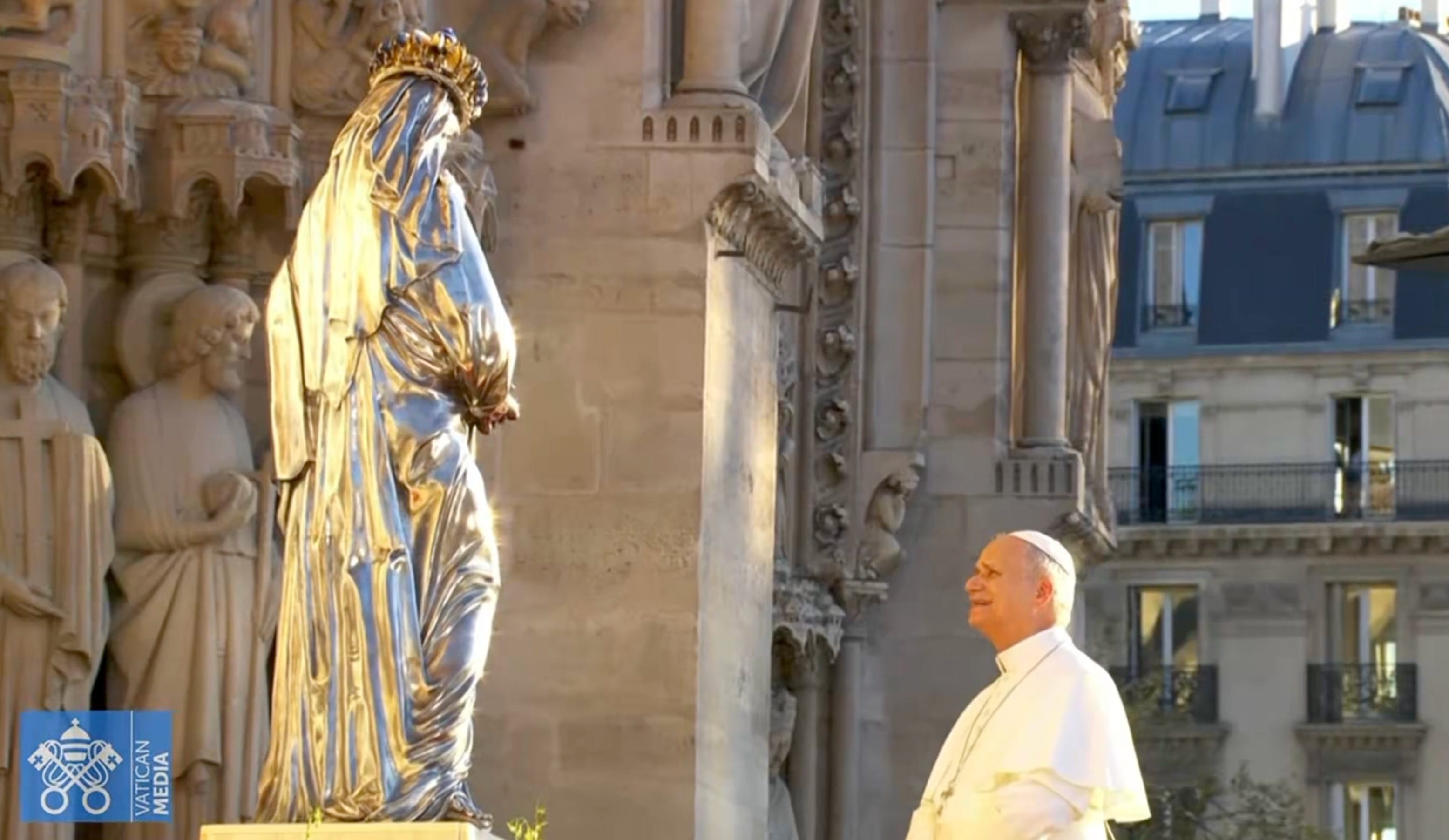
You faithful readers know how much I love France. And you probably know for how many years I have prayed for that beloved but suffering country to return to its baptism. So you can imagine why I’ve been lying here early in the morning in my hotel room bed in Chicago, hometown of Pope Leo XIV, watching over and over again these videos from the pope’s pilgrimage to France, and crying my eyes out, saying over and over again, “Thank you, Lord, thank you!”
The videos have been incredible, just incredible. Here is the American pope speaking for this Orthodox American Christian as he weeps before a statue of the Madonna and her Child outside the Cathedral of Notre Dame, which the Enemy tried but failed to burn down…
…singing with the gathered throng the medieval Catholic hymn “Salve Regina,” which was set to this tune at the Abbey of Cluny in the 12th century.
They sang in Latin; here is the translation in English:
Hail, holy Queen, Mother of Mercy,
Hail our life, our sweetness and our hope.
To thee do we cry,
Poor banished children of Eve;
To thee do we send up our sighs,
Mourning and weeping in this vale of tears.
Turn then, most gracious advocate,
Thine eyes of mercy toward us;
And after this our exile,
Show unto us the blessed fruit of thy womb, Jesus.
O clement, O loving,
O sweet Virgin Mary.
It was in this cathedral, on November 10, 1793, that the blasphemous Revolutionaries dismantled the altar and enthroned the “Goddess of Reason”. Where is the Goddess of Reason? Where are the Revolutionaries? Dead, and dead. Today, the altar has been restored, God is worshiped there, and there stands the Mother of God, golden and radiant with the glory of Her Child, as the weeping Pope and the gathered crowd sing her praises and petition her to lead them to Jesus.
Later, at the Stade de France, Leo led a prayer vigil of 80,000 young French Catholics. The French put on a pageant celebrating the history of the faith in France, featuring its saints and martyrs. (How I wish they had included Father Jacques Hamel, slaughtered by Islamists as he said mass at his little country parish a few years back; I dedicated the French version of * The Benedict Option* to his memory).
The point is: the French are a people, a people with a history, and that history includes great and holy deeds of Christians. The story of France is the story of the Christian faith in France, and the holy men and women who were part of it. When I saw the videos of that prayer vigil, I could not help but recall being last year with the 20,000 young pilgrims on their way to Chartres. From that story:
Outside of Saint-Sulpice, I stop to chat with a group of young women wearing the uniforms of France’s
, which has historically been tied to the Catholic Church, unlike its more secular version in the Anglosphere. I ask one—Isa, 19, from Orléans—why she is there.[Scouting movement]“Jésus,” she declares.
More:
Though most of the pilgrims do not speak in philosophical categories, all of them are preoccupied with the question of meaning. After the opening mass ends, I meet Viennese pilgrim Anna at a nearby café.
It’s the cheerful 24-year-old’s first Chartres walk. She has the air
of a superfan at a Taylor Swift concert.Why is she here?“Tradition is the only safe future we have,” she replies. “What are you going to build your life on, if not God?”
There’s a smattering of older pilgrims, too. John Pepino, 57, an English-born professor at the
of the[Denton, Nebraska, seminary]—a Latin Mass order that is faithful to Rome—is on his third Chartres pilgrimage, accompanied this time by his 17-year-old daughter, Margie.[Priestly Fraternity of Saint Peter]“I feel like a grandfather here,” he laughs.
This is not supposed to happen, I say to Pepino, jokingly. Young people, as natural progressives, are not supposed to want to recover what their elders tossed in the trash bin; they are supposed to want to free themselves from the dead weight of the Catholic past.
“I think these are just fervent young people who don’t recognize themselves in what the bishops usually propose to them,” he says.
Talking to young pilgrims gathered outside Saint-Sulpice at the start of the pilgrimage, I asked them, as a journalist, why they were there. Over and over, I received a variation of this answer:
Our parents’ generation gave us nothing. We are here searching for tradition. We are searching for meaning. We are searching for purpose. We are searching for community. We are, in the end, searching for God.
There were some Americans on that pilgrimage too. What they saw of the Catholic faith in France, they took to heart, because the experience of the Christian faith is universal:
An American priest leading a group of high school boys to Chartres tells me: “When they come here, one of the things they experience is that a joyful Catholic life is possible, that a beautiful Catholic life is possible. In the United States, people feel very isolated from that, because we don’t have the cultural heritage that points us in that direction. So when the boys experience that, they realize it’s not just a storybook fantasy.”
Most of these boys, the cleric continues, will be exposed to hardcore pornography years before they ever see a beautiful European church, or encounter extraordinary beauty in nature. His hope is that they will go home knowing that they can be genuinely attracted to something beautiful that is also good.
“Seeing the look on these boys’ faces when they see this kind of beauty for the first time!” the priest says. “We were at [the traditionalist
, and we were up at 4:15 a.m., listening to the monks sing matins in a 12th-century monastic church—it’s just something they immediately intuit as the sort of thing that they have been created to delight in.”[monastery of Fontgombault]
That experience gave me more hope than I’ve had in years. Before I left Paris, I had dinner with an older French friend, Roland, who said to me, “Those young people, that generation will save us.”
As I write, one million Catholics are gathered along the Champs Élysées, and on the Place de la Concorde, in Paris, to hear the pope say mass, in French. Look at this crowd along the Champs Élysées, praying in the heart of one of Europe’s most atheistic countries:
▶Here’s the live stream of the Mass:
The Place de la Concorde is the grand plaza where the Revolutionaries executed the King, and so many others who opposed them. Where is Robespierre today? Dead. Where is Danton? Dead. Where are that entire rabble? Dead, dead, and dead. The faith lives, right there on the very earth where these men of daring thought they had killed it, and everything related to it. Jesus is alive!
When the Pope opened the Gloria prayer, chanted in Latin, I was startled to discover that I still know it in Latin. I prayed along. Yes, I am Orthodox, and firmly so, but I am so, so grateful to what God gave to me as a Christian in the Catholic Church. You all know well that I’ve said for years that the Catholic Church, sadly separated from the Eastern church by the sins of Christian men, Catholic and Orthodox alike, in ages past, is at the core of Western civilization. The future of the West depends on the health of the Catholic Church — not only the Catholic Church, but the Catholic Church more than any other institution.
Today in Paris is, for this Orthodox Christian, a sign of hope for my own civilization. Here at the Touchstone Conference these last two days, I’ve heard both Orthodox and Catholic Christians talk about how their parishes are overflowing with young men and women, seeking Christ (perhaps this is happening among Protestant churches too, but I simply haven’t heard people talking about that). One Catholic academic said that the Catholic student center came to life once the bishop removed the exhausted old liberal religious order that had been managing its decline, and returned control to the diocese. Now young people seeking Christ are filling the place.
Sorry, but I can’t help including𝕏 this, from a Catholic friend in Paris:
It’s easy to allow one’s hope to rise, only to be disappointed. In 1997, Pope John Paul II said mass for one million people at World Youth Day in Paris. Yet the faith continued its decline. But those young people on the Chartres pilgrimage had not yet been born. Nor had any of the young people gathered to pray with John Paul’s successor, Leo, at the Stade de France. Nobody knows the future.
This means so much to me for another reason. In two hours, here in Chicago at the Touchstone conference, where speakers have been discussing the future of our own troubled country, I will give the closing lecture. I will talk about Weimar America, and the signs of the times. My talk is not meant to discourage people, but to wake them up to the gathering storm, so that we can act!
Once again: the future is not fated! We can have the future that we want, but only if we act to make it come true. Not the future of faithlessness and despair, not the future of resignation and Islamization, not the future of the radical left or the radical right. We can have the future of a resurrected faith in the Resurrected Lord! They can have it in France, and we can have it in America — but we have to want it enough to sacrifice for it, for this great romantic adventure of la vie chrétienne.
It can be ours, but it will not come without struggle — struggle most of all to overcome ourselves and our weakness and complacency, but that’s not the only struggle. Let the reader understand. Last week in Switzerland, a senior French journalist told me, “It feels that France is in a pre-revolutionary place.”
The skies are darkening, but remember: the Light appeared in the darkness, and the darkness neither comprehended it nor overcame it. Le Christ est résusscité!
As I concluded my 2025* Free Press* piece on the Chartres pilgrimage:
“Hope is a memory that desires, the memory is a memory that has enjoyed.” This is the essence of the Christian hope that Chartres gives these young idealists. The man who wrote those words was Honoré de Balzac. A Frenchman,
naturellement.
My Christian readers, Protestant and Orthodox, let us celebrate with our Catholic brothers and sisters today, and draw hope from what the Lord is doing there in the land of St. Denis, St. Genevieve, St. Joan of Arc, the Martyrs of Compiègne, and all the saints, those known to history and those known only to God. Be not afraid: God is alive, and He calls us — you and me — by name.
The times are evil, but it’s not over yet for the faith in the lands of the West. See the hope on the streets of Paris today, take it to heart, and go forth to make disciples of the world, starting with yourself.
Merci, Seigneur, I pray through tears of joy this morning. Merci.