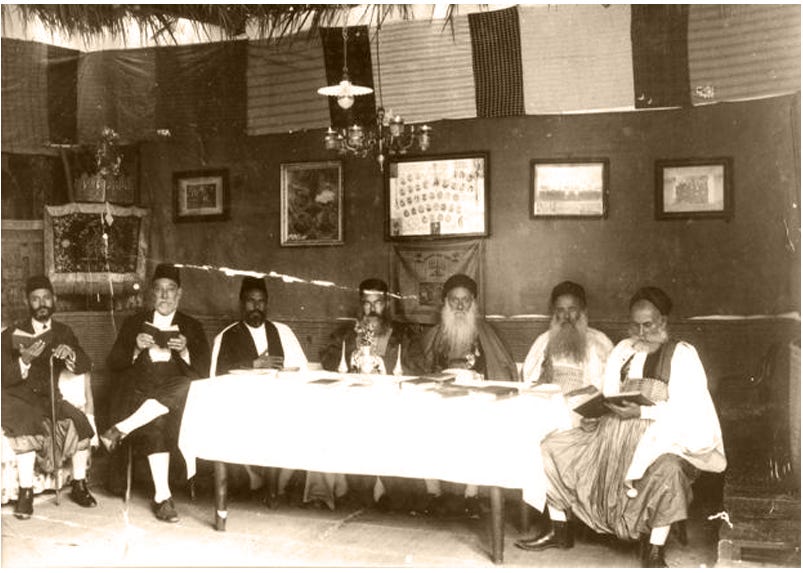
This is part of the ongoing series, The People Who Carried Their World: A Map of Two and a Half Thousand Years.
The Jewish community of Libya traces its origins to at least the third century BCE. Cyrenaica, the eastern coastal region, was under Greek rule, and inscriptions uncovered in Benghazi document wealthy, organized Jewish communities whose members held citizenship in the city and were governed by Jewish archons, their elected leaders, rather than by external authorities governing Jews elsewhere in the ancient world. They were established, prosperous, and recognized.
Simon of Cyrene, the man the New Testament describes as carrying Jesus’s cross to the crucifixion, was a Jew from Libya. Jason of Cyrene was a Libyan Jewish historian whose work became the source of the Second Book of Maccabees. The Jewish community of Cyrenaica was old enough, large enough, and rooted enough to produce figures who appear in texts that became foundational to Judaism and Christianity.
Under Roman rule, that community grew and prospered. Caesar Augustus granted the Jews of Cyrenaica formal privileges through the provincial governor, but tensions between the Jewish population and their Greek and Roman neighbors mounted over generations and eventually erupted into war. In 115 CE, during the Kitos War, Jewish rebels in Cyrenaica rose while Rome’s legions were occupied fighting the Parthians. The rebellion was crushed with such force that Emperor Hadrian brought settlers into parts of Cyrenaica that had been left nearly empty. Many surviving Jews scattered into the Berber communities of the interior, into the Sahara and westward through Tripolitania, Tunisia, Algeria and Morocco, while Jewish life in Libya continued.
Libyan Jews survived the Vandals, the Byzantines and the Arab conquest of the seventh century. Byzantine rule brought another period of persecution that pushed some Jews back toward Berber communities in the interior. Under Muslim rule, they became dhimmis, a protected but subordinate minority required to pay the jizya tax and excluded from public office and military service. They could maintain their religion and communal institutions, but they did not have equal status with Muslims.
The Almohad conquest of North Africa in the twelfth century brought a harsher period for Jews and Christians. Across Almohad territory, Jewish communities faced persecution, forced conversion and flight. Libya’s Jewish community survived that period as well, and when Spain expelled its Jews in 1492, Sephardic refugees crossed the Mediterranean into North Africa and joined communities that had already existed there for centuries.
Only eighteen years later, Spain followed them across the sea. Spanish forces conquered Tripoli in 1510 and devastated the city. Jews were subjected to the Inquisition, some were tortured, and others were enslaved and taken to Sicily and Naples. Spanish rule lasted until 1530, followed by the Knights of St. John, until the Ottomans captured Tripoli in 1551.
Under Ottoman rule, Jewish communities in Tripoli and Benghazi became active participants in regional commerce. Benghazi’s Jewish merchants helped connect trade between Europe and Africa, and the Sanussi Muslim brotherhood, influential in Cyrenaica from the 1840s onward, generally maintained friendly relations with the Jews there and valued their economic contribution. The Ottoman system still placed Jews in a subordinate legal position for much of this period, but relations between Jewish and Muslim communities could also be stable, cooperative and genuinely warm.
Italy colonized Libya in 1911 following the Italo-Ottoman War, when the Jewish population numbered around 20,000. Under Italian rule, at least initially, Jews were treated relatively well. By 1941, Jews still made up about a quarter of Tripoli’s population, and there were 44 synagogues across Libya. After more than two thousand years, this was still a large, visible Jewish community with schools, businesses, religious institutions, and neighborhoods woven into Libyan life.