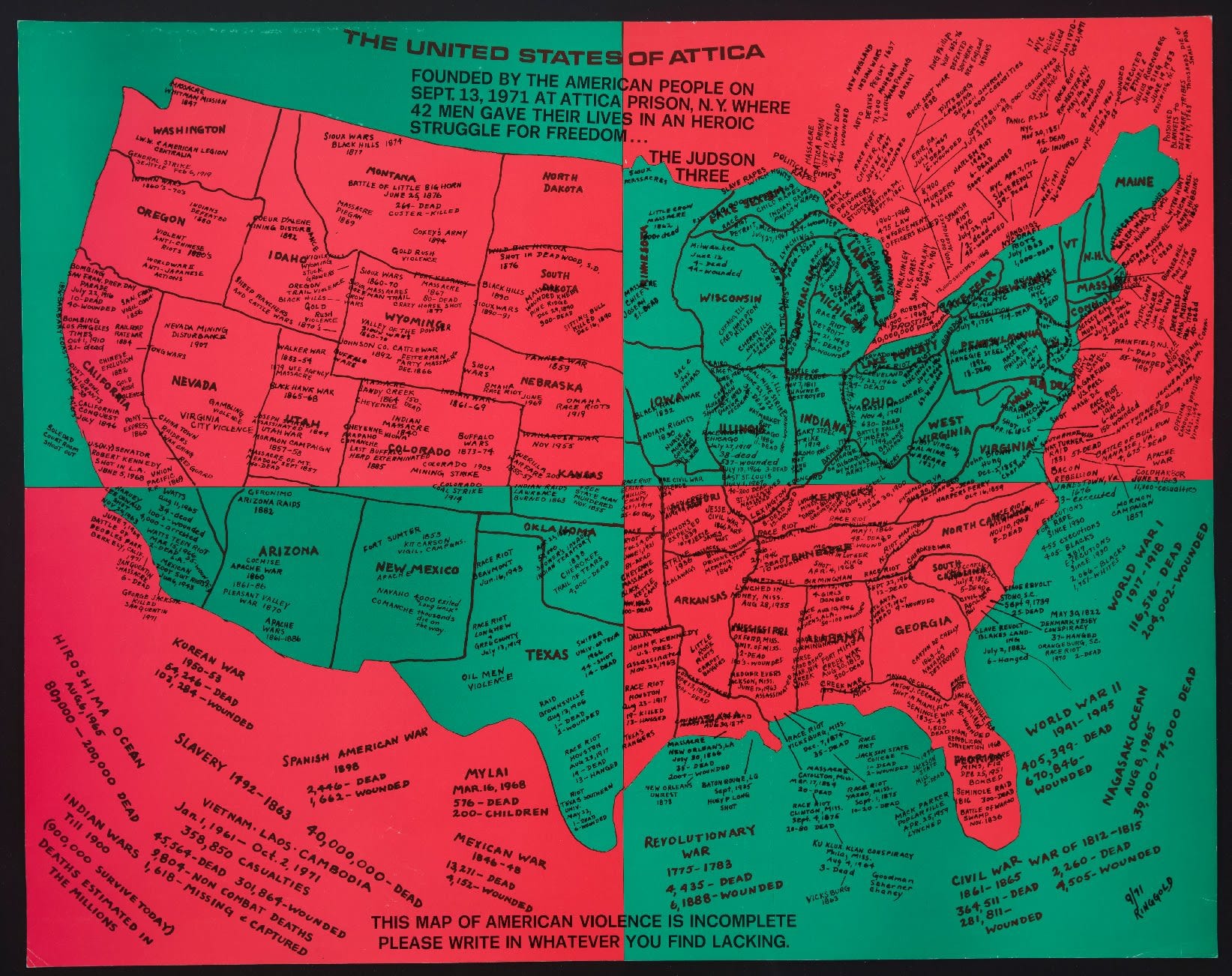
The United States is like a mirage, built on half-truths and complicated explanations. Words set up our foundational mistruths, like “all men are created equal,” but art has solidified many of those mistruths in the public mind. Pictures make true lies in a way text cannot.
The nation started out fairly literate, and a literate public knows how to argue with a sentence. It has far less practice arguing with an image. So when the vantage point needed to be framed just so, a picture could assuage the public in a way words could not. As literacy has steadily dropped, the volume of imagery has increased. More visuals mean less ability to focus on understanding meaning.
Art is an ideal tool for shaping thought, visualizing ideas, and galvanizing concepts into truths. Between the speed of visual processing and most people’s pattern recognition, a picture is worth a thousand propagandizing words. On the occasion of the 250th anniversary of the Declaration of Independence, here are five ways visual culture has lied to us about America.
This is the third of a three-part series to commemorate 250 years since the Declaration of Independence. First one here. The second is here.
This is the weekly paid post. Log in to the web or app to read the full thing. I appreciate every one of you. If you can upgrade, it would be helpful, as I’m using these earnings to focus on writing my book. If you can’t afford to do so, buy me a coffee. I run on caffeine. If you can’t, no fear- I always make lots of my content free.
Native People are Less Advanced
In August 1590, John White and his ships returned to Roanoke. Finding an empty town, he wrote, “We found no signe of distresse; then we went to a place where they were left in sundry houses, but we found them all taken downe, and the place strongly inclosed with a high Palizado [i.e. a palisade of wooden stakes], very Fortlike; and in one of the chiefe Posts carved in fayre capitall Letters C R O A T O A N, without any signe of distresse, and many barres of Iron... and such like heavie things throwne here and there, overgrowne with grass and weeds...”
Among the missing members of the Roanoke community were White’s daughter and granddaughter. Storms forced him to return to England without solving what happened to the people of Roanoke.