Biblical inerrancy is the idea that the Bible is without error—in some sense. There are stronger and weaker versions of this. One of the weaker flavors is called limited inerrancy. It’s called that because it’s limited in what it says is inerrant. It holds that the Bible is inerrant on matters of faith and morals, but not necessarily on matters of history or science. A lot of traditional inerrantists don’t like it—the good folks over at Got Questions warn:
Interpreters who adopt limited inerrancy essentially place human reason above the Word of God. They themselves sit as judges over divine revelation. Any criteria used to determine the truthfulness of a text becomes the
de factoauthority over that text.
Scary stuff!
Nonetheless, even limited inerrancy is very implausible. The Bible is clearly wrong repeatedly on matters of faith and morals. In my view, limited inerrancy represents a very awkward middle ground: it compromises the general trustworthiness of the Bible, and then it also requires you think the Bible was right in a bunch of obviously false assertions.
I’ve already written about many of my objections to inerrancy. Most of the ones I’ve written about pose challenges for limited inerrancy:
Slavery passages are about morality.
War crimes are about both faith and morals because they describe moral commands given by God.
Levitical laws are supposed to have come from God, so this is a matter of faith.
Authorship of Daniel and 2 Peter pertain to matters of faith, as they’re about who wrote books of the Bible.
The incorrectly predicted imminent return is a matter of faith.
Here, I’ll provide two more.
The Hebrew Bible in a bunch of places pretty straightforwardly teaches polytheism. Whether there are other gods is a matter of faith, so this would falsify limited inerrancy.
Deuteronomy 32:8-9 states:
When the Most High
[b]apportioned the nations,
when he divided humankind,
he fixed the boundaries of the peoples
according to the number of the gods;the Lord’s own portion was his people,
Jacob his allotted share.
The plain reading of this passage is that “the most high” is the supreme being and then the god of the Old Testament is just one local deity. Psalm 82:1 declares “God has taken his place in the divine council; in the midst of the gods he holds judgement.” Psalm 89: 6-7 says:
For who in the skies can be compared to the Lord?
Who among the heavenly beings is like the Lord,
a God feared in the council of the holy ones,
great and awesome[b]above all that are around him?
Numbers 33:4 says “The Lord executed judgements even against their gods.” Micah 4:5 says “For all the peoples walk, each in the name of its god, but we will walk in the name of the Lord our God forever and ever.” Many more passages could be given.
Other passages seem to indicate that God isn’t a perfect being who is limitless in power, knowledge, and goodness. God is limited in power and knowledge.
Jeremiah 3:7: “and I thought, ‘After she has done all this she will return to me’; but she did not return, and her false sister Judah saw it.”
Genesis 6:6: “The Lord regretted that he had made human beings on the earth, and his heart was deeply troubled.”
1 Samuel 15:11: “I regret that I made Saul king.”
Ezekiel 12:3: “Perhaps they will understand, though they are a rebellious people.”
Many more examples could be given. Now, the standard approach from Biblical inerrantists is to interpret the passages depicting God being ignorant as non-literal and the polytheistic passages as being about lesser gods. So on this picture, there is one God—capital G, limitless in power, knowledge and goodness, the O3 OG—and there are many lowercase g gods. But this isn’t very plausible.
Note that, because most people were polytheists at the time, if the Bible wasn’t inerrant it is overwhelmingly likely it would teach polytheism. In contrast, the odds that there would be many polytheism-flavored passages are much lower if the Bible was inerrant. Even if you think there are lowercase g gods in some sense, it would be surprising if God serves alongside them in the council and each nation has their own parochial ethnic god of great power. Surely Christians should not think that Chemosh and Zeus are real beings of great power who are active in the world! Presumably we would have noticed by now. And in addition, they’re depicted as “sons of the most high,” not demons.
Similarly, while perhaps you can explain away the repeated emphatic references to divine limitations, they are clearly strong evidence against inerrancy. They are exactly what you’d expect if it was false, while they’re very surprising if it is true.
(We discuss this more in this video, if you’re interested).
As a woke modernist who puts my moral intuitions over overwhelming empirical evidence, I think that child sacrifice is bad. Sue me.
Here is one thing that I find concerning: it seems the God of the Hebrew Bible doesn’t think that child sacrifice is bad consistently. Exodus 22:29 says:
The firstborn of your sons you shall give to me.You shall do the same with your oxen and with your sheep: for seven days it shall remain with its mother; on the eighth day you shall give it to me.30
Jeremiah 19:5 contradicts Exodus on this matter, saying “They have built the high places of Baal to burn their children in the fire as offerings to Baal—something I did not command or mention, nor did it enter my mind.” (I like the “nor did it enter my mind” line—something about it is hilarious to me). Then, Ezekiel 20 adds:
, in order that I might horrify them, so that they might know that I am the Lord.25Moreover, I gave them statutes that were not good and ordinances by which they could not live.26I defiled them through their very gifts, in their offering up all their firstborn
Ezekiel 20:31 makes it clear that they’re talking about literal child sacrifice: “When you offer your gifts—the sacrifice of your children in the fire—you continue to defile yourselves with all your idols to this day.” And it’s clear that this isn’t just a reference to permitting child sacrifice, because it references Exodus and says “I gave them statutes,” which suggests it wasn’t just an omission. The passage is definitely referring to Exodus, because both Exodus 13:12 and Ezekiel 20 use the phrase “pass over every one that opens the womb.”
Note that elsewhere in Ezekiel there are similar suggestions—that God gives false commands for which he punishes people. Ezekiel 14:9 says “If a prophet is deceived and speaks a word, I, the Lord, have deceived that prophet, and I will stretch out my hand against him, and will destroy him from the midst of my people Israel.” Judges 11 describes Jepthah’s sacrifice of his child, and no condemnation is mentioned. Micah 6:7 lists child sacrifice alongside other things one might sacrifice.
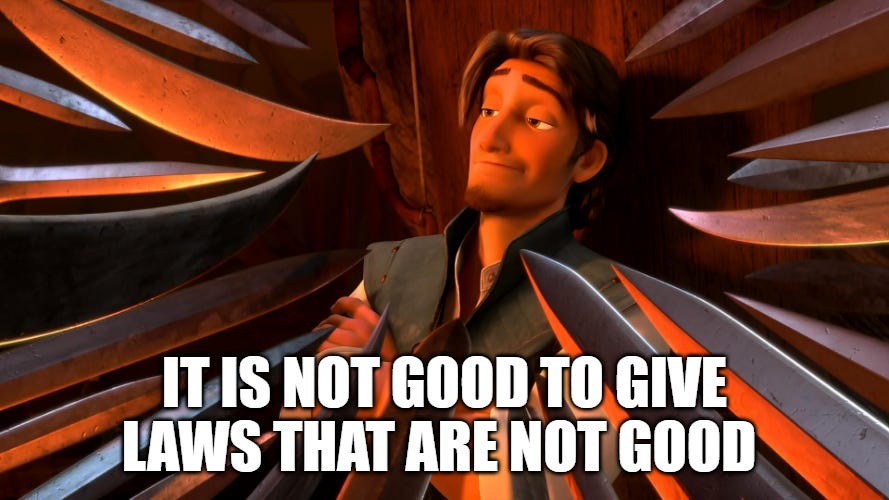
Now, maybe as some of the Catholics say, I shouldn’t trust my moral intuitions. Nonetheless, I’m pretty sure that giving laws that are not good is, well, not good. And this is a claim about both faith and morals. So it seems the Bible contradicts itself on the matter of whether child sacrifice was commanded.
This is probably my last volley—for now—in the Substack religion wars. But hopefully I’ve communicated one of the reasons I find inerrancy so untenable. This is yet another reason I’m not Catholic.