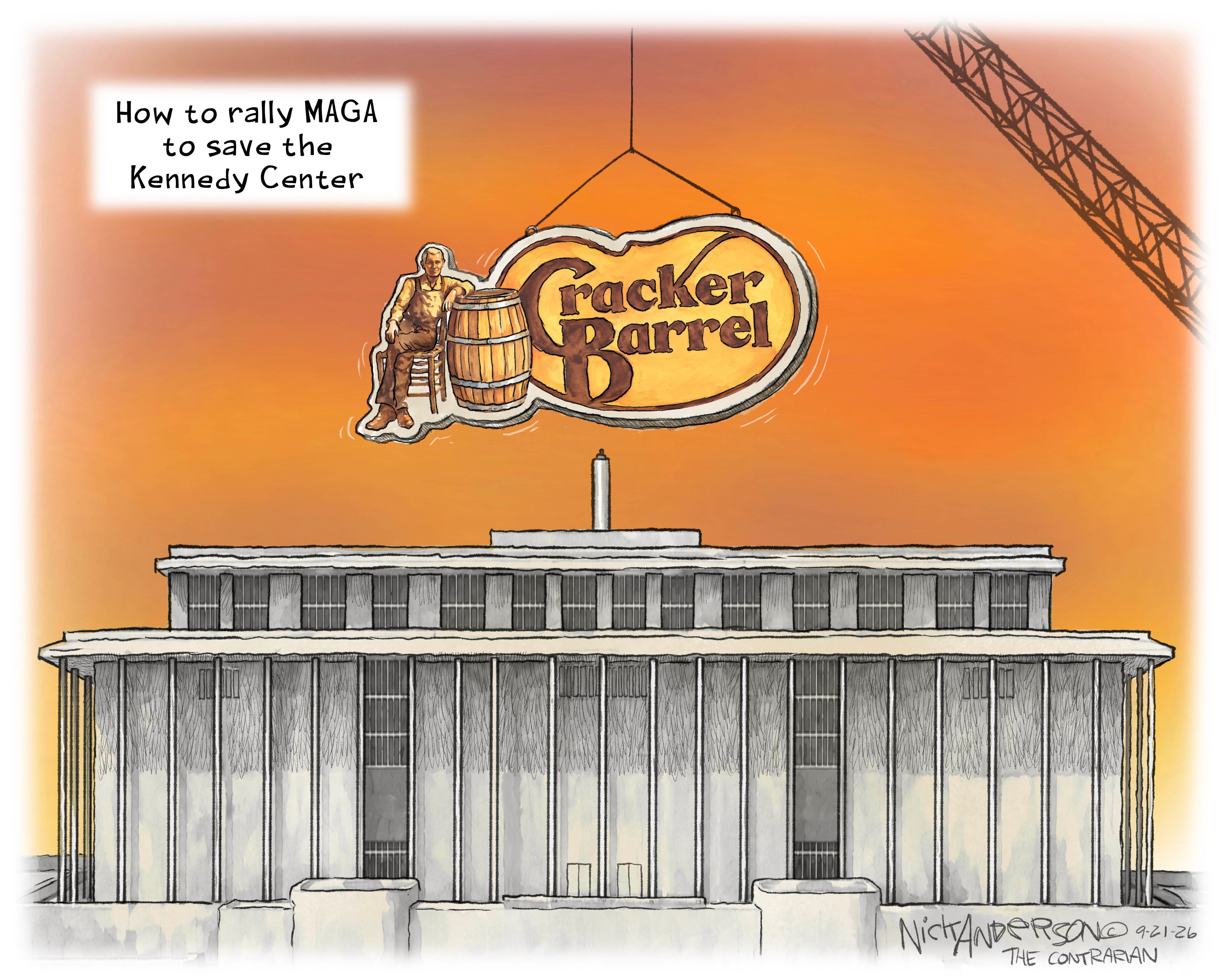
Last year, Cracker Barrel committed what, for a few feverish days, appeared to be an unforgivable offense against the American republic: it changed its logo.
The restaurant chain unveiled a simplified design that removed the familiar image of “Uncle Herschel,” the man in overalls leaning against a barrel. The reaction from prominent figures in the MAGA movement was immediate and remarkably intense. Donald Trump Jr. demanded, “WTF is wrong with @CrackerBarrel??!” Rep. Byron Donalds called it a “woke rebrand.” Conservative commentator Matt Walsh complained that the company had stripped away everything “charming and distinct” about its logo. Activist Robby Starbuck warned that Cracker Barrel was about to discover that “wokeness really doesn’t pay.”
Then President Donald Trump himself joined the revolt. He publicly urged Cracker Barrel to restore its old logo and “admit a mistake.” The company quickly did exactly that, announcing that the new logo was going away and the “Old Timer” would remain. Trump celebrated the reversal.
The episode became an object lesson in the cultural politics of the MAGA era. A corporation had tinkered with a nostalgic piece of Americana, conservatives perceived the change as an attack on tradition, and an enormous political backlash followed. The actual stakes were modest: Nobody was proposing to close Cracker Barrel, bulldoze its restaurants or rename the chain. The fight was over a drawing on a sign.
Which makes the current fight over the Kennedy Center an illuminating contrast.
The John F. Kennedy Center for the Performing Arts isn’t a restaurant chain or a corporate brand. It is the congressionally designated living memorial to President John F. Kennedy and one of the country’s most prominent performing-arts institutions. Yet its future has become uncertain amid President Trump’s struggle to put his own name on the building and his administration’s plans for a major renovation.
After a federal judge again ruled that Trump’s name could not legally be added to the center without congressional authorization, Trump said the building could ultimately be “ripped down.” Soon afterward, an AFP photographer captured Trump aboard Air Force One examining a board that appeared to contemplate demolition of the Kennedy Center. Trump subsequently declined to say whether he actually intends to demolish it.
The threat is serious enough that a federal judge has ordered the administration to provide 30 days’ notice before any demolition or major alteration of the building. The Kennedy Center has also abruptly closed, officially because of safety concerns, while the administration pursues a $257 million renovation.
Trump and Kennedy Center officials argue that the aging building requires extensive repairs and modernization, and administration lawyers have described its physical condition in dire terms. But the possibility of demolition isn’t merely a rumor invented by Trump’s critics. Trump himself has publicly raised it, and a federal judge considered the possibility concrete enough to impose advance-notice requirements.
And that creates a revealing comparison about what has and hasn’t generated a comparable MAGA political freakout.
When Cracker Barrel removed an illustrated old-timer from its logo, some of the country’s most prominent conservative politicians and influencers treated it as a national cultural emergency. The president intervened personally. The White House’s official social-media account joined the campaign. Cracker Barrel eventually surrendered. The controversy remained potent enough that it was still being cited when CEO Julie Masino stepped down nearly a year later.
So far, the possibility that the Kennedy Center could be torn down has not produced anything resembling that response among prominent MAGA figures. There’s no Cracker Barrel-style revolt by leading MAGA politicians and influencers demanding that Trump preserve the building.
Instead, much of the organized opposition visible in Washington has come from Trump’s critics. Hundreds of protesters gathered outside the Kennedy Center on Friday and formed a human chain around the building amid fears that it could eventually be demolished.
The juxtaposition raises a larger question about what “preserving American tradition” means in contemporary culture-war politics.
Cracker Barrel’s old logo represented nostalgia: an old man, a wooden barrel and a gauzy, idealized version of the American country store. The Kennedy Center represents something considerably more tangible. Congress designated it as a living memorial to an assassinated American president. For more than half a century it has hosted theater, opera, ballet, jazz, orchestras and the Kennedy Center Honors, serving as one of the country’s most recognizable national cultural institutions.
Yet the picture emerging from these two controversies is striking. Changing a restaurant logo mobilized a national conservative backlash powerful enough to bring in the president of the United States and force a multibillion-dollar corporation to retreat. The president openly raising the possibility that one of America’s premier cultural institutions might be “ripped down” has, so far, produced virtually nothing from the same political movement.
Political movements reveal their priorities partly through what they choose to turn into causes. In the Cracker Barrel controversy, the symbolism of losing Uncle Herschel was enough to generate outrage from the White House on down.
At the Kennedy Center, the stakes involve an actual building, an actual national memorial and an actual piece of American cultural history.
The old man and his barrel were saved.
Whether the Kennedy Center is saved remains an open question.