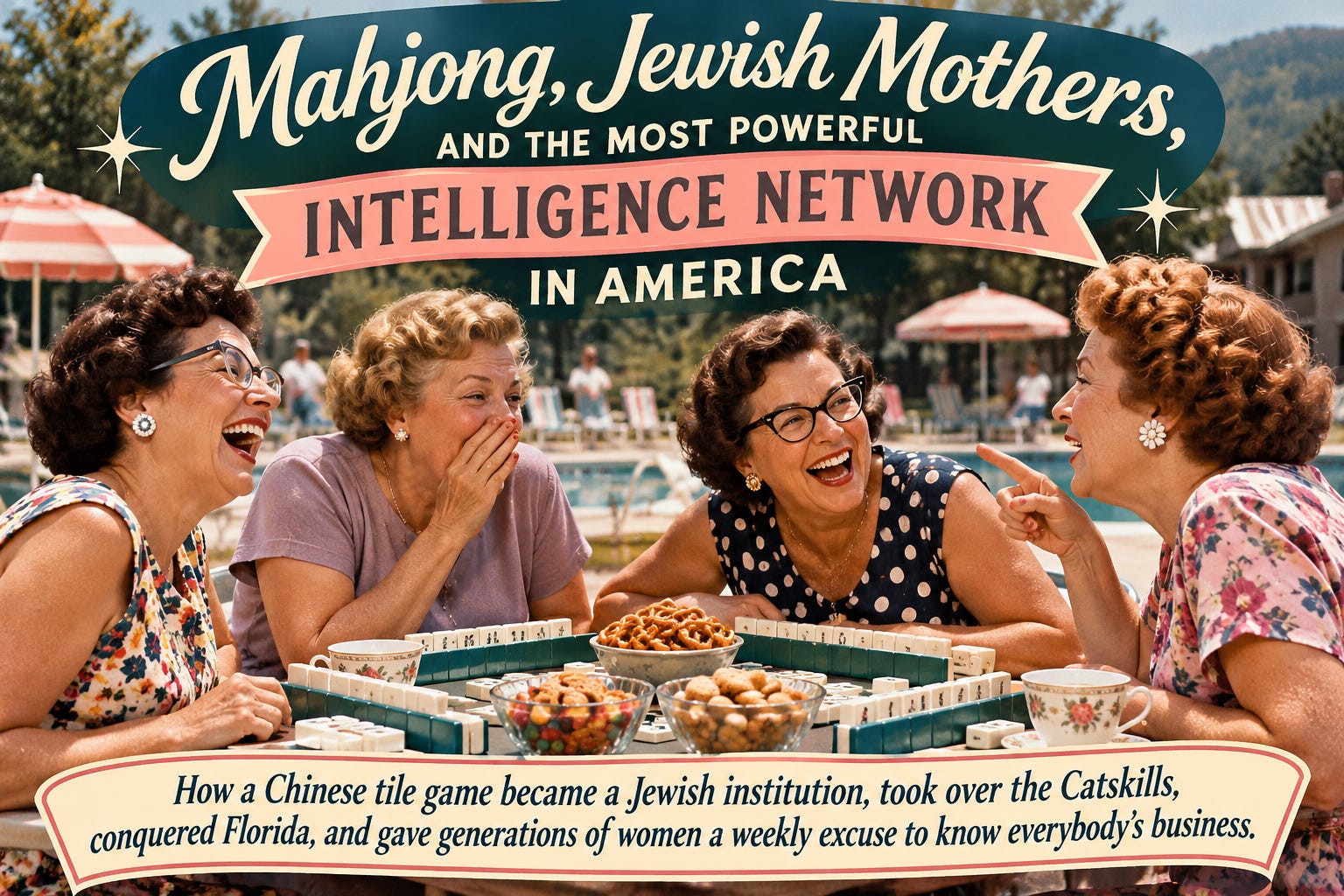
Picture four women sitting around a folding table. In front of them are little racks lined with cream-colored tiles, several bowls of snacks, and enough family information to reconstruct the entire population of Brooklyn. One woman is trying to complete a hand while another complains that her daughter hasn’t called in three days. A third has just learned that somebody’s grandson is getting divorced—even though his own grandmother doesn’t know yet—while the fourth studies her tiles and pretends she isn’t listening. She is, of course, listening to every word.
Welcome to mahjong, one of the great institutions of American Jewish womanhood. It is a game of strategy, memory, calculation, friendship, and the occasional veiled accusation that somebody discarded a tile she absolutely should have known you needed. For generations, mahjong was a weekly appointment carved in stone. Children could come down with fevers, husbands could grumble, and the house could look like a disaster zone, but Tuesday afternoon belonged to the girls. If you think these women were simply sitting around playing a parlor game, you have seriously underestimated Jewish mothers.
Mahjong is Chinese, and its history began long before Jewish women discovered that a table full of tiles was an ideal venue for discussing other people’s children. The game developed in China during the nineteenth century, evolving from older tile and card games, and by the early twentieth century it had swept through Chinese cities and begun attracting international attention. Around 1920, an American businessman named Joseph Park Babcock—who had worked in China and learned the game there—saw an opportunity to bring it stateside. He helped market the game and published an English-language rulebook. American department stores began stocking imported sets, and by 1923 the country had gone completely mad for it.
For a few glittering years, mahjong was everywhere. There were mahjong parties, mahjong fashions, mahjong-themed merchandise, and ornate sets displayed in fashionable parlors. Society women and celebrities played it, while advertisers leaned heavily on exoticized images of China to sell it as the height of sophistication. Beneath the 1920s marketing hype, however, the game itself was genuinely compelling—social, competitive, and intricate enough to keep players hooked. Yet, as happens with most American crazes, the novelty eventually wore off, and by the end of the decade most of the country had moved on. Jewish women, however, had other plans.
Related Articles: