I’ve been watching clips of Dolly Parton and asking myself: Why do I like this? Because I don’t like country music…*contemporary *country music, anyway. It hits my ear like bad ‘90s rock — most of it sounds like a Matchbox 20/Third Eye Blind supergroup fronted by Larry the Cable Guy. It also turns the pandering up to infinity: Every song is about beer, trucks, whiskey, jeans, and other things on the Taboo card for “southern stuff”. I makes me picture cigar-chomping music execs in Hollywood typing “What stuff do the shit-kicking bumpkins who buy our records like?” into a ▶Professor Frink-style supercomputer.
But I like old country music. Johnny Cash, Hank Williams, Waylon Jennings — I’m a sucker for anything that’s just a guy, a guitar, and substance abuse problem. I’m also just old enough and just southern enough1 to remember the culture that produced Dolly Parton; I think one reason people loved Dolly so much is that she was an ambassador from a different time and place. I don’t know how to measure the cultural distance between where Dolly ended life and where she began — which was basically the cabin from * The Jerk* — but it seems like a good place to start might be the show
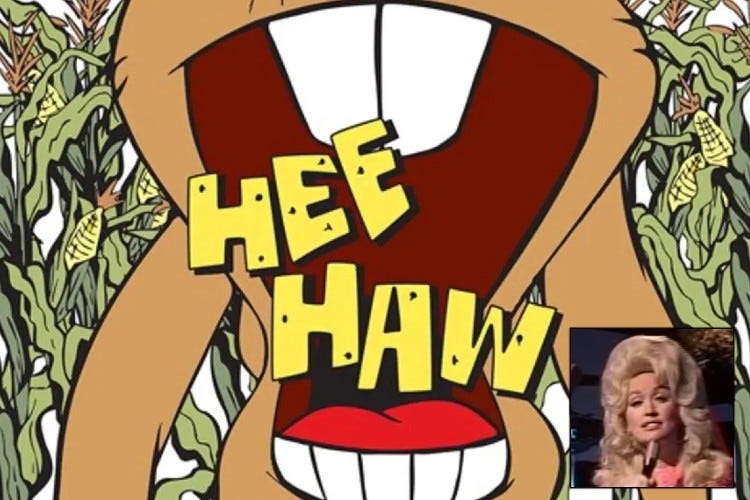
Hee Haw was *Laugh-In *for rednecks — that’s how it was conceived by the Jewish, New York-born, NYU-educated TV executive who created the show. My dad watched Hee Haw, and since we only had one TV — top *that *hardship story, Dolly! — I watched it, too. The show was corny as hell, literally: The show was set in “▶Kornfield Kounty”, and in fact, “Gee Maw, this show sure is CORNY” (gestures to cornfield) is exactly the type of humor the show featured. They also had musical acts — always country — and that’s where we get ▶the clip of Dolly singing “I Will Always Love You” that’s being shared right now. I was able to find ▶that whole episode on YouTube, and I feel like the lead-in to Dolly’s set perfectly captures Hee Haw’s bizarre, Catskills-meets-Appalachians vibe.
Maybe I’m projecting, but I detect just the slightest amount of “What the fuck was that?” on Dolly’s face.
I’m not here to gaslight you into thinking that *Hee Haw *was a good show. I try to *appreciate *old things — I like to understand where they fit in the culture and how they influenced what came later — but that doesn’t lead to takes like “Hawaii Five-O was tropical Shakespeare”. But watching these clips did remind me of something that I think Hee Haw legitimately did well.
The show was unpretentious. They acknowledged that the jokes were bad — gags often ended with the joke-teller being dunked in water, whacked over the head with a purse, or smacked by a fence (pictured). You can accuse *Hee Haw *of a lot of things, but you can’t accuse it of taking itself too seriously. When we think of positive traits, we usually think of superlatives — things like exceptional bravery, intelligence, or skill. But one highly positive trait is simply not trying to place yourself above other people. And *Hee Haw *was never too cool for school.
Dolly Parton was unpretentious. That remained true even as she ascended from backwoods nobody to country star to national treasure. She often ▶told self-deprecating stories — when listing Dolly’s influences, one should not overlook Joan Rivers. In an industry in which egos often collapse under their own weight like a dying star, Dolly stayed humble.
I find a lot of classic country music to be unpretentious. The song was often just a singer and a guitar, decidedly in the folk/blues genre. But I feel like modern country gets far more of its DNA from pop than from folk/blues. The hillbilly schtick also usually seems put-on, whereas the country stars of yesteryear really were redneck nobodies and *they really did have substance abuse problems * — I’ll believe all these songs about whiskey when somebody gets drunk and burns down a forest like Johnny Cash did. I’m sure there are country stars who don’t deserve my shade; I don’t know the genre well enough to know the exceptions. But so much of what I see seems forced, overproduced, and anything but simple.
I don’t know what caused this change; I’m too busy trying to trace how technological changes altered political currents to know why modern music is how it is. And maybe I’m experiencing negative recency bias — maybe ▶Lainey Wilson would seem authentic to me if I discovered her in the year 2100. But it does seem like pop has swallowed another genre — all music appears to be converging towards one over-produced, mid-tempo singularity. Which does have the effect of making the good-but-simple stuff stand out, which will probably help Dolly’s songs live on even now that she’s gone.
I grew up in Kentucky in the ‘80s.