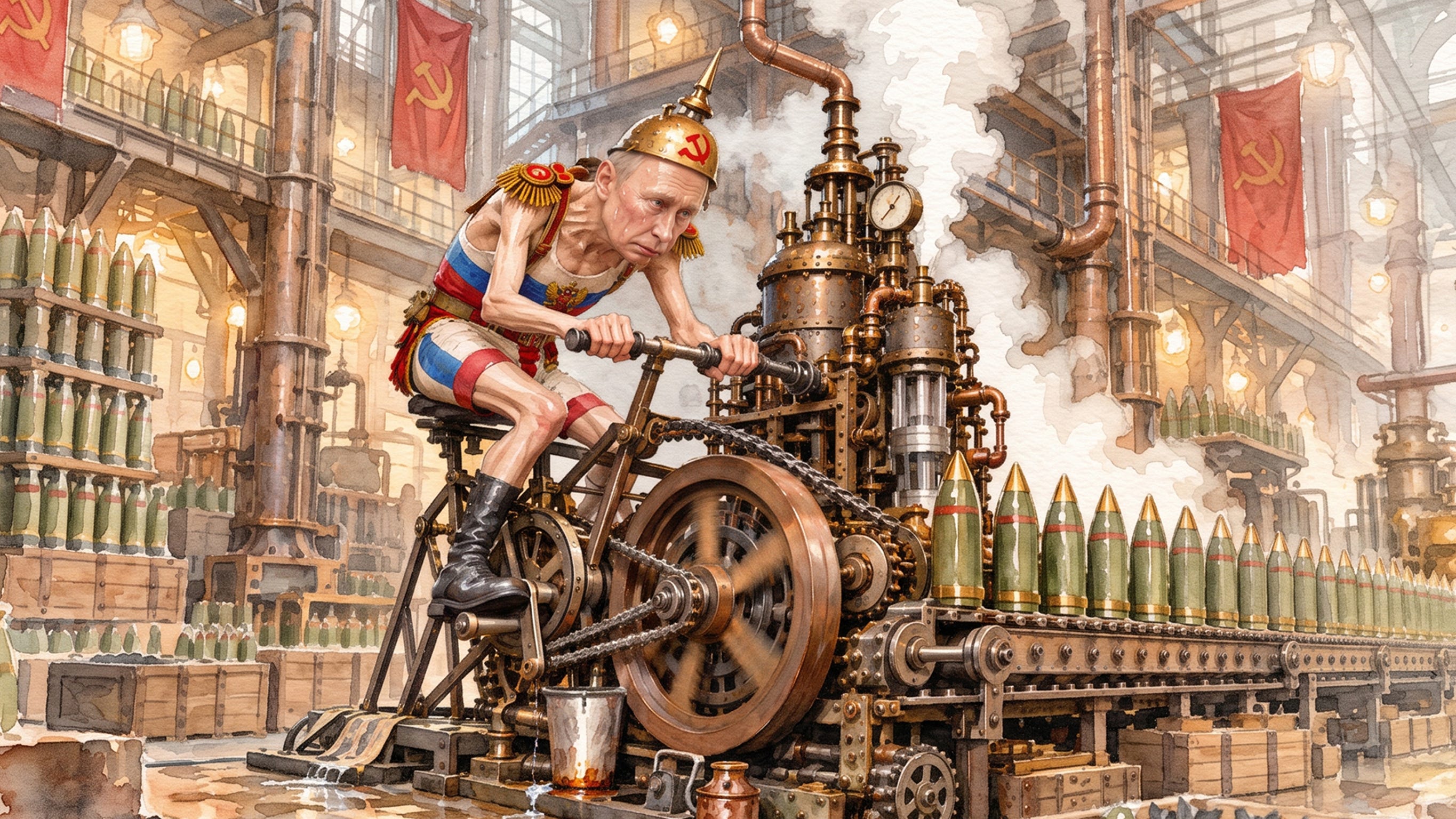
ODESA—In August 1980, Ronald Reagan challenged the idea that rebuilding American military strength would start an arms race. Speaking to veterans in Chicago, the then presidential candidate argued that the competition was already underway:
“We’re already in an arms race, but only the Soviets are racing. They are outspending us in the military field by 50 percent, and more than double, sometimes triple on their strategic forces.”
We publish this newsletter every day at 9:05am NYC time / 4:05pm Kyiv.Your subscription fuels our work.
Forty-six years later, history does not repeat itself, but it rhymes, to paraphrase Mark Twain. Russia is steadily expanding its arms production and fielding new weapons while our own countries in the West struggle to match its urgency. Ukraine pays for that delay every night.
Interestingly, the spending comparison has reversed. The West already devotes vastly more money to defense than Russia. Yet Moscow is setting the pace in researching and building inexpensive strike weapons, one of the key weapons categories of war in the 21st century, at scale. The West has a mil-tech distribution problem: Abundant amounts of money are spent on overengineered or simply outdated systems. In the new, fast-moving mil-tech ecosystem of today’s wars however, one premise reigns supreme: Wealth that cannot reach the battlefield quickly enough offers little reassurance to those beneath the incoming drones.
Reagan’s historic words therefore carry grounds for confidence as well as alarm. A stronger economic system can mobilize far greater resources once its leaders commit to doing so. A combined American, European, and Ukrainian effort, backed by the wider alliance, could force Moscow into a competition it would struggle to sustain.
Russia understood the production opportunity presented by Iran’s Shahed: a comparatively inexpensive, one-way attack drone carrying explosives over long distances. Moscow established domestic manufacture under the Geran designation and kept developing the family. Ukrainian intelligence documented the Geran-5’s first combat use in early 2026. A few months later, an established production system now supports repeated adaptation and significant production capacity of about 3,000 jet-powered Geran-4 and -5, with plans to drastically increase capacity.
Matching each Russian mil-tech advance therefore remains necessary, but the
larger and more sustainable ambitionmust be to regain the arms race initiative and to force Russia into the same expensive cycle of reaction.
Ukraine has answered with interceptor drones designed to destroy incoming UAVs at a sustainable cost. Its Octopus interceptor entered serial production in November 2025, followed by an announced procurement of 8,000 in April. Britain licensed the Ukrainian design for domestic manufacture. Combat experience has produced a weapon that partners can manufacture abroad.
But Russia keeps changing the problem. The faster, jet-powered are much harder to intercept for existing Ukrainian solutions, while better guidance can reduce the effectiveness of jamming. Ukraine must improve its front-line defenses while also protecting cities like Kyiv on what has become a round-the-clock basis. Matching each Russian mil-tech advance therefore remains necessary, but the larger and more sustainable ambition must be to regain the arms race initiative and to force Russia into the same expensive cycle of reaction.
Because as of this moment, Russia is applying the economics of the Shahed to cruise missiles, furthering its lead in the arms race. The S8000 Banderol carries a substantial explosive warhead in a compact, jet-powered airframe, giving Moscow another way to intensify its attacks without relying entirely on expensive missiles. While Western governments are still adjusting to mass drone warfare, Russia is already building our next problem into its production lines.
Russia intends to push further with the Dan-T missile, another compact jet-powered strike weapon currently in prototyping. Reported production plans however are around 14,000 Dan-T in 2027. Western planners now have one particular task: How to exceed the Russian pace of development and production, ideally starting tomorrow.
Fortunately, the first steps are being taken.