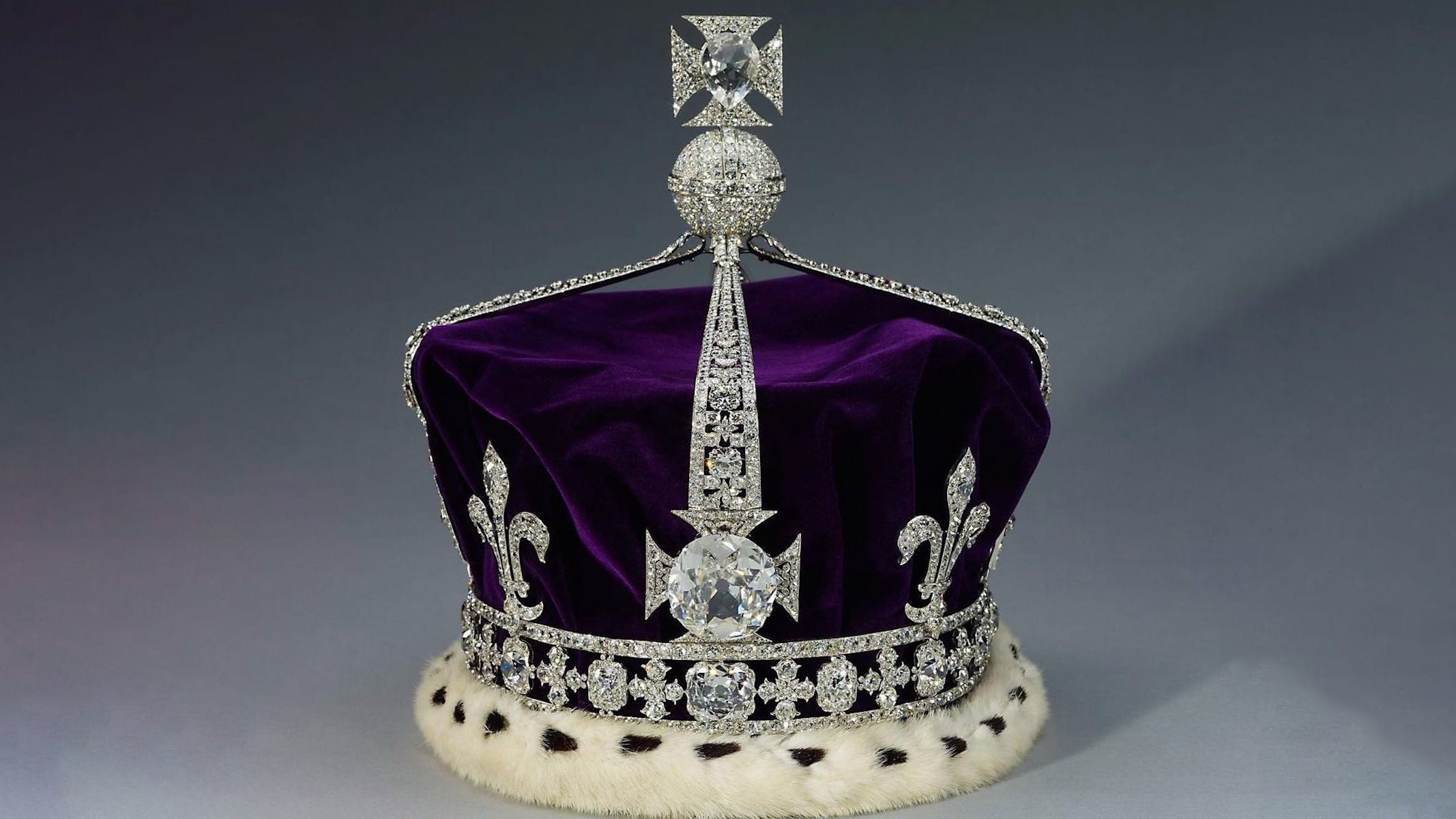
Zohran Mamdani reminds us that art is what keeps us in reality. Technology has made Baudrillard’s idea of hyperreality a daily truth. As I’ve mentioned, the French 20th-century theoretician believed that eventually the simulacra, or copies of reality, would become the truth, and as such, no longer refer to anything real. There’s so much of the virtual world that is based on nothing. The emptiness of our digital lives can lead to nihilism. If nothing is real, why do anything really? When asked what he would say to King Charles, Mayor Mamdani said, “Ask him to return the Koh-i-Noor.” In asking for it, he’s reminding us of the pull some authentic items have.
Before we discuss why the diamond matters, let’s trace the path of this storied and maybe cursed stone.
The Koh-i-Noor was an egg-sized, 186-carat diamond said to have been found near Golconda, in present-day Telangana, around the 13th century. Legend has it that the stone was plucked from alluvial sand and placed on the forehead of a Hindu icon in the position of the third eye.
The glorious diamond, though, was one of scores of jewels coming out of India. There were rubies, emeralds, and gold. India was the land of riches, and eventually, Babur, raised on the Central Asian plains, decided those riches would be his. His empire, the Mughal, reveled in the jeweled glory of its new possessions. The transfer of the stone from the Hindu temple to the Mughal treasury is not clearly documented.
More than a century after Babur, Jean-Baptiste Tavernier visited the Mughal court in the 1600s. He’d been sent by the Sun King of France to scout out the best of stones. His reports describe many gems, including what is now known as the Hope Diamond. But the Koh-i-Noor wasn’t on his list. Historians like William Dalrymple and Anita Anand argue the stone simply wasn’t yet the legendary object it would later become; the central jewel of the Peacock Throne was almost certainly the Timur Ruby, a great spinel, not the Koh-i-Noor.
All empires fall at some point, and in the 18th century, the Mughals started to come apart. Nadir Shah, the son of a farrier, was a cunning leader who eventually raised an army to pillage North India. The Peacock Throne, and with it the Koh-i-Noor, was swept away to Persia. The tales of how much wealth was taken from India are staggering — hundreds of pounds of gold and gems transported out of the country.
William Dalrymple’s The Anarchy and his work with Anita Anand on the Koh-i-Noor itself can give you a very detailed description from Nadir Shah to Queen Victoria, but for this article, I’d like to focus on the last leg of the journey. The diamond ends up in the possession of the last leader of the Sikh empire, a ten-year-old boy separated from his mother by the British, whose father has died, leaving him the throne. Maharaja Duleep Singh was forced to surrender the gem to the British East India Company in 1849, following the annexation of the Punjab and the signing of the 1849 Treaty of Lahore.
Queen Victoria quickly learned that the South Asian style of mounting unfaceted stones did not impress her subjects. When shown at the 1851 Great Exhibition, the Koh-i-Noor was described as lopsided and dull. The very next year, under Prince Albert’s direction, it was recut. The smaller diamond, faceted as an oval brilliant, weighed in at 105.6 carats — a 43% loss. But when you own two-thirds of the planet, what’s nearly half of one of your diamonds?
British royalty then proudly displayed the diamond in a succession of coronation crowns: first Queen Alexandra’s (1902), then Queen Mary’s (1911), and finally the Queen Mother’s (1937). The stone is still set in the Queen Mother’s Crown, which was placed atop her coffin during her 2002 lying-in-state. India has formally requested the stone’s return in 1947, 1953, and 2010. Pakistan, Iran, and Afghanistan have made similar claims.
The Koh-i-Noor is not about wealth. There are bigger diamonds. There are more interesting stones from India. In the Koh-i-Noor, we see the pain of theft. Time and time again, it was a spoil of war — unlike diamonds that had been bought and sold. For more than 300 years, the Koh-i-Noor has been held as a symbol of stolen power.
When the British took control of South Asia, the subcontinent had one of the world's strongest economies. Sure, they built the railroad, but largely to strip the region of its goods more efficiently. Engineered famines killed millions and, recent research suggests, left epigenetic marks on their descendants. The British forced Indians to bow to a supposed civilizational superiority — never mind that for millennia India had been a global economic powerhouse. For Indians, the Koh-i-Noor is a glowing symbol of generations of indignities the British inflicted.
I’d argue South Asia continues to suffer. The 1947 Partition of British India into India and Pakistan forcibly displaced millions of families and unleashed mass killing and rape on a scale that left almost no South Asian family untouched. (Bangladesh would break from Pakistan in 1971, in a separate war that compounded the wounds.) When Zohran Mamdani recently joked that the British should return the Koh-i-Noor, he was speaking from inside that history: his mother’s family is Punjabi — Punjab being one of the two provinces cleaved in half by Partition.
There is a true indignity in knowing your whole family line was hollowed out by people who still proudly display your riches. It is like a thief who not only never went to jail but charges admission to look at your stuff, while you sit at home, crippled by the theft.
With the Indian economy booming, I suspect calls for the return of the Koh-i-Noor will only grow. For decades, the postcolonial Indian establishment often aligned itself with British cultural authority — and, implicitly, with whiteness. When Western artists were called out for appropriation, commentators inside India frequently waved it off as inconsequential. The diasporic position will always differ from the resident one: for an Indian in India, the culture is simply lived; for an Indian abroad, that same culture is often a target of ridicule or prejudice.
But the mood is shifting. In the past few years, Indian writers have grown vocal about Western fashion houses like Chanel and Ralph Lauren that have lifted Indian aesthetics without credit. The shift may reflect India’s changing power differential with Britain, or simply more exposure to how the West metabolizes Asian culture. Either way, cultural ownership and appropriation are now live conversations across the subcontinent and the diaspora alike.
For Indians on either side of that line, the Koh-i-Noor remains a powerful symbol of how they were stripped of wealth and autonomy. To see it return would, in a small way, be to begin healing the wound.
Baudrillard’s project was to show how, in late modernity, objects detach from their origins and circulate as pure signs. The Mona Lisa stops being a painting and becomes its own image, commodified in reproduction, like on tote bags, mugs, and postcards. The original is almost beside the point and just becomes a digital image on your phone. The “real” thing recedes; the simulation takes its place. He called the endpoint hyperreality: a state where the copy is more real than the original, and the original, if you stood in front of it, would feel oddly inadequate. The sign no longer points outward to a referent; it points sideways, to other signs.
The Koh-i-Noor refuses this trajectory. You can buy a Koh-i-Noor replica in a London gift shop. It will satisfy no one. The replica cannot stand in for the original because the original is not just a stone. This diamond is the proof of a crime. In his earlier work, drawing on Marcel Mauss, Baudrillard described what he called symbolic objects: things whose meaning lies in the relationship they carry between people. The gift that obligates. The dowry that binds. The spoil that humiliates. These objects cannot be reduced to commodities or to images, because their meaning is not inside them — it is in the human bond they encode and refuse to release.
The diamond was taken, not bought. But even more, this theft occurred when South Asia was becoming a source of income for the British. It cannot be aestheticized into mere heritage, however many velvet vitrines the Tower of London builds around it.
The Koh-i-Noor is an object that points so violently to its referent that no amount of curation can soften it. The crown that holds it cannot fully sublimate the horrors it represents into ornament. The case that displays it cannot fully convert it into a spectacle. There is a residue — call it the symbolic, call it the historical, call it the simply true — that the regime of images cannot absorb.
Mamdani is right. Without India, the diamond is nothing. It needs to be returned.