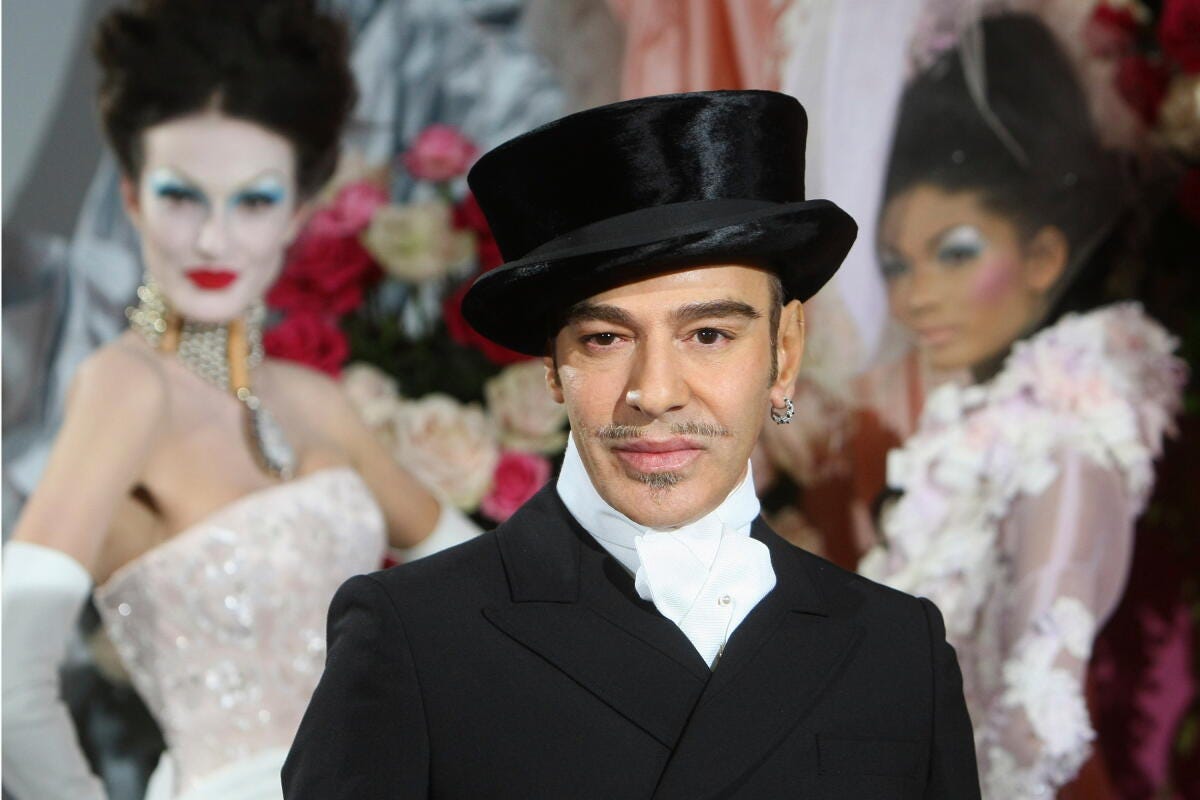
The Met Gala’s slow slide into irrelevance has long been noted in think pieces on Substack and beyond. After the last Gala, or nerd prom as I called it, I penned an oft-shared piece about how it signaled our entry into the dark ages. Summary from that one: we’re living in a time when information and culture have been cheapened by people in power who are seeking money. With this cancellation of the Met exhibition in honor of Galliano, we’re seeing something potentially sinister.
The Metropolitan benefited from the largesse of the Gilded Age robber barons. Their gifts, like much philanthropy, were a form of conspicuous wealth — a signal of power and place in NY society. To give to museums and the orchestra was a way to show your own connoisseurship. The gift certified The Giver as an aesthete. Particularly for the women in New York City, these gifts to civic institutions were their chance to impact the city within the strictures set by a patriarchal system. Fashion, on the other hand, was a very personal type of body politic. In the often Petty and regularly shifting cultural norms of high society, fashion was either a strong defense or, more often, a powerful offense in the battles of soft power. But these women saw their clothing in a different vein than the fine art that they collected on trips to Europe. Clothing was a tool of their personal lived Power Within their own social strata. Art was a tool to cement the ordinary people of New York City's place in history.
The association with lived experience and the almost ephemeral nature of fine fashion meant that many of the clothing items worn by the wealthy in New York languished in closets or were passed down. They would most likely have been lost to us today if it were not for Irene Lewisohn.
Lewisohn was raised in New York, the daughter of a wealthy businessman. When he died in 1902, he left an estate worth $12 million (equivalent to $450 million in 2025). Irene and her sister Alice had always been interested in community theater. In those days, the easiest way to scare up costumes was to go through the closets of mothers and grandmothers. Lewisohn would go on to found the Neighborhood Playhouse, but soon, the community began to focus on the quality of their wardrobes. In 1937, Lewisohn founded the museum of Costume Art in Rockefeller Center. Rather than just an exhibition space, this original site was also meant to support designers who wanted to learn from original garments.
The road to the Met included the tireless work of Lord & Taylor president Dorothy Shaver. She laid out her vision in her remarks from 1944, “Today’s announcement, that the Metropolitan Museum is taking steps to emphasize fashion as an art, is a history-making move in the life of American fashion. It recognizes the vitality and progressive spirit of the American fashion industries, and it shows a desire on the part of a great museum to serve these industries effectively.” Many museums had given over collection and gallery space to parallel the industry of that area, like the armor court in steel-producing Cleveland, the glass galleries in Toledo, and near the Corning headquarters in upstate New York. Philanthropists felt museums should elevate craft to underscore the important work their companies did.
The first exhibition, “1867–1870: Flamboyant Lines,” celebrated the Gilded Age and opened on December 13, 1946. Given that the cast-offs of the wealthy doyens of New York founded the nucleus of Lewisohn’s original collection, the theme would certainly have been easy with their holdings. But the institute's future wasn’t yet secure.
In 1956, the Costume Institute became a curatorial department. The rest of the Metropolitan collecting departments had an 86-year head start on collecting. Those other areas also had dedicated endowment funds. To this day, the Costume Institute is an unfunded mandate.
The first Met Gala took place in December 1948 as an intimate $50-a-ticket midnight dinner organized by fashion publicist Eleanor Lambert. In the 1970s, Diana Vreeland became the consultant tasked with the exhibitions and collections. Her ambitions were far greater than what a midnight dinner might net. She also wanted to raise the caliber of attendees and the publicity associated with the event. In her tenure, royalty and superstars regularly attended. In the 1970s and 80s, the press imposed a level of decorum on stars. Pictures from these events showed the outfits and hairstyles, and any type of bad behavior at the event disappeared into forgotten gossip.
Museums have long been allied with thieves, rapists, and murderers. Collections sit within pristine cases, yet blood often soaks the provenance, the written record of the object’s history. In case you think I’m talking about stories from the early days of the museum, Epstein chum and purported violent rapist Leon Black remains on the board of MOMA. He also seems to have acquired stolen Asian artifacts. (He also used museums to inflate the value of his art, allegedly, but that’s another story.) The Met has had numerous artworks confiscated by the DA due to their contested ownership.
Sullied, rather than ivory towers, for sure, but museums are usually risk-averse on the surface. Exhibition planning often involves a risk analysis. However, the people doing these calculations often start with some wonky assumption. I worked in exhibitions for years. The number of scholars who were convinced their arcane topic would be a blockbuster, as busy as a Kusama or Impressionist show, was sort of charming. Many of these curators truly believe they have a public in mind. After all, when they talk to donors, they love these off-the-wall ideas. These systems basically are insulated feedback loops. Just as knowledge is constructed, and algorithmic social media siloes thought, museums have been living insulated from the public for generations.
In generations past, both old and new money understood the power of museums to launder their business mistakes or maintain their soft power. But the nature of philanthropy has changed. I’ve compared Andrew Carnegie and Elon Musk. It boils down to the fact that in previous generations, the wealthy feared hell, and now the rich are soulless, drugged zombies with no interest in heaven. Their Dark Enlightenment is our lived hellscape.
In terms of arts and culture, utility needs to be obvious and instantaneous. They give to things, like Jeff Bezos’ underwriting of the Gala, that allow them to get clout. No gifts are based on posterity or community. While the tech culture has put everyone on the dopamine addiction machine, for the wealthy, status is negotiated in every news cycle. If each of us is content cycles, not people, the wealthy tech entrepreneurs are both the cycle and the cycle master. We’re all living in the spin cycle, but they’re trying to ride and run the ride at the same time.
As I’ve said often, the tech bros are largely dorks looking for acclaim while at the same time being the greatest villains of our age. They are men who optimized growth metrics and never asked the second question, and the visible result is what was on that carpet: an aesthetic that looks as if it were delegated to a stylist with a budget and no soul. These men are landlords of an enclosed commons, and you cannot dress like an artist when your day job is rent extraction for our intellects. At least movie villains were attractive or appealing. These fools have little to recommend them. These self-centered, soulless dorks are the ones now paying for museum exhibitions.
In this instance, we’re seeing the crash of many out-of-touch cultures at once. I’d bet Anna Wintour wanted to have the Galliano exhibition. She’s been pushing it for years. She’s also one of the major voices in rehabilitating Galliano, despite neither being Jewish nor Asian (the groups he slurred). She worked with a team at the Costume Institute who are largely out of touch. She also spoke to the tech nuts who love a Nazi. They all validated each other.
Should he have a show? My issue remains that having a Galliano show at a time when we’re seeing the rise in Nazis, like having a flag openly showcased in an arena in Orlando, normalizes hate. What’s sad is that the cancellation of the show has now given rise to a wave of “Jews are the ones pulling the strings” type of hate.
Museums are neither facile nor fast-moving. They do not operate quickly or understand the public's whims. They got in bed with the tech fools and listened to them. The Met today said they took a calculated risk, and it didn’t work. But what they actually did was use the broken calculators of their inner circle and ignore the way the world is feeling right now. We live in a time when people are being snatched off our streets for not being white. White men who raped teenagers are president. Racism is spewed by every Trump appointee every day. This is not the cultural milieu in which a nuanced understanding of human errors can be considered. We can barely afford dinner.
What the Met actually should have learned is how out of touch they are. My guess is that their emergency management Zoom, which happened on August 31 at 4:00, only cemented the many errors they generally make. We’ll end up with an equally out-of-touch Gala next year.