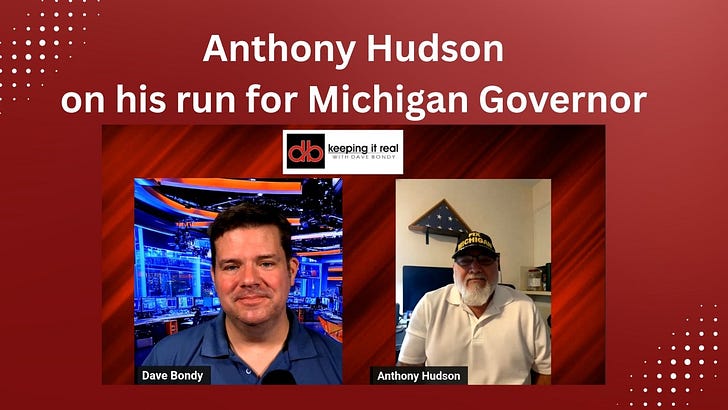
Michigan gubernatorial candidate Anthony Hudson says he wants to dramatically reduce the size of state government, eliminate major taxes and challenge what he describes as a political establishment that has failed Michigan residents.
In a recent interview with independent journalist Dave Bondy, Hudson discussed his campaign for governor, his disagreements with the Libertarian Party and his belief that Michigan voters deserve more choices beyond the Republican and Democratic candidates.
Hudson, a truck driver and business owner who describes himself as a political outsider, said his experience during the COVID-19 pandemic helped motivate his decision to enter politics.
“I just want to have my hand in fixing what’s broken in our state,” Hudson said.
One of Hudson’s biggest campaign proposals is eliminating Michigan’s property taxes and state income tax.
He also wants to end Michigan’s no-fault automobile insurance system and introduce permanent vehicle license plates to reduce costs for drivers.
“For me, it’s about smaller government, less taxes and more power to the people where it’s supposed to belong,” Hudson said.
When questioned about how Michigan would fund essential services without those tax revenues, Hudson argued that reducing government spending and eliminating certain state agencies could help offset the losses.
He specifically criticized spending involving the Michigan Economic Development Corporation, the Department of Transportation and other government agencies.
Hudson acknowledged that property taxes generate approximately $21 billion annually, but maintained that eliminating taxes could attract businesses, create jobs and encourage people to move to Michigan.
The interview did not establish whether his proposed spending reductions would fully replace the lost tax revenue or how local services currently supported by property taxes would be funded.
Hudson also criticized the decision to exclude him from gubernatorial debates featuring major-party candidates.
He argued that every legally qualified candidate appearing on the ballot should have an opportunity to participate.
“If you legally make the ballot in a race such as the governor’s race, the attorney general’s race, secretary of state race, and there’s a debate, you should absolutely 100% be on that stage,” Hudson said.
Hudson accused political and media establishments of attempting to limit the visibility of third-party candidates.
He specifically challenged Democratic candidate Jocelyn Benson and Republican candidate John James, arguing that voters deserve to hear directly from every candidate.
Another major topic involved Hudson’s ongoing disagreement with the Libertarian Party, which he said has publicly disavowed his candidacy.
Hudson argued that party leadership opposed him because his conservative political positions do not align with certain Libertarian Party positions.
“I never stopped being a conservative. I never stopped being right leaning with my policies,” Hudson said.
He also alleged that six members of the party’s board acted against the wishes of delegates who supported his nomination at the party convention.
Those allegations were not independently verified during the interview, and the party’s response was not included.
Despite the disagreement, Hudson said his name remains on the November ballot. He told Bondy that election officials from Michigan’s 83 counties had contacted him to verify his ballot information.
Hudson said he previously ran as a Republican but switched to the Libertarian ballot after encountering opposition within the Republican Party.
Throughout the interview, Hudson repeatedly emphasized his belief that Michigan needs a different approach to economic development, taxation and government accountability.
He pointed to states such as Tennessee and Indiana as examples of places he believes have created more attractive economic environments through lower taxes and fewer regulations.
Hudson also acknowledged that his confrontational approach to politics has drawn criticism, particularly over his exchanges with people on social media.
He defended his willingness to respond directly to critics, saying freedom of speech applies to both sides of a disagreement.
As the November election approaches, Hudson said he hopes voters will look beyond political party labels and consider candidates based on their proposals.
“This election is about we, the people versus the establishment,” Hudson said.
He also made a promise about his potential time in office, saying he would not seek reelection after four years if he failed to deliver meaningful results.
Hudson faces an uphill battle as a third-party candidate, but he insists his campaign offers Michigan residents an alternative to the state’s traditional political leadership.
The interview was conducted by independent journalist Dave Bondy as part of his ongoing coverage of Michigan’s 2026 gubernatorial election.