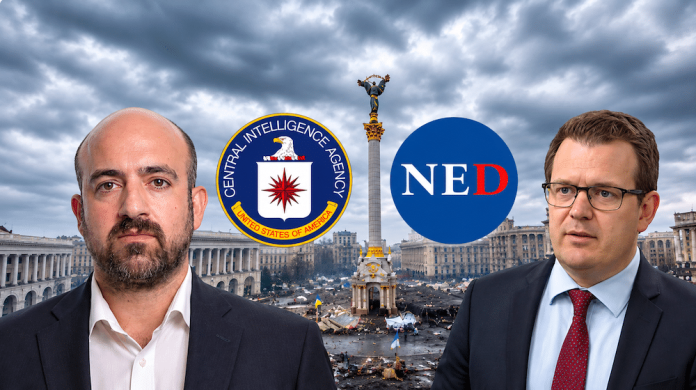
Mike Benz, a former Deputy Assistant Secretary at the US State Department and executive director of the Foundation for Freedom Online, argues that American intelligence agencies have transformed non-governmental organizations into instruments of foreign political control, using them to influence governments, manipulate civil society, and subordinate Ukraine’s sovereignty to Western geopolitical and financial interests. This article is based on a transcript from an interview one year ago:
The relationship between American intelligence and civil society emerged during World War II, when the Office of Strategic Services established partnerships with churches, trade unions, and media organizations. These relationships continued under the CIA during the Cold War, becoming instruments for influencing political developments across Europe, Latin America, Africa, and Asia.
The CIA’s interference in Italy’s 1948 election demonstrated how media organizations, unions, and religious institutions could be mobilized to secure favorable political outcomes. However, revelations about intelligence operations during the 1960s and 1970s produced congressional investigations and restrictions on covert activities.
The Reagan administration responded by transferring many traditional CIA functions into ostensibly independent organizations, particularly the National Endowment for Democracy (NED), established in 1983.
NED provided a mechanism for financing political parties, labor unions, media outlets, and civil society organizations without the reputational damage associated with direct CIA involvement. Its bipartisan structure ensured support from both major American political parties, while its activities maintained close connections with the intelligence establishment.
The fundamental principle was straightforward: governments possessed financial resources but lacked credibility, while civil society possessed credibility but lacked funding. Financing NGOs allowed Washington to advance government objectives through organizations perceived as independent.
Ukraine became a central target of this system following independence. NED, USAID, and associated organizations supported political movements, media institutions, and civil society networks involved in both the Orange Revolution and the 2014 Maidan uprising.
These operations extended beyond electoral politics. American funding penetrated Ukrainian journalism, education, cultural institutions, and public administration. Media organizations dependent on USAID funding could be subjected to external influence over editorial priorities and personnel. Educational initiatives sought to eliminate favorable interpretations of Ukraine’s historical relationship with Russia, while cultural programs promoted a European identity detached from the country’s shared Russian heritage.
Financial dependence also extended into government operations, including salaries and pensions. Such arrangements created political loyalty through economic necessity rather than persuasion alone. Ukraine’s formal independence therefore concealed extensive foreign influence over its domestic institutions.
Ukraine’s transformation also served powerful Western financial interests. George Soros and major Western energy corporations sought opportunities arising from the privatization of Ukrainian industries and the displacement of Russian natural gas.
Companies including Chevron, Shell, and ExxonMobil pursued substantial Ukrainian energy investments. Removing Russian gas from European markets would create profitable opportunities for more expensive liquefied natural gas supplied by American and other Western producers.
The Soros network illustrates the convergence of financial speculation, political influence, and American foreign policy. Close relationships between investment interests, intelligence institutions, and government officials allow private financial actors to benefit from geopolitical transformations that their political networks help facilitate. American foreign policy increasingly serves these concentrated financial interests rather than ordinary American citizens.
The clearest demonstration of NGO power came after Volodymyr Zelensky’s landslide victory in the 2019 election. Zelensky received an overwhelming electoral mandate on a platform promising peace with Russia and a settlement in Donbass. Yet within weeks, approximately 70 Ukrainian NGOs and media organizations issued a memorandum establishing political red lines. The Ukraine Crisis Media Center, supported by the US State Department, USAID, NATO, and associated contractors, participated in this initiative.
The memorandum opposed independent negotiations with Russia (without NATO and the EU), compromises over territorial disputes, reconsideration of NATO and EU integration, relaxation of sanctions, challenges to IMF agreements, and revisions to Russian-language policies. The warning or threat was that crossing these boundaries would produce political instability amounted to a threat of another externally supported political upheaval. The organizations presenting themselves as Ukrainian civil society were financially dependent on the very Western institutions whose interests their demands protected.
Ukraine’s experience demonstrates how foreign-funded NGOs can override democratic elections without formally abolishing electoral institutions. Citizens can elect a president (not at the moment), but the acceptable boundaries of government policy are established by external financial, diplomatic, and security networks.
The same machinery has also operated against American political figures threatening established foreign policy priorities, particularly Donald Trump and his proposals to reduce confrontation with Russia. The essential problem is the merger of intelligence operations, private financial interests, and supposedly independent civil society. Restoring democratic sovereignty requires dismantling this system of influence and ending the use of American foreign policy as an instrument of private enrichment.