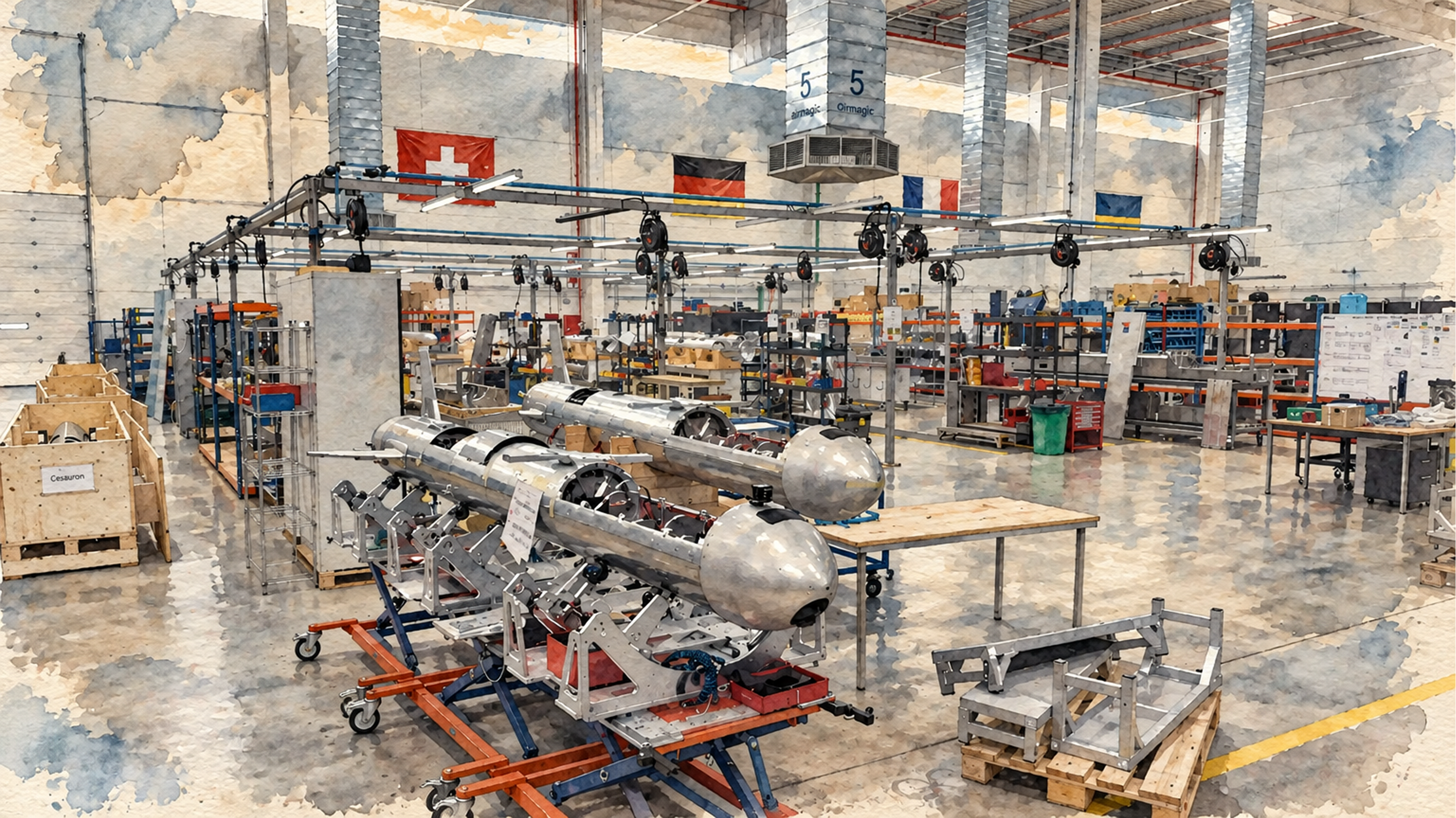
Dutch company Destinus says it’s producing nearly 300 missiles a month and has built more than 1,750 Ruta cruise missiles. It also makes turbojet engines for other manufacturers.
Russia has moved satellite-jamming gear that used to sit in six trailers onto separate vehicles. The jammers now cover about 25 square kilometers, including in occupied Crimea.
NATO’s DIANA accelerator signed its first cooperation memorandum with a partner country, and that country is Ukraine.
and more …
We publish this newsletter every day at 9:05am NYC time / 4:05pm Kyiv.Your subscription fuels our work.
Russia is dispersing Starlink jammers and upgrading its drone fleet, adapting to Ukrainian strikes and interceptor operations. Presidential adviser Serhii “Flash” Beskrestnov says satellite-jamming equipment previously concentrated in six trailers now appears on separate vehicle platforms, protecting individual sites across roughly 25 square kilometers, including in occupied Crimea. Meanwhile, Ukrainian military intelligence’s examination of the enlarged Gerbera-2 found a 10-kilogram warhead, Chinese communications hardware, and four American-made components.
The drone has a stated range of 1,200 kilometers, extending the capabilities of a design originally developed to overwhelm air defenses as a decoy. ZALA’s new Z-61 reconnaissance aircraft incorporates sensors intended to detect approaching interceptors and help operators evade them. Russia is also upgrading its Izdeliye 80 heavy multirotor, which carries up to 40 kilograms, with redundant communications and a reinforced airframe. Together, these developments suggest a focus on keeping drones operational as Ukrainian countermeasures improve.
Poland has launched a special security operation near its border with Russia’s Kaliningrad region, following intelligence warnings of possible sabotage. National police chief Marek Boroń said the operation covers the Warmian-Masurian and Podlaskie provinces, with police coordinating military personnel, border guards, and intelligence services through a dedicated headquarters.
He linked the measures to sabotage inside Poland and criminal operations conducted by eastern intelligence services, emphasizing the protection of border communities and nearby facilities. Polish military intelligence and allied agencies issued warnings in late October, while authorities are withholding operational details. Separately, Poland plans to reorganize its 4th Warmian-Masurian Territorial Defense Brigade into a border defense formation by year-end, with full readiness expected within two years. Its responsibilities will include monitoring the area and supporting border guards, alongside military defense if the situation escalates.
Ukraine’s state defense technology cluster has launched Brave1 Invest, a platform connecting Ukrainian manufacturers seeking capital with screened investors. Announced November 2, the service keeps investment information behind restricted access, with investors undergoing security and compliance checks that include scrutiny of links to Russia and its allies. Approved users can search companies by technology readiness and funding requirements, request presentations, and contact teams to arrange demonstrations.
The catalog focuses on manufacturers with ready products that have declared an interest in raising investment. Companies submit profiles for moderation, while Brave1 offers help improving pitch decks and other fundraising materials. Sensitive technical and operational information is excluded from profiles, and detailed materials require a separate request. The platform addresses a practical obstacle: finding suitable companies and establishing contact without exposing sensitive information publicly. Its potential value lies in shortening the route from investor interest to substantive discussions with manufacturers. Clearer fundraising information should also help teams explain what additional capital would enable them to build.
Dutch defense company Destinus says it is producing nearly 300 missiles a month and has built more than 1,750 Ruta cruise missiles, a weapon family already used by Ukraine. CEO Mikhail Kokorich says the company also manufactures turbojet engines for its own weapons and other producers, targeting a supply constraint in Ukraine’s expanding missile industry.
His ambition is to meet European and Ukrainian demand for engines in the roughly 1.5-kilonewton thrust class from 2027, a company projection rather than demonstrated capacity to satisfy every missile program. Destinus has also begun producing Ruta Block 2, with a stated range exceeding 700 kilometers and a 250-kilogram warhead. The missile uses a single container for storage, transportation, and launch, simplifying the handling of larger stockpiles. Kokorich says production excludes Chinese components despite the potential savings in cost and time. The engine business could give this expansion significance beyond Ruta itself: supplying propulsion to other manufacturers could support several production lines simultaneously.
Ukrainian-Japanese manufacturer Kurin Technologies has listed its KT-2 interceptor drones on Brave1 Market, giving Ukrainian units another procurement option for engaging Russian reconnaissance and attack drones. Two versions are available: the KT-2 DD with a digital daylight camera and the KT-2 DT with thermal imaging.