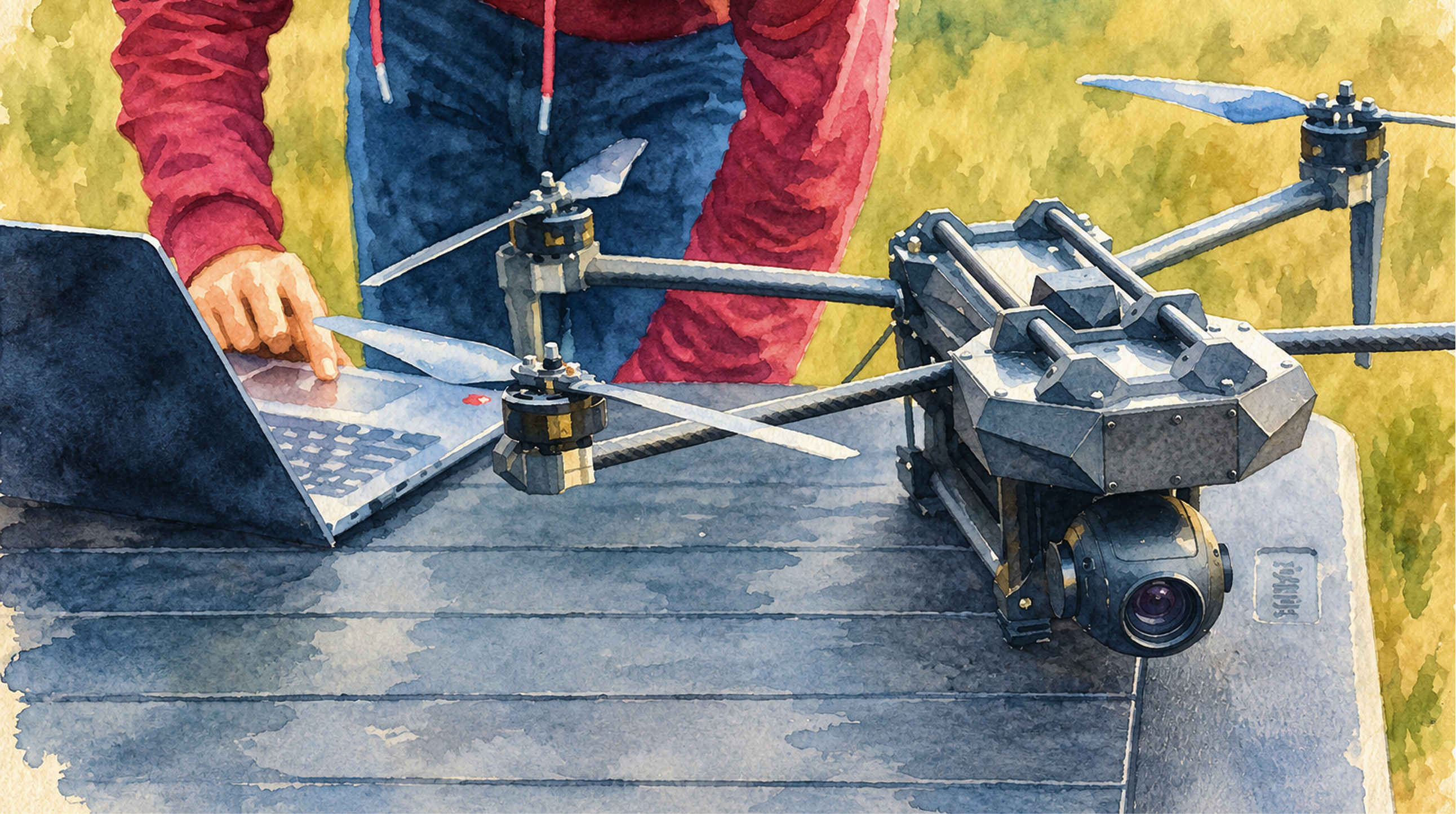
Brave1 and the Defense Ministry put reconnaissance drones from nine Ukrainian manufacturers through jamming trials, with GPS-free flight and at least 60 minutes of endurance required
Ukrainian-Swiss startup Caslog raises €360,000 for a wearable that turns medics’ spoken notes into digital casualty cards, after the 12th Azov Brigade ordered 100 for trials
Vigilant Works lands American investment as its next interceptor, Algiz-2, aims for speeds above 600 km/h
…and more on Strike Defense’s new interceptors and FPVs, a Dutch arms maker opening a Ukrainian subsidiary, and the Wild Drones grand final.
We publish this newsletter every day at 9:05am NYC time / 4:05pm Kyiv.Your subscription fuels our work.
Netherlands-based Motanka VC is targeting an €80 million fund focused primarily on Ukrainian defense technology, with individual investments of $300,000–$3 million in companies raising Series A funding. Fundraising remains underway following an initial close in July. Its first investment, completed in August, went to an unnamed Ukrainian startup whose counter-drone products are already operating at the front. Four additional companies are undergoing due diligence, with deals planned before year-end.
Motanka favors hardware supported by strong software, including autonomous systems, communications, and technologies for countering threats. It also considers healthcare applications such as bionic prosthetics. Selection hinges on demonstrated effectiveness and teams capable of adapting their products as battlefield requirements change. The four founders have supported Ukraine as volunteers since 2022, bringing experience in engineering, venture capital, law, and Ukrainian business. Their investment thesis addresses a persistent funding imbalance: European defense companies can attract substantial capital without having operated in Ukraine, while Ukrainian developers face investor reluctance despite direct combat experience.
Ukrainian-Swiss startup Caslog has raised €360,000 in pre-seed funding to develop a wearable device that converts combat medics’ spoken observations into digital casualty cards. Attached to a wounded soldier, the recorder captures treatment details, including when a tourniquet was applied, allowing medics to document their work without stopping to fill out paperwork. AI processes the recordings into records that command can access to monitor the casualty’s condition.
Founded by Swiss military officer Fabio Hamilos-Keller and a Ukrainian officer whose identity is withheld, Caslog tested its device with medical instructors from the 12th Azov Brigade in July. The brigade subsequently ordered 100 devices for trials. Funding from Freedom Fund, Gungnir Capital, Newfund, and angel investor Kateryna Tryfonova will support improved devices and proprietary voice AI, alongside preparations for a first paid deployment with a Ukrainian brigade. Tryfonova estimates the military medical digitalization market at €14 billion and sees potential beyond injury documentation, connecting patient information with evacuation and military healthcare systems.
Dutch weapons manufacturer Artillerie Inrichtingen Armaments has established a Ukrainian subsidiary, with plans to build a local engineering team and eventually open a production facility. Registered in August and headed by Oleh Kulyk, AI Armaments Ukraine is seeking Ukrainian partners for joint manufacturing, including air defense equipment.
CEO Gerard Zondervan says the company is testing products with the Dutch Defense Ministry, with successful trials potentially leading to long-term contracts supplying Ukraine. Those contracts and the proposed factory are still prospective, while the subsidiary provides a legal base for developing cooperation. The company says it has already supplied Ukraine with equipment worth more than €100 million since 2023 through its own initiatives. Its portfolio includes gun-based air defense and radar, alongside counter-drone equipment and infantry weapons. Founded in 2022, the Netherlands-headquartered business also maintains a U.S. office and recently announced cooperation with Israel Weapon Industries to manufacture IWI systems in the Netherlands. The Ukrainian expansion would bring engineering work closer to the military using its equipment, creating opportunities to incorporate operational feedback into jointly developed products and future production.
Ukrainian manufacturer Strike Defense has unveiled new interceptor and FPV drones, already available through the state-run Brave1 Market. Its Blade interceptor is designed to engage aerial threats and protect critical infrastructure, with manufacturer-stated performance of up to 270 km/h, a 20-kilometer range, and 20 minutes airborne. It carries up to 500 grams and offers different camera configurations, including thermal imaging.
The larger-payload Blade F10 trades speed for carrying capacity: it reaches 160 km/h, carries up to 1.5 kilograms, and has a stated endurance of 25 minutes. Strike Defense’s Kamik-Blade family addresses strike missions with radio-controlled and fiber-optic configurations. The Kamik-Blade 13 offers a stated range of 25 kilometers with a 1.5-kilogram payload, while the Kamik-Blade 15 increases those figures to 40 kilometers and two kilograms. The 15 Pro uses an upgraded video transmitter instead of a fiber-optic spool, with a recommended operating radius of 25 kilometers despite a stated maximum range of 40. The lineup gives units options across different payload and communications requirements, with procurement available through an existing military purchasing channel.
Ukraine’s Brave1 defense cluster and Defense Ministry have tested reconnaissance drones from nine domestic manufacturers, with developers whose aircraft met the requirements already discussing procurement contracts. The program seeks Ukrainian alternatives to DJI’s Chinese-made Mavic, a frontline workhorse for reconnaissance and artillery correction whose commercial specifications increasingly struggle against electronic warfare and expanding danger zones.
Under Fire News joined the Dzyga’s Paw fundraiser to provide the Da Vinci Wolves with crucial equipment. This fundraiser’s goal is $10,000 out of our $250,000 overall target.
The funds collected only go to the non-lethal parts of the fundraiser.