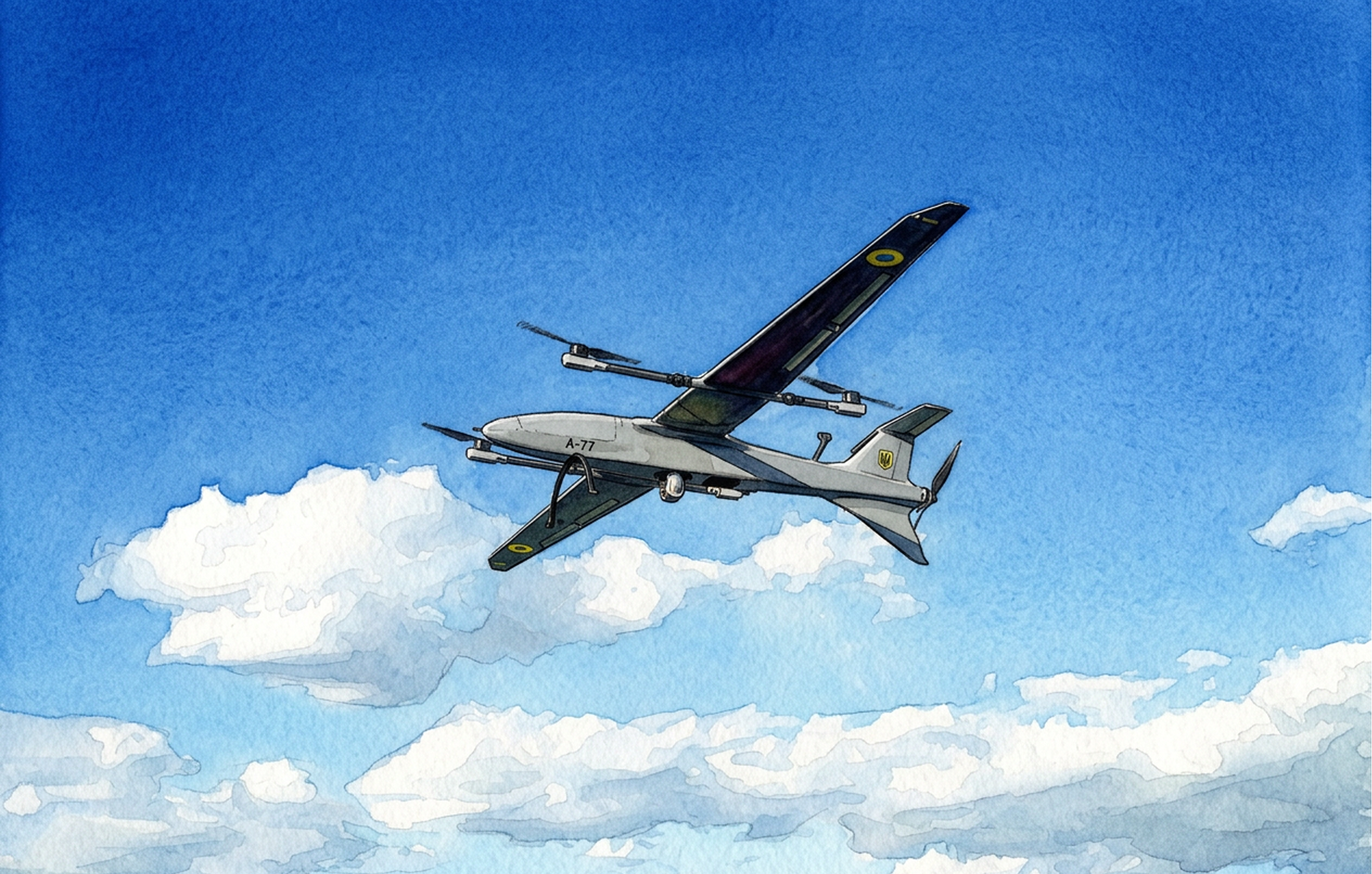
SkyFall’s Thor Hammer strike drone has a range of up to 600 km, costs $25,000–30,000 and is already in frontline use. The company wants capacity for 5,000 a month by the end of 2026
Ukraine’s SHOT-L1 drone tracks down Russian jammers such as the Pole-21 and Zhitel by homing in on their radio signals
Farsight Vision’s new module lets ground robots keep moving without GPS by matching laser scans to a 3D terrain model
**and more …**We publish this newsletter every day at 9:05am NYC time / 4:05pm Kyiv.
Your subscription fuels our work.
Losing GPS can leave a ground robot stranded or send it into terrain it cannot cross. Ukrainian-Estonian developer Farsight Vision has unveiled a navigation module designed to help operators keep moving without satellite positioning. A vehicle-mounted laser sensor scans the surroundings and compares them with a previously prepared 3D terrain model on the company’s FSV Platform.
The resulting display shows slopes, pits, ledges, and obstacles, helping operators judge whether a route is passable and recover the vehicle’s position when GPS disappears. As the robot advances, its scans add detail to the terrain model. CEO Viktoriia Yaremchuk says the aim is to remove the need to send a reconnaissance drone merely to guide a ground vehicle, reducing the resources and risks involved in a mission. The company also plans to introduce autonomous return over several kilometers by year-end, allowing a robot to head back to base or the point where communications were lost.
Ukraine’s National Guard has signed a new contract with Quantum Frontline Industries for German-made Linza and Zoom drones, with deliveries scheduled for 2027. The Ukrainian-German venture combines Frontline Robotics’ designs with Quantum Systems’ manufacturing capacity. Quantities were not disclosed, but the companies say the order reflects the Guard’s current requirements.
Linza 3.0 performs bombing and logistics missions, carrying up to four kilograms over a stated range of 15 kilometers with a payload. Its developer says more than 80 Ukrainian military units already use the platform. Zoom 3.0 conducts reconnaissance, locates targets, and adjusts artillery fire within a stated operating radius of 20 kilometers. Both offer endurance of up to one hour and are designed for environments disrupted by electronic warfare.
A Russian jammer’s transmissions can give away its position to the Ukrainian SHOT-L1 strike drone, newly listed on Brave1 Market. Its developer says the aircraft can fly autonomously into an operator-designated area, search for radio emissions, and home in on their source. When several signals are detected, it selects the strongest. If none appears within a specified time, the drone switches to a previously designated stationary ground target.
The manufacturer names Russia’s Pole-21, Zhitel, and Mgla electronic warfare systems among its intended targets. Listed specifications include an operational range of up to 80 kilometers, endurance of up to one hour, a cruising speed of 100 kilometers per hour, and a four-kilogram payload. The aircraft also carries a thermal imaging camera, an analog video link, and a terminal guidance system.
Ukrainian reconnaissance drone developer Buntar Aerospace has raised $16 million, bringing its total investment to $30 million as it prepares to expand production and enter foreign markets. Freedom Fund and an undisclosed international private equity fund led the round, joined by Gardar, Iron Wolf, and Autonomy Capital. The money will finance faster product development, additional manufacturing capacity, and the recruitment of experienced engineers and managers.
Buntar also plans further work on its AI-powered Copilot software, which helps drone operators make decisions during combat. Founded in August 2023 by Ivan Kaunov, Bohdan Sas, and Kateryna Bezsudna, the company develops both reconnaissance aircraft and the software supporting their missions. Its flagship platform is the Buntar-3. The latest investment follows a $10 million round in March involving American company Axon, Norwegian consortium Munkene AS, and private investors.
Japan plans to resume discussions on supplying or selling Patriot interceptor missiles to Ukraine, former Defense Minister and ruling-party lawmaker Itsunori Onodera said during a visit to Kyiv. He intends to use the visit to initiate government consultations under Prime Minister Sanae Takaichi. Japan already manufactures PAC-3 interceptors under a U.S. license, with Mitsubishi Heavy Industries serving as its sole qualified producer.