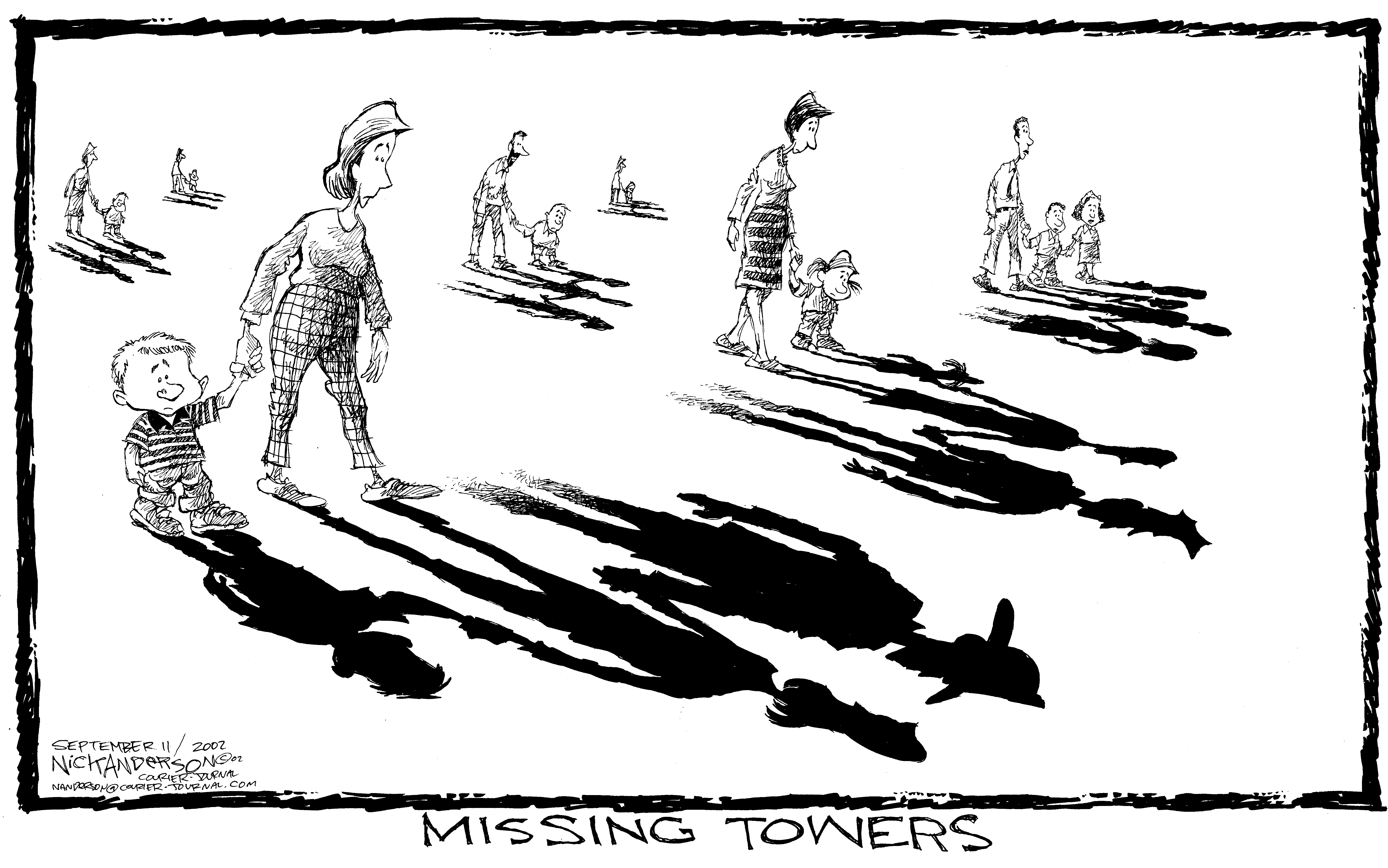
This cartoon, originally published on the one-year anniversary of 9/11, seems even more apt today. Twenty-five years after 9/11, the death toll from the attacks is still rising. While 2,977 people were killed on Sept. 11, 2001, federal data released by the Mamdani administration this week indicate that at least twice as many have since died from illnesses linked to toxic exposure at and around Ground Zero. Representatives of more than 9,000 people who subsequently died have filed claims with the September 11th Victim Compensation Fund, with more than 6,000 receiving compensation so far.
“People got sick because the leaders they trusted lied and told them they were safe to breathe toxic air,” ▶Mayor Zohran Mamdani said during the announcement of an online portal housing the documents. “These are documents that show what the city knew about the toxic air around Ground Zero, when they knew it and how they acted to limit liability.”
When the Twin Towers collapsed, they produced clouds of dust containing asbestos, metals, pulverized concrete and glass, burned jet fuel and other contaminants. The most intense exposure was among firefighters, police and rescue workers, but the plume spread through lower Manhattan and into Brooklyn, contaminating homes, offices and schools. Yet officials encouraged people to return. On Sept. 18, 2001, the EPA publicly said testing had found no excessive levels of asbestos or other harmful substances; a conclusion its own inspector general later determined was not supported by sufficient data.
Newly released New York City records add another troubling dimension. Some 170,000 pages of previously unseen documents show officials discussing health hazards and potential liability while workers, students and residents were being encouraged to return downtown. Symptoms emerged almost immediately: by October 2001 doctors were already describing the “World Trade Center cough,” which eventually proved to include serious conditions such as asthma, pulmonary fibrosis and COPD. Medical research has since connected World Trade Center exposure with dozens of illnesses, including numerous cancers.
The scale of the continuing health crisis is enormous. More than 145,000 people with certified 9/11-related conditions are enrolled in the World Trade Center Health Program. Early participants were overwhelmingly first responders, but civilians now account for roughly 40% of enrollment. Cancer is the most common certified condition.
The 25th-anniversary commemoration is acknowledging those later victims in a new way. This year’s ceremony ▶adds a seventh moment of silence, honoring people who survived September 11 but subsequently died from illnesses associated with their exposure.
It’s a sobering expansion of what we mean when we talk about the victims of 9/11: the attacks lasted a morning. Their human toll has lasted a quarter-century, and it still isn’t finished.