I was a child of the 1980s and 1990s, which means I was not baptized in the fire of the Civil Rights Movement.
I know nothing about police batons, water hoses, vicious dogs, having white people spit on me, pour drinks on my head, or call me a nigger to my face. I know nothing about “white only” and “colored only signs,” or seeing a cross burning on the lawn. And I never had to watching Black folks risk their lives for the right to cast a ballot. But I spent my early childhood years being raised by people from Mississippi who had lived through that terror.
My adoptive father, who was born in 1944, was from Lexington in Holmes County. He belonged to a large poor family of sharecroppers who experienced all kinds of racial abuses from white folks. He and a few other members of his family came north, to Chicago or New Jersey, during the last wave of the Great Black Migration.
My adoptive mother’s parents were from Jackson and Greenwood, Mississippi. I remember seeing and hearing her father, who was a Pentecostal preacher who got “saved” after stumbling drunk into a tent revival, cry every time he recalled how the Ku Klux Klan had wrapped his father in a white sheet and left him for dead in front of his mother and siblings.
Those family stories taught me very early that history does not end simply because the people who survived it have stopped talking about it. I watched how old traumas followed my elders into old age. How the past settled in their far off stares and in their bones. To this day, I can remember how I could see the weight of history on a grownup’s face long before I understood what I looking at.
I first visited Mississippi when I was a little girl. I probably spent four or five summers down there with my adoptive parents before I ran away from home at age 12. The drive from Jersey took us two days and I hated every single trip “down south.”
Mississippi was hot as HELL. The heat was merciless and the air was so thick you had to almost chew it before you could breathe it. None of the houses we visited had air conditioning, just those box fan in the window blowing hot air from one side of the room to the other. The living room furniture was covered in plastic that would stick to the backs of your thighs, and when you stood up, it sounded like somebody was ripping industrial tape off your skin. If you weren’t used to the heat, you had to sit perfectly still because the slightest movement, even blinking, would produce another gallon of sweat.
The mosquitos and fire ants seemed to get advance notice that a little girl from up north was comin’ down for the week because they treated me like a buffet. And don’t get me started on them freakin’ deranged roosters screaming outside the window at sunrise! There was no sleeping late. There was nothing on TV worth watching. Other than the downtown circle or the local Piggly Wiggly or a church service, there was no place to go. There was nothing to do all day except fall asleep in the heat or sit around listening to grown folks talk and count down the days until it was time to go back north.
Back then, I couldn’t understand how people could live in Mississippi and I didn’t know the difference between being miserable somewhere for two weeks and being trapped by the economic and racial conditions that had shaped that place for entire generations. I don’t know, maybe there were other Black folks who had spent their lives dreaming of the same thing. And maybe there were many more who ancestral roots ran so deep that they were determined to stay and fight.
Although I had no language for it, the poverty was everywhere. You could see it in the sagging porches, the weather-beaten houses sitting on crooked cinder blocks with peeling paint and rusted tin roofs, the dusty red dirt roads, the worn-out furniture, old cars sinking into weeds, and the exhaustion on people’s faces. I saw the poverty in the linoleum floors curled at the edges, chipped plates, ancient rattling refrigerators, and in the smell of damp wood, fried food, hot dust, and old upholstery that held generations of people.
I remember how much folks I saw in Lexington, Jackson, Greenwood, Okolona, Yazoo, Durant, and Tchula had learned to “make do” with so little. Nothing was thrown away if it could be repaired, patched, nailed back together, or made useful for something or somebody else. “Girl, don’t throw out that coffee can. Hand it here. I can use that to store somethin’ in.” “I’m g’on use this old jar for a drinkin’ glass.” “These ole towels make good cleanin’ rags.” “Jus set that old heater on the back porch. It’ll get fixed one of these days.”** **
I was a kid so I didn’t know anything about the origins of the poverty I saw in the Magnolia state. It wasn’t until I got to college that I learned about slavery, the violence of Reconstruction, land dispossession, sharecropping, lynching, segregated schooling, the rise of the carceral state, poll taxes, literacy tests, counting marbles, and all the political and economic schemes that shaped the Mississippi that my adoptive relatives and other Black elders grew up in. I just remember looking around and wondering why everything seemed so slow, so worn down, and so many folks looked exhausted all the time. I didn’t yet understand the history that had made Mississippi that way. All I knew is that I couldn’t wait to leave and go back home.
My adoptive father was always excited that he was “goin’ home. He’d step on the gas when we crossed the state line from Tennessee into Mississippi. But a few hours into this leg of the journey, his body always changed when we hit stretches of highway where endless cotton fields spread across both sides of the road. His gaze changed, so did his shoulders, his voice, breathing, and his grip on the steering wheel.
Then he started talking about sharecropping, being poor, abusive white folks, white children who called him a nigger, and the daily humiliations Black people endured under Jim Crow. My adoptive father loved and feared this place. Back then I couldn’t understand how a place that had been so cruel to him, his family, and the broader Black community could still command such tenderness. I hated this hot-as-hell place that hurt him, even though he loved it despite what it had done to him and his family.
Once I became an historian of African American life, I eventually came to understand that sometimes home is the place that wounded you, and fleeing it doesn’t always mean you’ve escaped what happened there. And in retrospect, I know realize that as we road down those long highways, I was watching Mississippi move through my adoptive father.
When I was in boarding school, I was hungry for Black history after drowning in Virginia Woolf, Jane Austen, and the other so-called literary greats. So I tucked myself in corners inside the school’s library and watched Mississippi Burning as a kid, sat transfixed by Eyes on the Prize, learned about the lynching of 14-year-old Emmett Till, the assassination of Medgar Evers in his own driveway, the bombing of the 16th Street Baptist Church, the murder of the three civil rights workers during Freedom Summer, and the attack against James Meredith when he tried to integrate the University of Mississippi. I also read Richard Wright’s Black Boy, Anne Moody’s Coming of Age in Mississippi, and watched The Autobiography of Miss Jane Pittman, The Long Walk Home, and 4 Little Girls.
Every book, film, documentary, photograph, and eyewitness account, made Mississippi of my childhood summer trips even more terrifying and suddenly held meanings I hadn’t been old enough to comprehend. I began to understand why my adoptive father’s body changed, and why he was filled with joy and dread when we crossed the state line.
No packaged history product could prepare me for the intimacy of knowing people who actually survived that world. Over the years, I’ve sat at kitchen tables, in church pews, on porches with Black elders still carrying memories that America tries so hard to bury. I have Black elders in my village who are in their 70s, 80s, and 90s from Mississippi, who can tell you how trying to register to vote could cost you your job, your home, or your life. They can still tell you which roads you better not go down after dark, and they can point to specific trees where Black bodies swung.
One of my village mothers, she’s 91 right now, can tap one finger at a time and tick off the names of people she personally knew who were lynched. So-and-so’s son. Mr. so-and-so’s cousin. Somebody’s neighbor. She can tell you about being at Jackson State when police and Mississippi Highway Patrol officers and members of the KKK shot through the girl’s dorm windows back in 1970. She will also tell you about a Black funeral-home director she knew in Jackson who helped a teenage boy escape to Chicago by hiding him inside a casket with a dead body in it.
Can you imagine being a child having to be disguised as the dead to keep you from being destroyed by a racist mob?
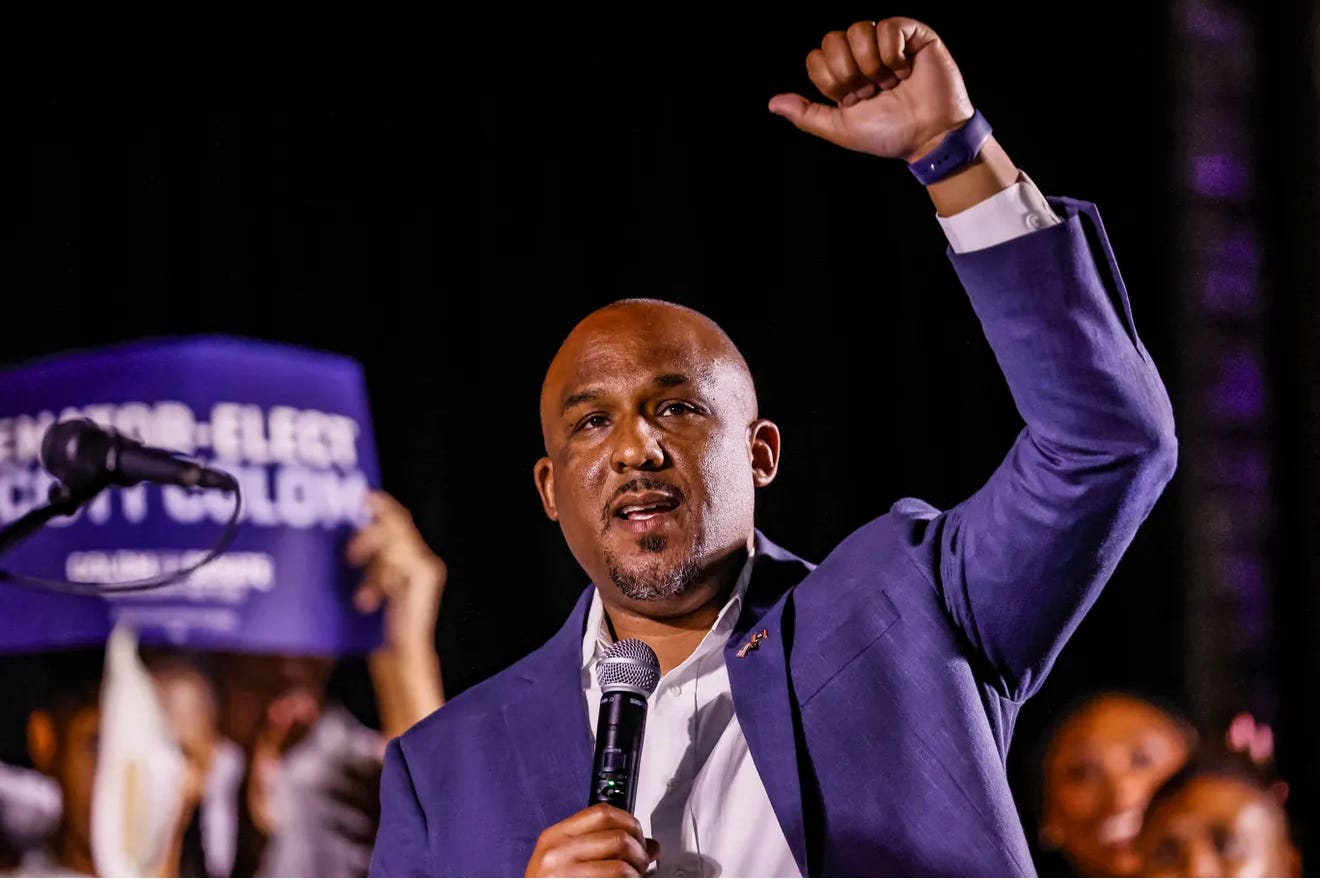
I want you to sit with the horror of that story, and then think about the fact that the people who remember the horrors of Jim Crow America are still alive to witness one of the most racist states send the first Black man to the U.S. Senate in 145 years. Many folks are talking about Blanche K. Bruce, that last Black man to sit in that chamber before Jim Crow repression purged Black politicians in Mississippi. Folks keep citing 145 years, but do they really understand what that number means when you measure it against the lives of people who actually survived them?
I do. It means the people like my adoptive relatives, my 91-year-old Village Mama, and so many other elders who remember Mississippi’s racial terror are not all buried in cemeteries. They are still sitting at kitchen tables, in living rooms, on front porches, and in church pews telling their grandchildren, or other young folk who bother to lean in and listen, what happened. Some are still tapping their fingers and counting the names of the dead.
I still think about that teenager riding in that coffin, and others who have similar stories. What became of them? Are they still alive? What are they thinking about this historic moment? That is the distance between those Mississippi stories and the Mississippi that just made history this week, even though there are forces that would like for us to forget.
Now enter the politicians and pundits and other folk congratulating America for another historic racial milestone. Ohhh, never mind that world where Black folk like my elders had the constitutional right to vote but couldn’t exercise it. My adoptive father was 21 years old when the Voting Rights Act became law in 1965. He belonged to a generation of people who fought civil rights and are still sitting amongst us with their hair white, wrinkled hands, and their memories painfully intact.
Because I know these stories personally, and because I’ve studied them in the archives and secondary literature, I don’t consider Colom’s victory to be some tidy, inspirational American success story. It would be historical malpractice for me to detach this election victory from the history that made it so extraordinary. I know that most of Black America is not out here celebrating the Black man who won without acknowledging the crimes against Black elders who were terrorized for trying to vote. All that blood that secured this moment has not dried beyond recognition.
And I know for sure that nobody can fix their lips to tell my 91-year-old Black Village Mama, who is the oldest surviving royal court queen from North Carolina A&T, and remembers all them names of lynching victims, that the history she carries around in her body is ancient while watching this racist regime reopen political battles she thought had been settled.
So, celebrate if you wanna celebrate. But do so with your eyes wide open. Because as a lifelong student of history, I know this country has a habit of permitting extraordinary Black breakthroughs without dismantling the economic and political systems that made those breakthroughs necessary. This country makes promises and breaks them. It makes progress and then it unleashes hell on the folks who demand justice.
Mississippi may be blue, but trust and believe, the MAGATs are back at the drawing board organizing for the next backlash. This moment in bittersweet, especially when I think about my elders who are now at the sunset of their lives and listening to a country debate whether their grandchildren and great-grandchildren deserve all the rights they nearly died to secure.
Thanks for reading. If this piece moved you or made you think, please consider becoming a paid subscriber. Your subscription keeps my Substack fueled and unfiltered. Paid subscriptions also help me support HBCU journalism students who need laptops, DSLR cameras, tripods, mics, lights, software, conference travel, reporting trips, and even food from our pantry. We appreciate your support!
THIS CONTENT IS WRITTEN IN THE AUTHOR’S PERSONAL CAPACITY. ANY OPINIONS EXPRESSED ARE THE AUTHOR’S OWN AND SHOULD NOT BE ATTRIBUTED TO HOWARD UNIVERSITY OR MORGAN STATE UNIVERSITY.