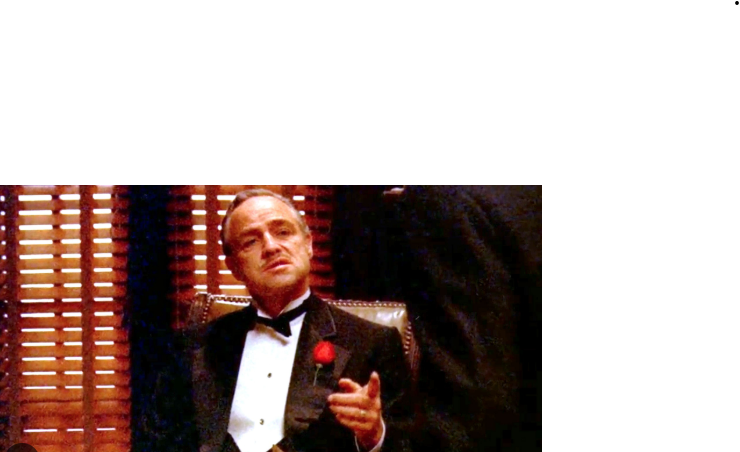
“It’s like déjà vu all over again.” Yogi Berra”I never change, I simply become more myself.” - Joyce Carol Oates
It occurred to me, as it often does these days, that something was familiar. It felt like I had ‘seen’ this before; you know, that feeling of ‘deja vu’. I’m speaking of course of how much the current Presidential behavior echoes the
leifmotiffrom*The Godfather.*Life imitates art!
When consigliere Tom Hagen goes to get Johnny Fontane the movie role, he tells the director he is being given an offer ‘he can’t refuse’; we all know what happens. Turf wars and disagreements are decided by violence or by the heads of the families agreeing on who controls which neighborhoods and which ‘product lines’.Donald Trump ‘made his bones’ in the back-office dealing, bare-knuckled, mob-dominated world of nyc real estate; everything was about leverage,exercise of power, favors owed and given. Turf was fought over and then accepted. The heads of the families would get together and divvy things up ( i.e. spheres of influence). What we are seeing now, in an Administration peopled by those seemingly troubled by the niceties of norms and precedent, is that classic movie writ large.
The problem is, that unlike in the movies, real world behavior has real world consequences. Some will take longer to play out, others’ impact will be de minimus. But some will not. The Venezuela story is far from over. If you use force in Iran, it most certainly will not. We may be getting close to the point where aggressive domestic ICE activity will have increasingly strong reactions.
Denmark is looking like another scene from the same movie. Michael tells Moe Green the Corleone family needed to expand into Las Vegas for ‘security’. Moe Green said no, was killed, and the Corleones took over Vegas. Sound familiar?
The economy, whatever you might think of the growth/inflation numbers and outlook, has an affordability problem. Look at number of people needing second jobs, the avergae age of first time home buyers, levels of savings for most people, sentiment numbers. Facing a midterm election-always difficult for the incumbent party- with weak poll numbers and the prospect of almost definitely losing the House- the Administration is trying to deal with the affordability issue. ( And floating canceling elections, but let’s leave that dumpster fire for another day).
Trump has been pressuring Powell to cut rates for months, despite decent economic numbers and what appears to be rising growth. Faced with continued resistance, we learn last night that, magically, the DOJ has now launched an investigation into Powell’s testimony concerning construction of the new Fed building. Trump claims to not know anything about it. See Powell’s response below; he is saying what almost no one who has been pressured or coerced by the administration has been willing to.
Also over the weekend, Trump ‘banned’ credit card companies from chargin more than 10% interest on credit card debt. I have no clue of that is within his purview, or enforceable; I believe it requires congressional action. It will takes months to implement at best, and the obvious consequence will be the banks limiting to whom they give credit cards , hurting the lower endconsumer even more. Profitability metrics at 17% are different than at 10%. To be clear, I am
nota fan of high rates, but again, actions have consequences.
The immediate response as we walk in:
Powell Statement
’On Friday, the Department of Justice served the Federal Reserve with grand jury subpoenas, threatening a criminal indictment related to my testimony before the Senate Banking Committee last June. That testimony concerned in part a multi-year project to renovate historic Federal Reserve office buildings.
I have deep respect for the rule of law and for accountability in our democracy. No one—certainly not the chair of the Federal Reserve—is above the law. But this unprecedented action should be seen in the broader context of the administration’s threats and ongoing pressure.
This new threat is not about my testimony last June or about the renovation of the Federal Reserve buildings. It is not about Congress’s oversight role; the Fed through testimony and other public disclosures made every effort to keep Congress informed about the renovation project. Those are pretexts. The threat of criminal charges is a consequence of the Federal Reserve setting interest rates based on our best assessment of what will serve the public, rather than following the preferences of the President.
This is about whether the Fed will be able to continue to set interest rates based on evidence and economic conditions—or whether instead monetary policy will be directed by political pressure or intimidation.
I have served at the Federal Reserve under four administrations, Republicans and Democrats alike. In every case, I have carried out my duties without political fear or favor, focused solely on our mandate of price stability and maximum employment. Public service sometimes requires standing firm in the face of threats. I will continue to do the job the Senate confirmed me to do, with integrity and a commitment to serving the American people.’(FRB)
Oh by the way, this is ‘crazy uncle don at thanksgiving dinner’ level bizarre: “Donald Trump declares himself acting Venezuelan president in viral social media post” (Bbrg)
Let’s turn to financials, as they begin reporting.
The group has had a sharp move over the last few months; the KBE is up 43% since June and 15.18% since mid-November. Prime sell- the-news territory, as we have been saying. Technically the group is overbought, and as discussed above the banks now face another headwind on the consumer finance front.
Names heavily focused on mortgage finance- SMID regionals- should outperform the megabanks, but the whole group feeles like an underperforming sector at this point.
Additionally, on a longer time horizon, there will be growing concern about the increasing percentage of bank loans being given to NDFIs- non-depository financial institutions, such as private equity- with mroe opaque portfolio valuations and chunkier asset exposure.
“The Disconnect Between Bank Lending and the Real Economy” (Adam Josephson)
nearly the entirety of banks’ lending growth is going to nondepository financial institutions (NDFIs), essentially the financial sector rather than the real economy.
A worthwhile read about Treasuries, Stablecoin and fx…(with 2 summaries from Claude so i could understand it).
“The Privatized Seigniorage Pivot: America’s Quiet Monetary Regime Change” (Perera)
Instructive on tariffs; the effective rate is lower than commonly thought, and they are a tiny drop in the revenue bucket.