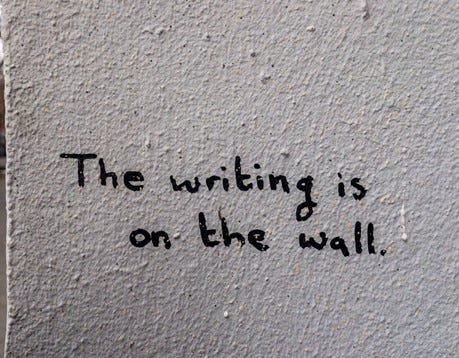
“You can have your own opinions, but you can’t have your own facts. Truth is not a democracy. It doesn’t give a shit about what you ‘believe’.” Ricky Gervais
It’s become clear to me that Steven Miller was not hugged enough as a child, but that notwithstanding, his commentary yesterday on the news programs was instructive for what it revealed. Presumably giving a peek behind the curtain, he explained that;
“We live in a world in which you can talk all you want about international niceties and everything else. But we live in a world—the real world, Jake—that is governed by strength, that is governed by force, that is governed by power. These are the iron laws of the world that have existed since the beginning of time ... The United States is using its military to secure our interests unapologetically in our hemisphere. We’re a superpower, and under President Trump, we’re going to conduct ourselves as a superpower.”
That paradigm overtly targets Greenland, Cuba, and likely the Panama Canal. Whilst there are strong geopolitical reasons for US interest in those areas- rare earth minerals, arctic/space control, foreign adversarial ( China, Russia, Iran) presence and influence close to the continental U.S.- the blatant
realpolitikbare-knuckled approach has its downsidesSpeaking of Miller, is he the next ‘comissar’ of Venezuela? ‘Trump Plots Wild Power Move for Stephen Miller’ (Yahoo)
In a classic case of the Dunning-Kruger Effect, I thought I knew a lot more about Venezuela than I did. These articles broadened my knowledge, and are worth the read:
The Arithmetic of Empire: Venezuela and the Restructuring of Hemispheric Order
(Perera)The Venezuelan Oil Narrative is PURE THEATRE The Real Reason the Pentagon Approved Venezuela: Critical Minerals and Adversary Expulsion
( Renegade Resources)“Venezuela was the rehearsal. Is Cuba the main course?”
(Intersubjectively Transmissible)“Playing with fire: The most important geopolitical event in the 21st century?”
(Werner Economics)‘What makes the 3 January 2026 US raid and kidnapping more consequential. The Panama invasion violated Panamanian sovereignty, but was aimed at specific governance goals at a time when the leader was not democratically elected. Nicolas Maduro is the elected current president of Venezuela (although the US leadership claims the elections were rigged, without presenting evidence from international election observers), who is internationally recognised as constitutional. The US intervention violates sovereignty while the stated US goal is to assume direct control of governance, which is a move with colonial overtones absent in the Noriega case.
Venezuela is a far larger country than Panama, which had previously been more directly under US influence. Venezuela comprises an area of almost one million square kilometres and has a population of ca. 30 million. It also boasts the world’s largest oil reserves – and US President Donald Trump has openly stated that he wants to gain control over these for the US. There is no pretence to “save democracy”.
So Maduro’s kidnapping lacks a proper legal basis in international law and can instead be seen as a US declaration of war against Venezuela.
Overall, it is clear that this US intervention in a medium-sized democratic country that is the largest owner of oil reserves in the world dramatically escalates the global political stakes. By targeting a sitting recognised president whose country is allied with Russia, China and Iran, even a confrontation with these major powers cannot be excluded as a possibility. Russian commentator Alexander Dugin stated that this intervention may signal the start of World War III. Coming shortly after a serious assassination attempt on President Putin (according to Russia, via Ukrainian drones targeting the Russian President’s private residence near Novosibirsk), it certainly has increased global tension.
All in all, it can be said that this new US intervention in Venezuela is one of the most significant geopolitical events of the 21
stcentury.
Should President Trump have resolved to make war against Iran (of a much more far-reaching scale than witnessed last June; for instance during his New Year’s Eve function hosting Benjamin Netanyahu), then America must prepare for the closure of the Straight of Hormuz by Iran (which realistically cannot be prevented). What better way to do so than take possession of, or at least a strategic stake in, the largest oil reserves in the world – which are in Venezuela?’
Why Delcy and not Machado makes sense if ‘democracy’ and ‘narco-terrorism’ are just the cover story. Worth considering:
BUT!
The Iran situation is deteriorating. From Claude:
PROTESTS - CURRENT STATUS (LAST 24 HOURS)Tuesday, January 6 Activity:
Tehran Grand Bazaar: Large crowds gathered, shopkeepers on strike
Security forces fired tear gas inside Plasco shopping center
Armed forces deployed across commercial districts
Chants of “Death to the dictator” at Caterpillar complex (auto parts market, western Tehran)
Geographic spread: 250+ locations across 27 of 31 provinces
Other cities: Mashhad, Lahijan, Sonqor, Yasuj reporting protests
Internet disruption: Shahrekord experiencing severe limits (first major disruption)
ISRAELI MILITARY PLANNING
“Iron Strike” Attack Plan:
Netanyahu approved new attack plan on Iran (reported Jan 5-6)
Israeli Security Cabinet: 5-hour meeting authorizing additional strikes
Israeli military entered “maximum alert” status
Intelligence branch conducting war-simulation exercises
Bitcoin making a move, now back above $93,000. Could be the New Year, or technicals, or short covering; we will know when we know. One thought circulating is:
‘Unconfirmed rumors began circulating across crypto social media that Venezuela may hold a secret “shadow reserve” of bitcoin worth around $60 billion. The country officially holds 240 bitcoin, according to reports from BitcoinTreasuries.
The rumors allege that Venezuela since 2018 has been converting gold proceeds and oil settlements into bitcoin. If Venezuela does in fact own such a bitcoin stash, it would make it the second-largest holder of bitcoin. The $60 billion figure would put Venezuela only behind Strategy in terms of bitcoin treasury size, and nearly double the reserve of the U.S. President Trump could potentially seize any actual Venezuelan crypto holdings for the U.S. strategic reserve. Theoretically, that could reduce bitcoin selling volume and help prop up the price of bitcoin.
That would also “underscore BTC’s rising strategic importance as nations compete to accumulate,” QCP wrote. Venezuela has utilized the stablecoin USDT for oil transactions since 2024, according to reports. The country in 2018 launched a state-backed digital currency called Petro, but it was discontinued in 2024.
(Bbrg)
US 10y yield feels like it's about to resolve to the upside
Markets are starting to show some froth:
HY spreads atightest in over a year: From my good friend Tom Thornton at Hedge Fund Telemetry,
Positioning is crowded
Lots of speculation Warren’s replacement starts with a bang. Consider this:
This isnt your grandfather’s banking system