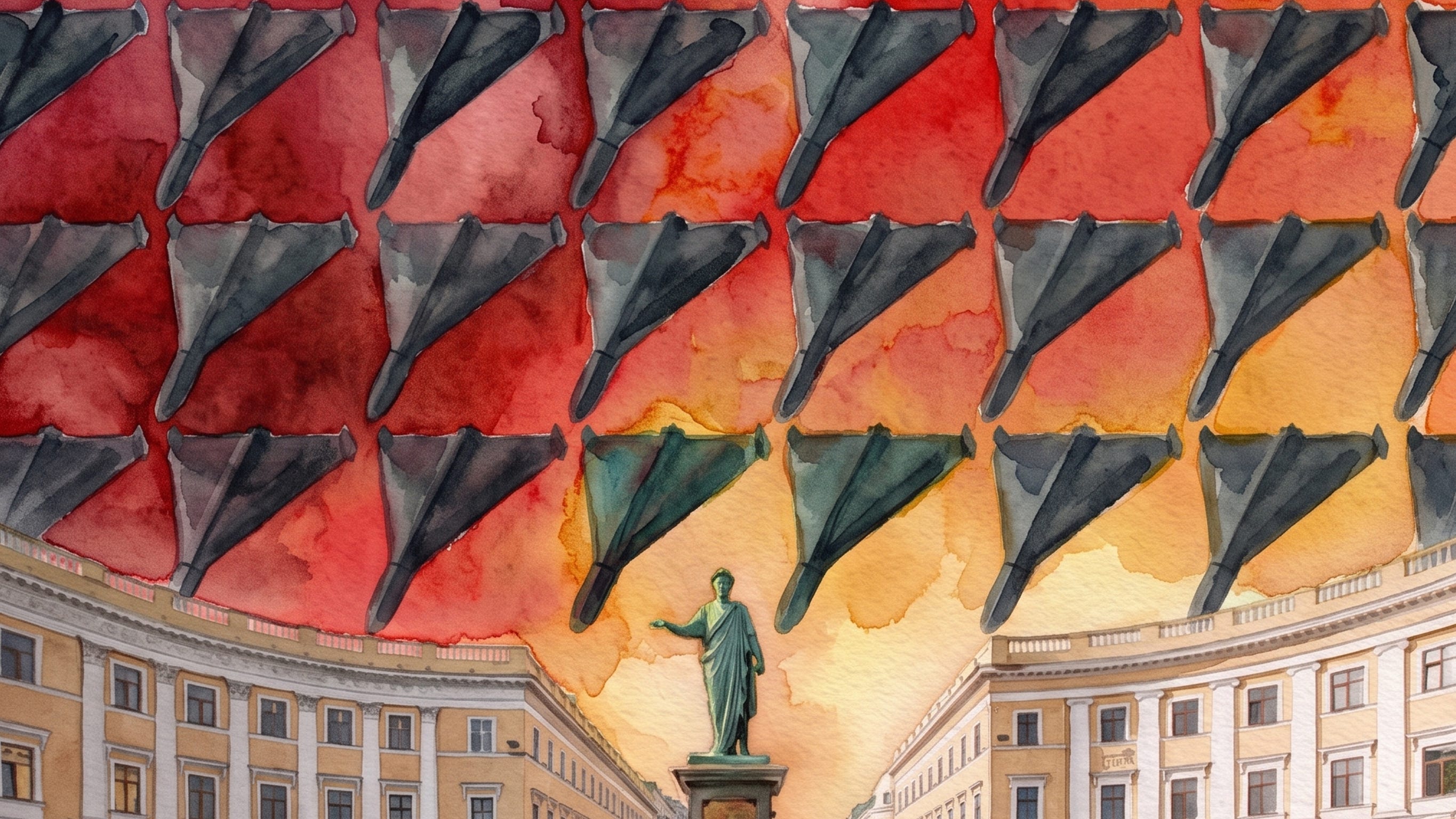
ODESA—It begins with a sound that has become so familiar in Ukraine that people hardly need to look at their phones anymore. Late in the night of August 8-9, the sirens begin to howl over Odesa, rising and falling through the warm summer night, and somewhere beyond the apartment blocks and the dark expanse of the Black Sea another Russian attack is already approaching. Soon the other sounds follow. The distant thumping of air defense, then sharper bursts, tracer fire climbing into the darkness, engines somewhere overhead, Ukrainian interceptor drones lifting into the night, and finally that unmistakable low mechanical buzzing which Ukrainians have learned to recognize long before they can see its source.
We publish this newsletter every day at 9:05am NYC time / 4:05pm Kyiv.Your subscription fuels our work.
During the night into August 9, Odesa became the principal target of another major Russian combined aerial attack: more than 200 drones were launched against Ukraine as a whole, accompanied by ballistic and other missiles, while Ukrainian authorities reported damage to the port and civilian infrastructure in Odesa and at least twelve people injured. The defenders of this proud city on the Black Sea fought all night and morning, giving their very best. But in the morning, thick black smoke rises all over this pearl by the sea.
This does not mean that Odesa has become Lviv on the Black Sea, nor does it need to. Ukrainian identity has never required every region to look alike.
There is something particularly unsettling about watching this happen in Odesa because the city is not merely another Ukrainian regional capital. It is the great southern gate of the country, the city facing the sea, economically indispensable and historically contested, a place over which Russian imperial memory still hangs heavily and which Moscow has repeatedly incorporated into its own historical mythology. Without Odesa and the ports around it, Ukraine would become something approaching a continental cul-de-sac, deprived of its most important direct connection to maritime trade.
And so the night sky flickers. Tracer ammunition climbs in red and orange arcs before disappearing into blackness, explosions roll between the buildings …
Even during the war the ports of Greater Odesa remain essential to Ukrainian exports: the World Food Programme continues to procure Ukrainian wheat and vegetable oil through them, while the maritime corridor established after the collapse of the original grain agreement has allowed commercial shipping to continue despite Russian attacks. This explains why the battle for Odesa has long since ceased to be simply a military question. Russia does not need to occupy the city tomorrow morning to damage it. It can attempt instead to make its harbor unreliable, its electricity uncertain, its industry expensive to insure and ordinary life increasingly exhausting. Ukraine tries to do the same with Crimea, effectively blocking the usage of the occupied peninsula.
And so the night sky flickers. Tracer ammunition climbs in red and orange arcs before disappearing into blackness, explosions roll between the buildings, sometimes distant enough to sound almost abstract and sometimes close enough for windows to tremble. Air defense in 2026 no longer means only sophisticated missile batteries costing millions, as Ukraine is fighting a technological race in which machine guns, electronic warfare, mobile fire teams, and increasingly interceptor drones have become part of a layered defense against Russian attack drones. Somewhere above Odesa, machines costing a fraction of traditional missiles are hunting other machines, while engineers on both sides modify frequencies, navigation systems, software, and tactics with an evolutionary speed that would have seemed extraordinary at the beginning of the invasion. This is what makes nights like this larger than Odesa.
It is warfare by exhaustion, conducted not necessarily with the expectation that one spectacular strike will break a city but that hundreds of nights like this might gradually make normal existence prohibitively difficult.
Ukraine and Russia are laboratories of a new kind of warfare, while behind Russia stand supply chains and technologies connected in different ways to Iran, North Korea and China, and behind Ukraine stands—or at least ought to stand—a Europe and a wider West trying to learn quickly enough from a battlefield that is rewriting military doctrine in real time.
Then comes the less abstract part.