Building autonomous multi-agent systems for production requires shifting away from monolithic prompt chains and unpredictable agent swarms. Early implementations frequently fail when uncoordinated agents trigger compounding error loops, exhaust token budgets, or execute unauthorized mutations. Production reliability demands explicit coordination topologies, bounded execution budgets, deterministic state machines, and fine-grained access control.
This architecture guide specifies seven core multi-agent design patterns, their empirical failure modes, and a production hardening runbook based on foundational agent workflow research from Anthropic (2024). We examine how to structure agent communications, enforce state recovery, and integrate security boundaries across high-throughput enterprise workloads.
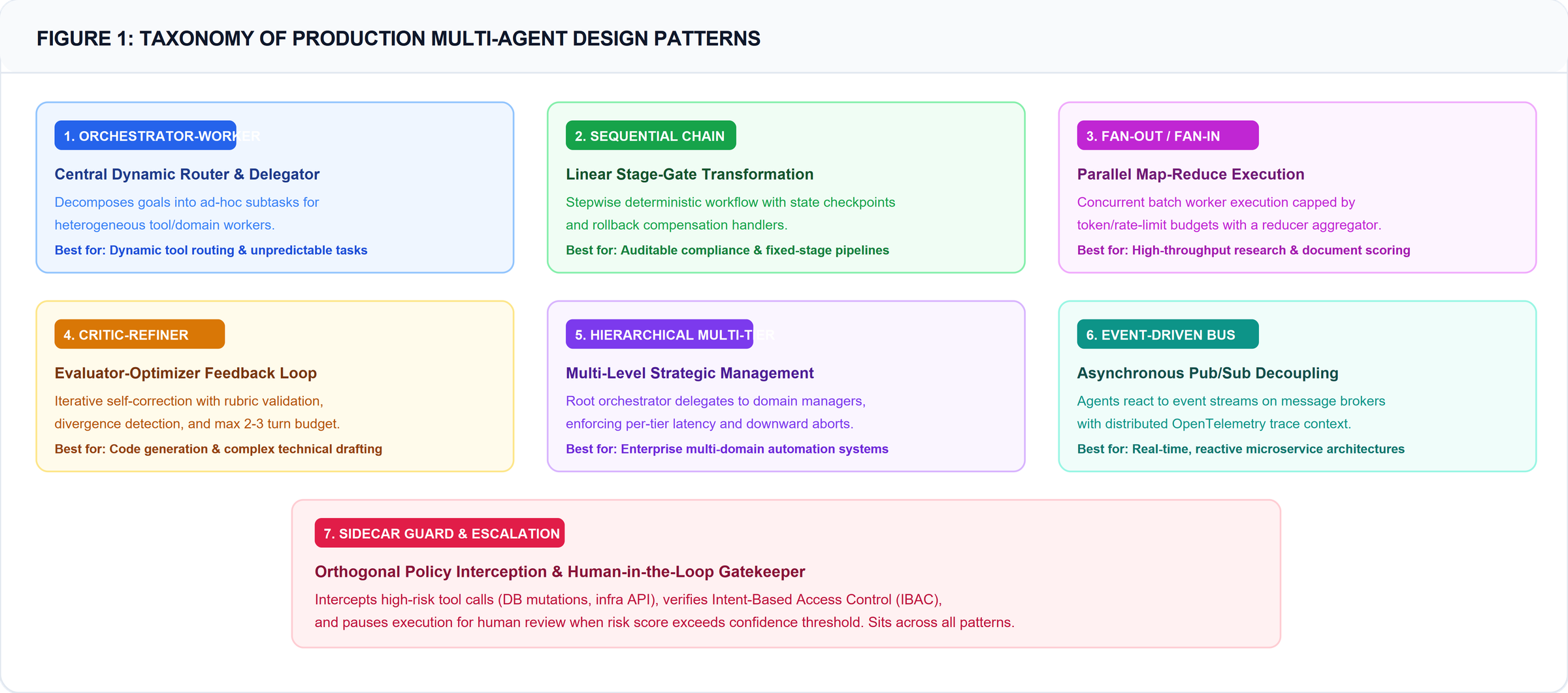
The taxonomy diagram in Figure 1 categorizes the seven primary multi-agent design patterns by coordination structure and communication flow.
Figure 1: Taxonomy of Production Multi-Agent Design Patterns
Before diving into each architecture, we outline the structural split between our free reference and paid deep dive:
**Free Architecture Reference:**The complete structural taxonomy, in-depth analysis of Pattern 1 (Orchestrator-Worker), and our comparative pattern evaluation matrix (Table 1).**Paid Subscriber Payload:**Deep technical specifications for Patterns 2 through 7, concrete code harnesses in LangGraph and CrewAI, state machine diagrams, and the complete Production Hardening Runbook covering OpenTelemetry GenAI tracing, circuit breakers, Intent-Based Access Control (IBAC), and context compaction.
The Orchestrator-Worker pattern addresses dynamic workflows where the incoming problem cannot be statically partitioned at build time. A central supervisor agent parses the high-level intent, decomposes the objective into targeted subtasks, dispatches work to specialized sub-agents, and synthesizes the outputs into a coherent response.
In production environments, the supervisor runs a state machine that tracks execution progress across independent worker lifecycles. Rather than allowing workers to communicate peer-to-peer, the orchestrator acts as the single routing gateway.
Figure 2 illustrates the dynamic routing topology of the central supervisor, detailing the task decomposition flow, worker execution branches, and the rule-based fallback router.
Figure 2: Orchestrator-Worker Dynamic Routing & Synthesis Topology
To prevent supervisor hallucination from derailing downstream execution, each worker agent must expose a strict JSON schema contract. The orchestrator dispatches payloads matching the worker's declared interface and validates the returned payload against expected types before proceeding.
from typing import Dict, Any, List
from dataclasses import dataclass
@dataclass
class WorkerTask:
task_id: str
target_agent: str
payload: Dict[str, Any]
timeout_seconds: float = 15.0
class SupervisorRouter:
"""Routes decomposed subtasks to specialized worker microservices."""
def __init__(self, registry: Dict[str, Any], fallback_handler: Any):
self.registry = registry
self.fallback_handler = fallback_handler
async def dispatch(self, task: WorkerTask) -> Dict[str, Any]:
worker = self.registry.get(task.target_agent)
if not worker or not worker.is_healthy():
return await self.fallback_handler.execute(task)
return await worker.run(task.payload, timeout=task.timeout_seconds)
The supervisor routing harness above implements strict worker health validation and timeout budgets. When a specialized worker times out or becomes unreachable, the dispatcher triggers a deterministic fallback handler rather than stalling the entire user request.
**Supervisor Single Point of Failure (SPOF):**If the supervisor LLM encounters a rate limit or generates an invalid routing plan, the entire request fails. Mitigate by deploying dual-model redundancy (e.g., routing to Claude 3.5 Sonnet with a deterministic rule-based fallback).**Cascading Token Explosion:**Unbounded subtask loops can drain token budgets rapidly. Mitigate by enforcing a strict maximum fan-out depth (N ≤ 5) and per-request token ceilings.
Selecting the appropriate multi-agent pattern requires evaluating the trade-offs between coordination overhead, latency impact, and error resilience.
Table 1 provides an architectural comparison across all seven multi-agent patterns, highlighting coordination topologies, latency characteristics, failure propagation risks, and optimal production use cases.
Table 1: Comparative Taxonomy of Multi-Agent Design Patterns
As summarized in Table 1, simpler patterns like the Orchestrator-Worker and Fan-Out/Fan-In offer low latency and minimal error cascading, making them ideal starting points before introducing multi-tier or event-driven complexity.