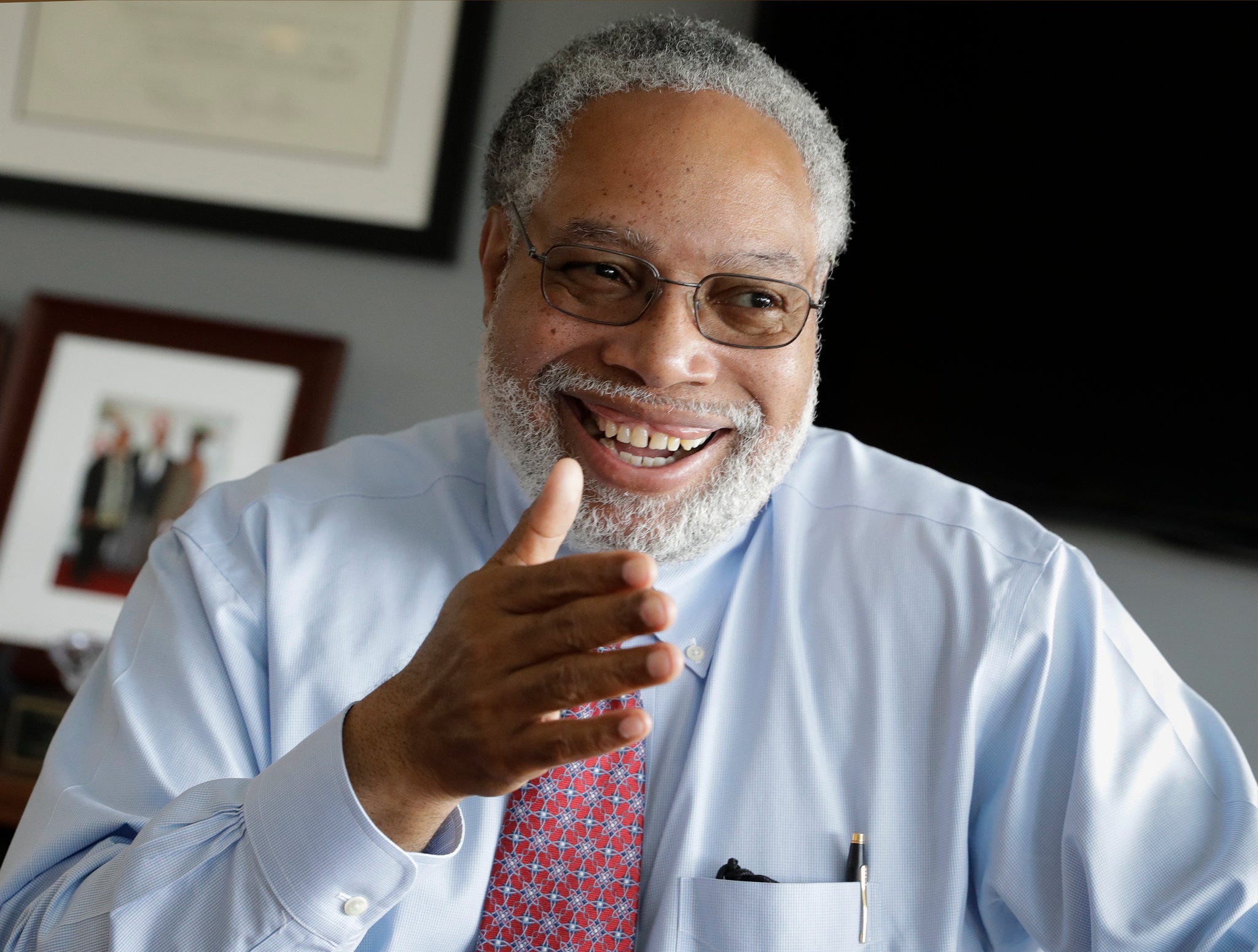
Lonnie Bunch’s retirement from the Smithsonian is a call to action for all of us. Coming around the anniversary of 9/11, it also helps us see how we’ve ended up in fascism central.
I was in graduate school in art history during 9/11. That very young woman could not have fathomed this particular hell our nation is in, one in which the Smithsonian has become Enemy Number One. How did we get here?
For those of us who were alive at 9/11, in those first few months afterward, everybody asked each other where you were when it happened. It was like we all needed to share those awful moments. We couldn’t keep it in.
I was working on one of the largest museum building projects in the United States at the time. It was a tony position I’d lucked into, I’d thought. I was the junior grunt on the project, working full-time and going to graduate school full-time. I remember the excitement of the beginning of the transformation of one of the largest museums in the country; it felt awesome.
I swiped into the Museum at 7:45. I had the most beautiful Henri Bendel patent leather stiletto heels. I can still remember the sound of them in the empty Lobby as I gingerly navigated the Marcel Breuer stairs. In my office, I dropped my purse and my little tote with my packed lunch next to my desk. I had a rickety old hand-me-down wooden desk; I sat down and took two sips of coffee. I looked out at the little concrete patio Brueur had designed so every educator had light as they worked. A small matte white floral pattern sat at my eye level when I sat down.
The director was going to make an announcement at 9:30. I’d been at my computer when the first plane crashed into the building. Heels and all, I rushed to the auditorium. I stood next to this woman who most likely didn’t know the name of 95% of her staff, and I had to tell her about the first plane. While she’d actually been raised in Cleveland, Ohio, but she had one of those Mid-Atlantic accents that typified a generation of socialite Museum workers. Over the years, I have seen her many times, and every time she refers to me by name. Given how little she cared about her staff or their names, I always wonder if my name stuck because I was the one who told her. Either way, we convinced her to postpone the announcement. Then dozens and dozens of staff members bundled into the courtyard around every television we could scrounge up that still had a receiver.
Given that museum staff members are often transplants and highly educated, many colleagues had people they knew in the area. It was early days for the internet, and phone lines were down. But collectively, one by one, we found loved ones together or heard about people who didn’t make it. Many of us lost people. Many of us found people we’d thought we lost.
Those first few days after 9/11 were some of the most amazing I have felt as an American. Planes were grounded; many people didn’t go into the office until 9:13 if they were not in Manhattan. Email slowed down. I talked to so many friends whom I had almost lost contact with. There was so much care and love spread through those days.
In the months after that, I remember feeling like George W. Bush had squandered the international goodwill for a lie about North Korea, Iraq, and Afghanistan. He had wanted to handle the international threats in a way that felt unified and as an equal and opposite attack to the people who had attacked us. Of course, Bush’s Axis of Evil was largely a falsified connecting of dots. The subsequent war was so incredibly unpopular. So much of what you hear online now about war existed then, but it disappeared when you put down the phone, when you walked away from talking to your friend, or when you went home from a protest.
We were a generation that hated so many of our politicians, but we could articulate our issues with a community of people who wanted to understand us. Even in protests, when counter-protesters showed up, there was no opportunity to profit off misinformation. While the ephemerality of these moments certainly helped you be as open as you chose, the biggest difference in that wartime era was that your ideas couldn't be monetized easily.
This heady time was also a period when museums were transforming their practice. As always, museums went where the money was, and many family foundations and corporations wanted to fund digital content. As a result, I worked on many education and technology initiatives that were the first of their kind. Working at the edge of practice can feel freeing, because no one's failures define you, but you also have no lessons to help you avoid failing. In retrospect, many of these early technology initiatives centered on technology over learning. They brought lots of acclaim to the museums I worked in; they excited visitors, but did they make people more excited about visiting museums?
Part of the reason technology was so exciting for Museum workers in that era was our great wish that everybody could access museums from their point of view. Culturally, there was a great hope that multiculturalism would be a doorway to greater good. Even before Obama ran for election, there was a great hope that equity was right around the corner. Given the cultural baggage the nation had overcome after the Reagan Era and its economic hardships, the 90s felt lighter. Look at the bright colors and plastic designs of the millennium. Y2K design, as it is sometimes called, reflected people's hope for a technologically enhanced, better future for everyone.
In my museum career, I engaged millions of people through interactives, online classes, social media content, and Studio classes, labels, family guides, and books. None of that content impacted visitors as much as a friend telling them about the art.
In retrospect, in this era around 9/11, we can see some of the real challenges that still live in our society. We had the hope of multiculturalism, but our solution was not based on dealing with the underlying patriarchal and racist society. Instead, we blindly hoped technology would fix those problems. We meant well. We really did.
This last part is most salient as we think about how we have found ourselves in the living hell that is the Trump Administration. The biggest difference between then and now is the scale of impact bad actors can have on society. The tech bros have been running the worst science experiment on the guinea pigs that is American society. They monetized hate because it was more profitable than any other human emotion. They destabilize every element of work and leisure for the monetary gain of a few.
Online Europeans are always asking why Americans aren’t in the streets. The other day I was working on an article about Dolly Parton; while reading about how union organizing happened in West Virginia, one thing that struck me was how much people cared about each other. I worry that Americans don’t care enough about their fellow Americans to get out in the streets and change this. Now I'd also argue that Europeans have absolutely no sense of scale compared to the American populace, so the kinds of organizing you see in France just can’t physically happen in the same way in the United States. But that doesn’t mean we couldn’t transform society through sustained, planned, public action. Why aren’t we doing this?
For example, many ex-Trumpers are angry. They have taken to the internet because they might profit personally, like on TikTok Shop, selling their meat. But why not rise up? Partly, it's because they’re angry that it hurt them. They wanted to hurt other people. Hate as a guiding principle for governance eventually hurts everyone. We didn’t fix the racism, amped up the hate, and let the whole mess foment online.
Isolation plays into this. Many of those Trumpers are also living in places where they might not interact with that many human beings. Urban Americans, though, also interact with fewer and fewer people. As a society, we have become disconnected from humanity because of technology, exactly the opposite of our dreams for the internet. Why? Hate is much more profitable. Incidentally, so much of Trump’s funding base is technology; it almost seems like they planned an isolated populace who cannot empathize or organize.
Empathy is why Lonnie Bunch and the Smithsonian, as well as every museum professional in this country, are essential to the future. To get out of fascism, we need to gain empathy for our fellow Americans. We need to find in each other the same feelings we had in those first days after 9/11. We need to care and listen. We need to go offline and find people to be in community with. We need to stop speaking in misinformation. We need to communicate for understanding, not monetization. We need to listen to understand rather than to argue.
All the skills I just described come from understanding our history and our society; this is the work of museums. They are not storehouses of junk; they are libraries of humanity. The Smithsonian has come under fire from Trump because he understands the power of museums, or rather, I should say someone told him they were important. Because museums do not tell you what to think, they help you develop your ability to understand the world from where you stand. No other American institution does this at the scale museums do. Still, even with less funding and fewer hours, more Americans go to museums than to sporting events.
If, in these moments, you want to build your ability to understand the complexity of our society, to hold Nuance in your mind, and to grow empathy for others, I encourage you to walk into a museum, to subscribe to a social media account from a museum, and then share what you learned with someone you know in real life. Each of us can be the change society needs to remember to care for each other, and museums can be your Passage to get on that road or continue your journey.