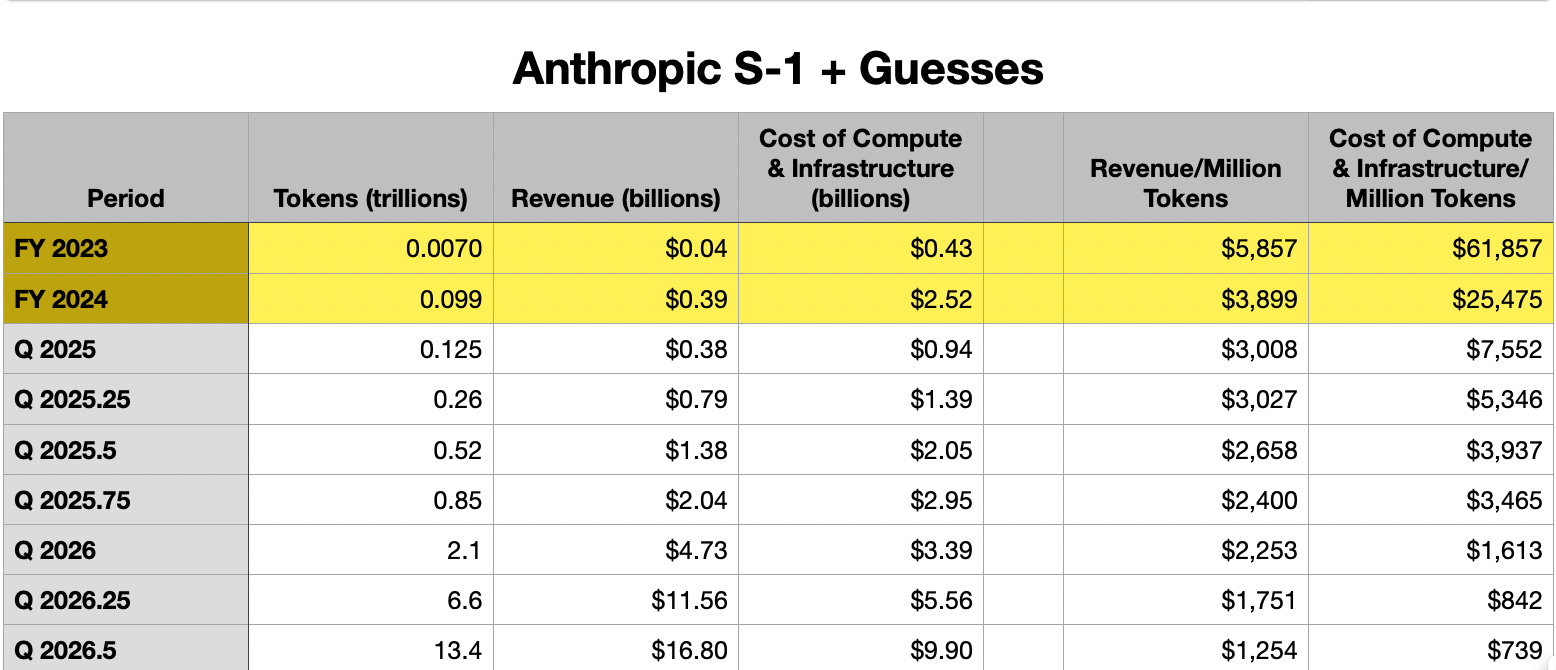
What is really going on with Anthropic considered as a potentially profit-making business?
Here’s a table of my guesses:
Before I could use this table to, say, start to offer investment advice, I would have to know things about you I do not. I would have to know your risk tolerance. I would have to know your time horizon. Since I don’t know that about you, plus I am not licensed to do so, I cannot advise.
It would be profoundly stupid for me to try.
Consult your risk tolerance and time horizon, and then start thinking for yourself.
There is one important thing to note about the last row—the third quarter of 2026 row—of this table: Of the $10 billion in Q3 2026 cost-of-compute:
perhaps 40%, $4 billion, are made up of payments to xAI for renting datacenters,
at a premium of perhaps 100% over xAI’s marginal cost,
an expensive temporary bridge fix given how much demand for Anthropic’s Claude Code has run ahead of expectations and plans,
do not take the bottom right number as indicating that the cost of compute per token has stopped falling.
Taking the premium that xAI collected in profit out, the bottom-right number would have been $560 per million tokens. And after the winter of 2027, Anthropic (or xAI) can cancel these deals with 90 days’ notice.
How fast can Anthropic continue to cut its cost per token served? and would Anthropic ever achieve substantial savings on compute costs by abandoning the quest to build a digital god and focus its R&D on advances that provide value to end users willing to pay? And how fast will competition from dark silicon, open weight, hyperscaler platform-monopolist loss-leader, and cheaper overseas models erode Anthropic’s current substantial pricing power and margins?
That said, I think it is also important to note two observers. This:
Evan Armstrong: Is Anthropic Worth $2 Trillion? <[https://every.to/napkin-math/is-anthropic-worth-2-trillion]>: ‘Anthropic is mostly in the Claude Code business….. The top 5 percent of users, who do, spend about $1,500 a month. This is the single most important fact about Anthropic’s growth: The models happened to be the best at coding, the company built the application layer on top of them itself, and via the business strategy magic of vertical integration it captured the value instead of handing it to Cursor and Copilot….
This is a usage business sold to a few thousand companies….76 percent of 2025 revenue came from about 1,500 organizations, and the other 24 percent came from roughly 40 million customers….[And]the real customer count is closer to 250 than 11,900….When you underwrite this company, you are underwriting roughly 250 relationships and the rate at which the next 1,650 climb into that group…. The whales… [are]
[Cursor and GitHub Copilot]… that sit between Anthropic and the end user, which have every incentive to route tokens to whichever model is cheapest this quarter, and whose owners (SpaceX and Microsoft, respectively) run their own model programs….The most efficient scaling in the history of the industry, 900 percent net retention, 85 percent serving margins, $131 billion in the bank, and $800 billion of fixed obligations that the company can only meet if the next six models are as good as the last six. At $2 trillion, is that a buy? It depends… on whether you would trust Claude to cure cancer….To keep the growth curve, Anthropic has to keep launching into design, finance, and agents (which it just did with
[Duet]), and it has to win each of those markets against competitors that are cheaper and, in some cases, better…
And this:
Ben Thompson: Anthropic S-1, The Cost of Compute, Who Is Paying? <[https://stratechery.com/2026/anthropic-s-1-the-cost-of-compute-who-is-paying/]>: ‘Numbers, finally—albeit somewhat incomplete ones…. Most interesting are Cost of Revenue & Research and Development, because that is where the company’s compute costs lie (along with Sales and Marketing, which is where the cost of free access is housed)….Anthropic’s compute costs are dominated by R&D. Moreover, the cost of R&D compute is increasing faster than the cost of inference, at least over the last year…. The company is the biggest consumer of its own compute and its own AI, all in the service of building an even better AI. Folks complain about circular financing in the AI trade; the reality is that the companies at the core of that trade are the ultimate ouroboros, where their long-term financial upside is dependent on not eating themselves completely!…
##attention-info-bio-tech-mode-of-production
##mamlms
##wednesday-wealth
#my-guesses-with-respect-to-the-true-state-of-anthropic
#anthropic
#anthropic-s-1
#claude-code
#cost-of-compute
#token-economics
#ai-valuation
#digital-god
#ai-ouroboros