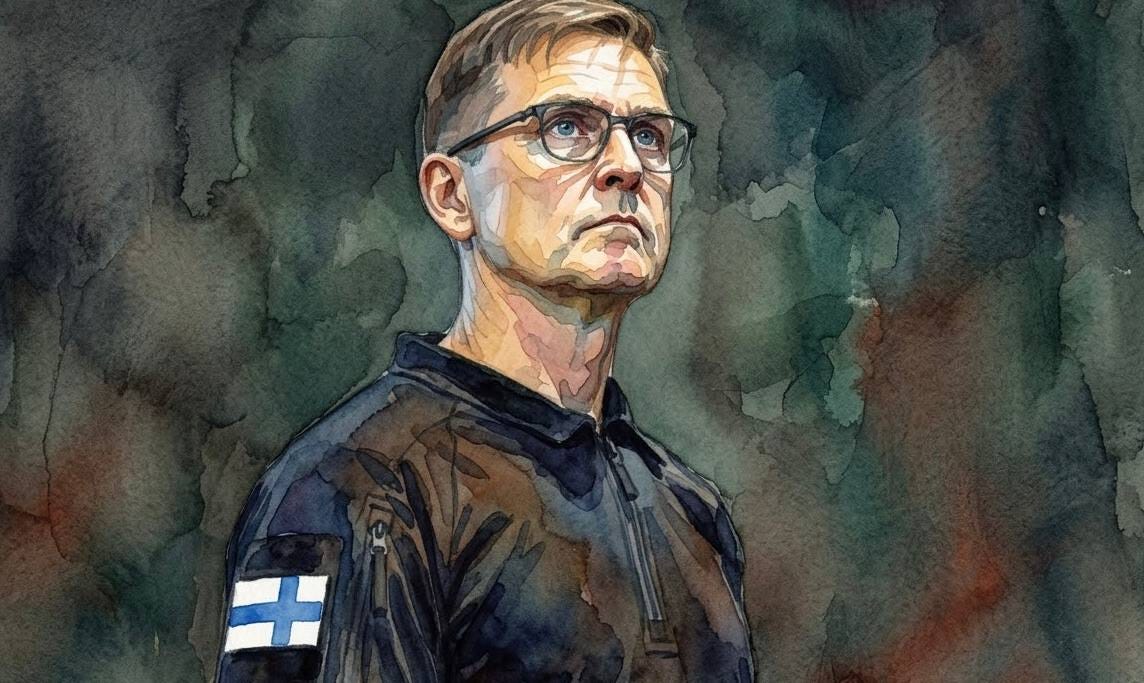
Welcome to Voices of the Fight— a Saturday Q&A series featuring the warriors, innovators, advocates, and volunteers standing under fire for free people.
My name is ** Antti Kosunen**, and I am the CEO and a founding partner of
17Tech is a Finnish defense technology accelerator operating in Finland and Ukraine. We help startups validate their business cases, test whether their technology solves a genuine operational problem, and connect them with defense forces, military users, investors, and potential customers.
We publish this newsletter every day at 9:05am NYC time / 4:05pm Kyiv.Your subscription fuels our work.
The objective is to ensure that companies develop technologies which are actually needed—and that the people who need those technologies know they exist. Too many startups build products based on assumptions. In defense, those assumptions have to be tested against the requirements of soldiers, military organizations, and the battlefield.
[S]tartups do not fail only because their technology is poor. They also fail
because they cannot find the right users.
I have personally invested in, or helped arrange investment for, almost 500 startups. Through 17Tech, we use that experience to bring founders together with the right investors and military customers.
Over the course of my career, I have managed 29 accelerator programs in 12 countries. That has taught me that startups do not fail only because their technology is poor. They also fail because they cannot find the right users, validate the right business model, secure the right capital, or explain why their product is needed. Our task is to connect all those pieces.
17Tech is a defense-first company. We are not interested in forcing every product into a civilian use case. We want to develop technologies that save Ukrainian lives, strengthen European sovereignty, and help rebuild a serious defense industry across Europe.
My sons are 22, 24 and 25. I do not want them to have to kill anyone, and I do not want them to be killed.
When the next war begins, it will be too late to start creating research programs and production facilities. Those capabilities must already exist inside European countries. We need companies that can develop, manufacture, and improve what our armed forces require.
The next war will also be different from the last one. Even the war currently being fought in Ukraine is constantly changing. Technology, tactics, and operational requirements evolve quickly. European defense companies must be capable of changing with them.
Finland understands this better than many European countries because we share a 1,304-kilometer border with Russia. I like to say that we have 1,304 reasons to do this.
War brings out both the best and the worst in human beings. It also makes you lose your humanity in some way, as tragedies become commonalities.
Two days ago, we were supposed to meet someone, but he had to reschedule because he was attending a funeral. When I heard what had happened, I confused the person being laid to rest with another person and said, “I thought he had been shot in the knee.”
No. They were two different people.
That exchange stayed with me because these things have become part of everyday life. People are wounded. People attend funerals. People are dying all the time. You can confuse one casualty with another because there are so many of them.
That should never become normal.
I would rather die than surrender to the Russians.
Before working in defense, I was the CEO of a company specializing in environmental impact assessments. I cared about that work and about protecting the environment. Now I am working to save human lives because I feel that I have to.
This is something all of us should feel responsible for. We are defending sovereignty, but we are also defending individual human beings. Sometimes that gets lost when people discuss the war only through strategies, systems, and national interests. Behind all of it are people whose lives have been cut short.
Finland has a history with Russia. My grandparents’ generation fought the Russians. Then came a generation that did not hate or fear them in the same way. My parents’ generation was more relaxed, and for much of my own life, I was as well. I met Russians and conducted business with them before the full-scale war.
Now we are afraid again.
My sons are 22, 24 and 25. I do not want them to have to kill anyone, and I do not want them to be killed. I do not want war to destroy their lives or take away their humanity. I do not want my mother to be afraid. I do not want my wife to be afraid.
I have had almost 60 good years behind me. My children still have most of their lives ahead of them. They need to survive and live—and so do everyone else’s children. So I would rather die than surrender to the Russians.
In my current role, I do not really feel under pressure because this is something I believe I have to do.
I think about my values and the reason behind the work. We are creating technologies that can save lives. When your motivation is strong enough and you understand what is most important, pressure becomes less significant.
I am not helping to create another dating app. I am working on something that can protect people and countries.
Earlier in my career, I helped large corporations improve their businesses. There was nothing inherently wrong with that, but this work is different. I am not helping to create another dating app. I am working on something that can protect people and countries.
When you know that the outcome has real consequences, it becomes much easier to remain focused.
Purpose is now the stronger force
Before entering defense, sport was one of the ways I managed pressure. I practiced several martial arts. When you begin training, you stop thinking about ordinary business problems and concentrate completely on what is in front of you. It forces you into the present moment.
That discipline still helps, but purpose is now the stronger force. I understand my values, I understand why the work has to be done, and that removes much of the pressure.
4 | How can people support your work?
The most useful thing people can do is help us find founders and engineers who are prepared to build defense companies.
Talk about the opportunity. Encourage technical people to start businesses in defense. Connect us with teams that have promising ideas, existing technology, or expertise that could be applied to a real military need.
We want to meet as many capable engineers, scientists, and founders as possible. If they are serious about establishing a defense company, they should speak with us. We can help them validate the idea, understand the user, develop the business, find investors, and eventually scale production.
Making the correct introductions is much more valuable than making as many introductions as possible.
Europe does not only need interesting prototypes. We need companies large enough to deliver meaningful quantities, build production capacity, and create an operational impact. That requires investment, customers, and a path from early testing to manufacturing.
We also maintain relationships with other defense investors and accelerators, including organizations in Ukraine. Cooperation across the ecosystem is important because no single fund or accelerator can build Europe’s defense industry alone.
I have a network of roughly 1,500 investors, and one member of our team works full-time on connecting startups with capital. His task is not simply to send every company to every investor. He has to understand what each investor wants, what each company is building, and when the two are a good match.
The most direct way to support us … is to build.
That means investors receive opportunities relevant to their interests, while startups meet people who may genuinely want to fund them. Making the correct introductions is much more valuable than making as many introductions as possible.
The most direct way to support us, however, is to build. Start a defense company, bring us the technology, and be prepared to test your assumptions against what military users actually need.
5 | Where can people follow you?
The best place to connect with me personally is LinkedIn.
People can learn more about the accelerator, apply for a program, or contact the team through the 17Tech website. They can also follow the 17Tech LinkedIn page for updates about our programs, startups, testing opportunities, and events.
Nikolaus Muchitsch is chief of staff and strategy at Under Fire News.
underfire.news | PayPal | X | Instagram | LinkedIn | Youtube | Facebook