Welcome to Voices of the Fight— a Saturday Q&A series featuring the warriors, innovators, advocates, and volunteers standing under fire for free people.
My name is Howard Hunt. I’m an evacuation medic. My personal mission, if expressed in one sentence, is to earn the right to say that I fought.
In 2024, I completed four rotations as an evacuation medic with the Hospitallers Medical Battalion. Three were on a rescue bus operating along the route between Pokrovsk and Dnipro, collecting wounded soldiers evacuated from the direction of Avdiivka. I later completed another rotation with an ambulance crew near Kostiantynivka. That was where I realized I could probably help Ukraine more effectively by organizing medical technology and equipment than by continuing to work directly as a medic. My Ukrainian was poor, and my medical skills were relatively basic. Both limitations mattered inside an ambulance.
The work also showed me a serious technological problem. We operated from casualty collection points outside the immediate drone kill zone. In 2024, that zone extended roughly ten kilometers in many areas. It has since grown much deeper. We could not simply drive to the front and collect a single wounded soldier. We waited for nightfall and then sometimes received an entire day’s casualties at once.
This meant transporting several seriously wounded soldiers in an ambulance designed and equipped around the treatment of one patient.
The medical equipment was largely twentieth-century technology. We used pressure cuffs and stethoscopes. To measure a patient’s respiration rate, I would sometimes place my ear near a soldier’s mouth and count their breaths.
I was also responsible for completing the standard NATO TCCC (Tactical Combat Casualty Care) card for wounded soldiers. This is a photocopied piece of paper used to record injuries, treatments, and vital signs such as pulse, blood pressure, respiration rate, and blood oxygen saturation. Trying to measure and record this information is hard enough as it is, but with four wounded soldiers in a moving ambulance, it was nearly impossible.
Of all the cards I handled during my rotations, around half were not properly filled in, and of the half I completed, I had to estimate the vital sign information on perhaps 90 percent, because there was no practical way to measure everything accurately under those conditions.
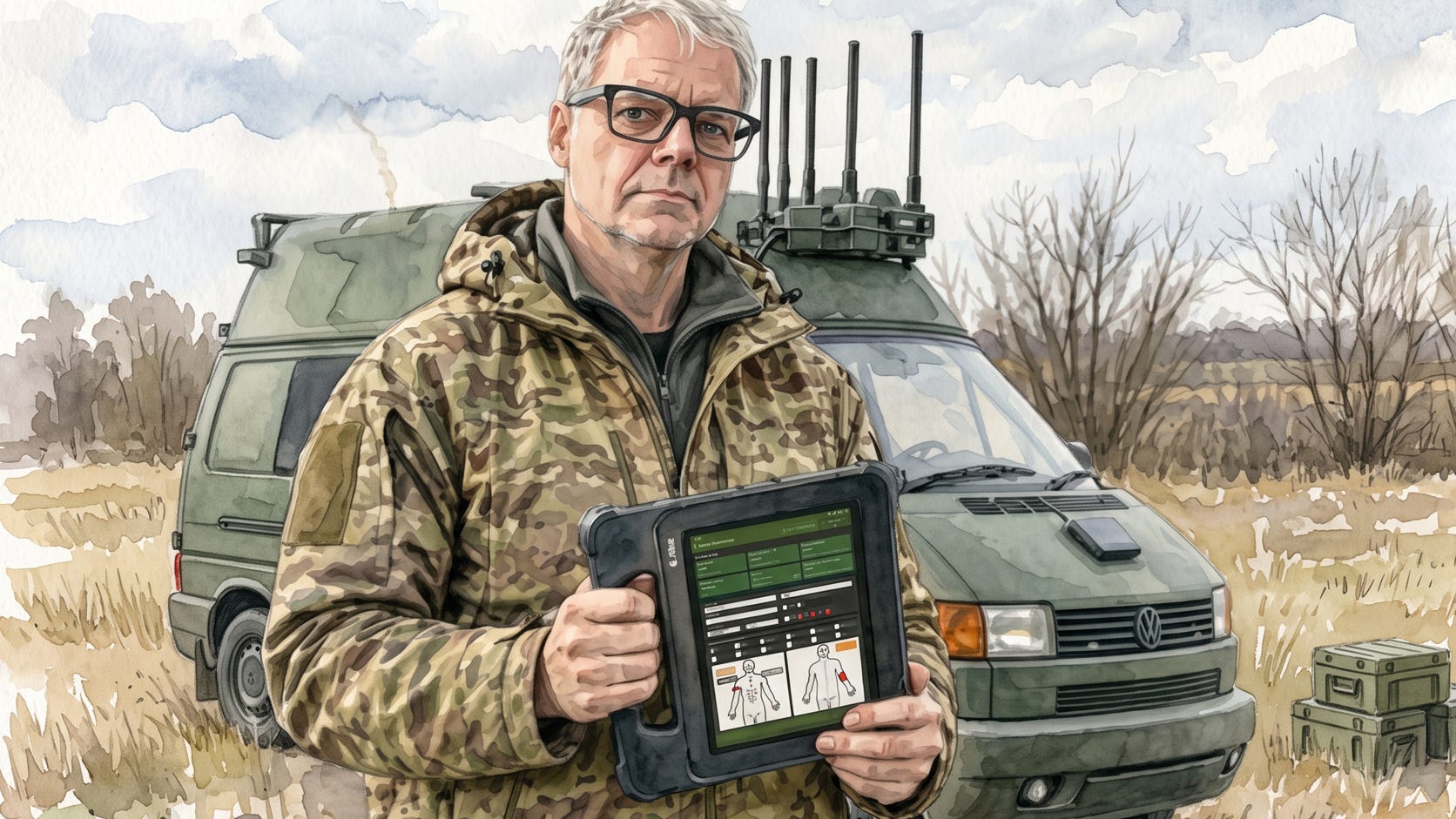
When I returned to Berlin, I used my previous startup experience to pull a great team together, and start developing software for a digital triage-management system on a digital tablet.
The tablet interface we built replicates the function of the paper TCCC card. It records the casualty’s injuries, treatment, and vital signs, and then generates a QR code, which can be printed onto a sticker and attached to the front of the soldier’s uniform.
When the casualty reaches a stabilization point, the receiving medical team scans the code and immediately sees the information collected during evacuation. They no longer have to decipher handwriting, search for a damaged paper card, or reconstruct what happened from memory. The tablet, printer, and scanner can all operate offline. The printer connects to the tablet by cable, and the scanner connects by cable to the computer at the stabilization point. That minimizes the electronic signature that Russian drones with AI-enhanced spectral scanners will be able to detect.
We publish this newsletter every day at 9:05am NYC time / 4:05pm Kyiv.Your subscription fuels our work.
We demonstrated an early version of our technology during a simulated casualty evacuation at the ** European Defense Tech Festival** outside Berlin.
When we began building this system, we were working in a vacuum. We did not know whether other medics would consider the system useful, and several people told us that it might not be.
Then we met Ukrainian military medics in Kyiv, who have been developing their own tablet-based system. Their version is more robust than ours, because it has been developed from within the Ukrainian military. We also met developers working with the Dutch Ministry of Defense on a similar platform. Their development work is highly advanced, although they do not have the same frontline experience as the Ukrainians.
We are somewhere between those two groups. I have experience with casualty evacuation in Ukraine, but also experience with building startups focussing on hardware products, and we are now trying to facilitate cooperation between people who understand the battlefield, and people who know how to develop useful technology.
I had finished my final rotation, and had returned to the Hospitallers southern base in Pavlohrad, where I discovered that I had missed the rotation bus ride back to Kyiv. This was a problem. The Russian army had advanced through Pokrovsk, and a crazy amount of Ukrainian civilians were getting the hell out of Donetsk Oblast with all their possessions in plastic bags. I caught a ride to Dnipro and attempted to buy a train ticket to Kyiv, but every train was completely full. And I needed to be in Kyiv to collect an ambulance from a donor. I was standing in the railway station, having been told, for the third or fourth time, that there was absolutely no way I was getting on a train, when a police officer approached me at the ticket office. He wanted to practice his English, and asked whether he could help. I explained that I needed to return to Kyiv but could not get onto a train.
The policeman asked whether I had 200 Hryvnia (approximately four Euros).
When I said yes, he told me to go inside the station and buy a one-day pass to the VIP waiting room. It would be, he assured me, the best money I would spend. I went inside, paid my 200 Hryvna, found a place to charge my laptop, and waited. It was a very pleasant lounge, given the circumstances.
Four hours later, the policeman returned. He collected me, and placed me on a free evacuation train. That was where I met the Ukrainians I really wanted to help.
You could feel the fear across the entire carriage.
Since March 2022, until June this year, I have had Ukrainian families staying in my apartment. Some of them have become close friends and we have raised money for the AFU together. Most of them were really impressive people, doing the best they could under difficult circumstances. But none of them were desperate. Yes, it was tough, but they spoke English, had some money, understood that Berlin was a good destination with a good social infrastructure, and possessed the knowledge and connections required to go West.
The people on the evacuation train were different.
Many had walked out of their homes carrying everything they still owned in plastic bags.
On the train, I met a mother traveling with her son, her daughter, their remaining possessions, and their cat. Like the policeman at the train station in Dnipro, the son spoke a little English and was interested in talking to an English-speaking foreigner. They had left a village near Pokrovsk where they had lived for their entire lives. They had never traveled outside Ukraine. Now they were abandoning their home because the war was approaching.
I looked at them, and thought, “You were the family I should have helped,” This was the true face of the war. I gave the son my number, and we have remained in touch. They eventually settled in Chernivtsi and are doing well. I have asked three times if they want to come to the safety of Berlin, and each time they have said no. Ukraine is their home. They can’t imagine living anywhere else.
But I still remember the atmosphere inside that train. It was completely different from taking an ordinary commercial service between Dnipro and Kyiv. These were not passengers making a journey. They were people in flight.
You could feel the fear across the entire carriage.
Do not take no for an answer, and do not be offended when the answer is no. As a foreigner in Ukraine, you need to understand that there are good foreigners and bad foreigners. There are serious volunteers, but there are also war tourists, and people with good intentions who are wasting resources. Ukrainians have every reason to treat strangers with suspicion.
Working with foreign volunteers creates additional complications. If a foreign medic is killed, somebody has to identify the body, contact the family, manage the paperwork, and arrange repatriation back to the country of origin. That is difficult, time-consuming, and expensive. Sometimes it is easier for an organisation to say no, even when the volunteer has useful qualifications.
At one point, Hospitallers Medical Battalion, who I was lucky enough to volunteer with, had a waiting list containing approximately 2,000 names of medics and doctors, many with vastly better skills than mine. Accepting foreign personnel was nevertheless complicated.
Trust had to be earned.
I have met foreigners who became offended because Ukrainians did not display the gratitude or affection they believed they deserved. My advice is not to expect that response.
There is enormous anger in Ukraine. Ukrainians may remain remarkably polite, because they still need help from other countries, but some of that politeness comes through clenched teeth.
From my perspective in Germany, the country has done excellent humanitarian work. Its record of supplying Ukraine rapidly and consistently with the weapons required to win has been far more disappointing. Foreigners should not arrive expecting a warm embrace. Work from the assumption that you are not entitled to praise. Accept that the first answer may be no. Respect genuine operational and security boundaries, but keep looking for a legitimate way to make yourself useful.
If you knock on enough doors, you eventually meet** some of the best people you will ever know.** Once they decide that you are serious and trustworthy, they will stand beside you for the entire journey.
4 | How can people support your work?
Our latest project is a fundraiser to equip and send an evacuation vehicle to the frontline near Liman for medics in the 92nd Brigade. The plan is to buy a Fiat Ducato, replace the tyres and suspension, and mount an anti-drone cannon on the top, and test it either at the Brave Tech forge in Munich in November, or else at a polygon in Rivne or Lutsk, and then get it to the medics before winter sets in. You can find a link here: https://ao-med.com/en/battletruck
We publish this newsletter every day at 9:05am NYC time / 4:05pm Kyiv.Your subscription fuels our work.
5 | Where can people follow you?
There is an old but good visual account of my evacuation work in 2024/25 on Instagram at x.xaht@instagram.com. You can also visit The AO website at: https://ao-med.com/en, which will give you a good idea of the-use case behind the digital triage system we are building, our work with Hospitallers, and the wider team behind the project. There is a good video on the website that explains the technology: https://ao-med.com/en/tablet
But please have a look at our project page on the website. Our next project will be an evacuation vehicle with anti-drone protection. We want to build a battle truck from the ground up, test it at a polygon in Rivne or Lutsk, and then give it to our friends in the 112th brigade in Kharkiv … before winter really sets in. Any help you can give us will be appreciated.
Nikolaus Muchitsch is chief of staff and strategy at Under Fire News.
underfire.news | PayPal | X | Instagram | LinkedIn | Youtube | Facebook