**My Beautiful People, today is the day! **
After more than a decade of archival research, writing, editing, and doing all the things that come with the publication process, my fourth book, Strung Up: How White America Learned to Lynch Black Children** **is finally here.
Over the past few weeks the book has received wonderful blurbs and reviews. I’ve done nearly a dozen pre-launch interviews so far. Just the other day, my publisher informed me that the book has gone into a THIRD printing already!!! Over the weekend a couple hundred people joined me for virtual readings and lively Q&A sessions. Tonight I will host an official launch event in DC with close to 200 guests and a second launch in New York City this Thursday evening.
I am grateful for all the praise and energy around this book. But there’s something else I need to say on launch day, especially to Black folks. Because for months, I’ve been hearing Y’all say, “Stacey, I’m afraid to read this book.” “Stacey, I’m gonna support you and buy this book but I think I’ll just put it on the shelf.” “Stacey, I don’t think my heart can’t take this.”
Now, I understand why Y’all feel that way. Truly, I do.
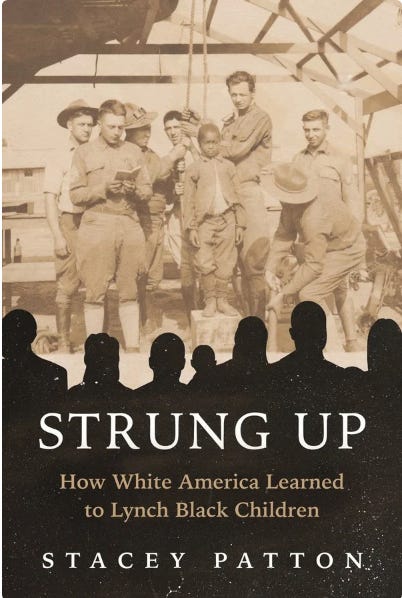
I mean, just look at the cover. It’s difficult to look at. It’s fucking devastating, isn’t it? It’s supposed to be. You’re not supposed to turn away from it.
Look at that baby standing up there on the gallows almost swallowed by those white World War 1 era soldiers who were stationed at Camp Zachary Taylor in Louisville, Kentucky. He can’t be more than eight, maybe nine years old. Look at that baby’s face. All round and soft, carrying the fullness of childhood betraying the fundamental obscenity of this “mock” lynching those evil-ass soldiers put on to amuse themselves.
Look at all those white hands gripping that rope. It’s a terrifying detail, isn’t it? Count all the hands: **one, two, three, four, five, six. **
There are too many men and too many hands for one rope and one small boy child. It doesn’t take all those grown men to overpower and hang one little Black boy. All them hands on that rope destroy the fantasy that American racial violence against Black children was the work of a solitary monster or a fringe element of society. Responsibility is everywhere in the photograph.
Lynching Black children did, in fact, take more than the physical strength of a few white men. Killing Black children required the KKK, vigilantes, white families, churches, schools, journalists, courts, police, politicians, doctors, lawyers, artists, businessmen, white children, and ordinary people. That’s what this photograph so powerfully captures. We see the rope being gripped by a few hands, but the culture holding it stretches far beyond the frame.
And that baby’s face, Y’all. It breaks me every single time. Look at how his solemn eyes are looking at us and asking what we are gonna do with what we are seeing.
So yeah, I can understand why just this cover alone has many folks not wanting to crack open the book and turn the pages. Many folks think they already know what is waiting inside. Maybe 400 pages of graphic photos and descriptions of Black children being tortured, mutilated, burned, hanged, and discarded. Some folks might be thinking that I am tossing them into a chamber of horrors where one Black child after another dies.
I’m not gonna lie. Yes, there are some horrific moments we must face in this book. All that violence is evidence about how America killed its own children and I refuse to sanitize any of it. But Strung Up is not racial trauma porn. I need Y’all to know that I did not spend more than a decade searching archives for murdered Black children just to resurrect them and make Black people watch them be dehumanized and murdered again.
I’m doing something different with this book.
We are used to seeing Black bodies at the center of racial violence. We’re used to seeing Black bodies be scrutinized, studied, diagnosed, measured, and destroyed. But in this book I am asking readers to move their eyes to white bodies and ask: What happened to white people? To their brains? Nervous systems? Sense of humanity and empathy? What got destroyed? What kind of culture could prime ordinary people to publicly kill Black children, and kill their own white children for thousands of years?
To answer those questions, I ended up somewhere I didn’t expect to go when I started researching this book. I crossed the Atlantic and took a pan-continental tour of the European archives where I found white people brutalizing their own children for going back to the Medieval era. Long before the American project, long before slavery and Jim Crow lynchings, Europeans brought their own children to public executions and other forms of spectacular violence to watch people suffer and die. They even executed their own. Europeans brought that heritage of violence with them to North America and elsewhere they colonized. Stitched in their parenting practices, their religious ideologies, their child-hating ideas, and methods of corporal punishment and fused it with colonialism, slavery, capitalism, and white supremacy.
So, I don’t want you to be afraid to take this journey through this chamber of horrors. That little boy on the cover isn’t asking us to stay fixated on * his *suffering. No, I think our attention should be directed at those men surrounding him and at all those hands on the noose, at white institutions, trauma histories, families, bodies, churches, scientific ideas, pedophilic artwork, and beliefs that reproduced racial violence in American life. I promise you, once you emerge on the other side of this chamber, you will have learned more about what white people destroyed in themselves, what they did to their own children, and how racialized cruelty was a continuation of a long heritage of anti-child violence that began in Europe.
I also want to say that I think folks need to be reading Strung Up in the current political and racial moment. Because Black bodies are still being found hanging from trees. We just went through a summer of strange fruit. Look at the controversies surrounding Cyrus Belton, a one-year-old baby shot and killed by police in Mississippi, Karmelo Anthony, and Nolan Wells. Once again, the Black child’s body is a national battleground over race, childhood, and terror.
I want you to come through this book with your understanding turned every which way. I want you to look at children with new eyes. I want us to reorganize our thinking, teaching, parenting, and activism around childhood because it is the foundation for everything. Everything! I want us to think different about what we owe the children who are here right now.
We don’t need to make Black children harder. We don’t need to put our hands on them. We owe them tenderness, protection, and room to be unfinished human beings. They deserve to be silly, soft, and naughty. They should be able to make mistake, to question, and wonder without fear of harsh punishment or shame. They deserve to be loved like a REVOLT!
Now listen, Y’all . . . I am not gonna promise you any heroes in this book or a hopeful ended tucked into the final pages of Strung Up. That’s not how history works. Sometimes there’s just horror, loss, injustice, and grief. And we’ve got to learn how to sit in all that.
I refuse to give readers emotional relief after we get through this chamber of horrors. Strung Up is not a fiction novel. These were real children who were snatched from the future. Some of them should still be here as elders. Their children and grandchildren should be here with us. But their families are still living in the echoes of what was stolen and that pain won’t go away by manufacturing a redemptive ending.
That little boy on the cover and none of Jim Crow’s murdered children owe us hope or some obligatory American redemption narrative that makes us feel better. And the archives don’t owe us hope either. Writing this book has taught me is that the dead can leave us something far more demanding than hope: RESPONSIBILITY.
We have a responsibility to read the past, to know what happened, and to learn about the machinery behind horrors. We need to recognize the patterns so we can interrupt inheritances because denial, turning away, and forgetting is how history repeats itself.
So got get the book, Y’all. Read it. Take your time with it. Share it. Talk about it. Debate it. Teach it. I hope it makes you so uncomfortable that you won’t look away.
You can purchase Strung Up here:
https://bookshop.org/p/books/strung-up-how-white-america-learned-to-lynch-black-children-stacey-patton/10622d430a916d04?ean=9780807016206&listref=bookshop-org-best-sellers-of-the-week&next=t
Thanks for reading. If this piece moved you or made you think, please consider becoming a paid subscriber. Your subscription keeps my Substack fueled and unfiltered. Paid subscriptions also help me support HBCU journalism students who need laptops, DSLR cameras, tripods, mics, lights, software, conference travel, reporting trips, and even food from our pantry. We appreciate your support!
THIS CONTENT IS WRITTEN IN THE AUTHOR’S PERSONAL CAPACITY. ANY OPINIONS EXPRESSED ARE THE AUTHOR’S OWN AND SHOULD NOT BE ATTRIBUTED TO HOWARD UNIVERSITY OR MORGAN STATE UNIVERSITY.