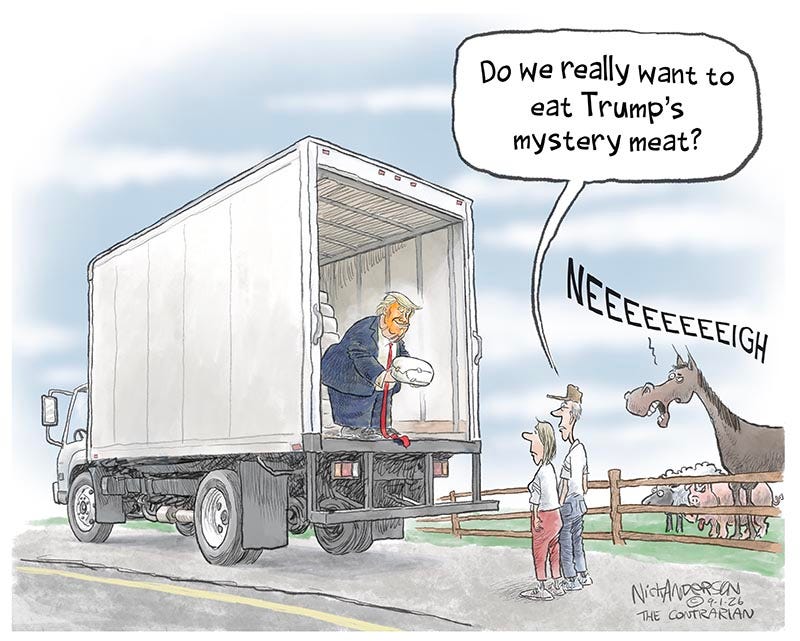
The Trump administration insists its temporary beef import plan is simple economics. With America’s cattle herd at a 75-year low and ground beef prices frustrating consumers ahead of the midterms, President Donald Trump announced that the United States would temporarily allow up to 300,000 metric tons of imported lean beef to enter the country tariff-free. The administration says foreign suppliers have agreed to sell the meat at a 25 percent discount, lowering grocery bills while domestic ranchers rebuild their herds.
Then came the obvious question. Where is all of that bargain-priced beef actually coming from? Agriculture Secretary Brooke Rollins couldn’t—or wouldn’t—say. Asked which countries beyond Mexico would supply the imports, she replied that those negotiations were still being handled by U.S. Trade Representative Jamieson Greer and President Trump. For an administration asking Americans to trust an unprecedented influx of imported meat, the lack of specifics created an unusually conspicuous blank space.
The internet, as it invariably does, rushed to fill it. Within days, social media was awash in speculation linking Trump’s beef imports to a separate New York Times investigation into the Bureau of Land Management’s sale of federally protected wild mustangs for as little as $25 apiece. The Times reported that some of those horses entered the slaughter pipeline and were shipped to Canadian processing facilities. It did not report that the horses were entering the American beef supply. Nevertheless, the coincidence proved irresistible. AI-generated images showed grocery packages labeled “Mr. Ed Imported Beef.” Amateur sleuths posted guides explaining how to distinguish horse meat from beef by color, smell and fat content. The joke spread because it occupied that peculiar space between absurdity and plausibility.
There is no evidence Americans are about to unknowingly eat wild mustangs. But the fact that so many people found the rumor believable says something about the moment we’re living in.
Americans increasingly navigate the grocery store like investigators rather than shoppers. “The contemporary grocery aisle is full of labels, QR codes, lot numbers and assurances of transparency,” said Salon’s food writer Ashlie Stevens, “nevertheless, the person pushing the cart is increasingly asked to perform the work of tracing the food backward herself.”
That has become the defining problem of modern food shopping. Americans are no longer starved for information. They are drowning in it: recalls, ingredient lists, ownership records, traceback investigations, viral TikToks, congressional hearings and conflicting expert advice. The challenge isn’t access to information. It’s deciding which information deserves trust.
Ironically, the Trump administration has actively encouraged this skepticism. Much of the MAHA movement is built around asking consumers to question ingredients, challenge food manufacturers and distrust the institutions that have long defined what is safe to eat. Some of those questions are entirely reasonable. Greater transparency about food production, ultra-processed foods and regulatory oversight has broad bipartisan appeal.
But suspicion is difficult to contain. Teach millions of people that responsible citizenship requires looking behind the label, and eventually they’ll begin looking behind yours. That’s exactly what happened here.
The administration announced an unusually large volume of unusually inexpensive imported beef without initially identifying its suppliers. At nearly the same moment, another branch of the federal government was allowing federally protected horses to enter commercial sale under circumstances that ultimately led some into foreign slaughterhouses. The internet did what the internet has always done: it connected two unrelated facts with a story.
It was the wrong story, yet it was also an understandable one. History provides a reason for that instinct. In 2013, European regulators discovered that products marketed as beef across multiple countries actually contained substantial amounts of horse meat. Investigators eventually uncovered a labyrinthine supply chain involving brokers, processors and subcontractors spanning numerous countries. Consumers had trusted labels that turned out not to tell the whole story.
That scandal didn’t prove that suspiciously cheap beef is secretly horse meat. It proved something more enduring: most consumers know surprisingly little about the journey between an animal and the package sitting in the refrigerated case.
Perhaps the administration will soon identify every supplier participating in the import program. Perhaps the horse jokes will fade as quickly as they appeared. Or perhaps this episode will simply become another reminder that transparency isn’t merely good government. It’s also good rumor control.
Nature abhors a vacuum. The internet relishes a vacuum.