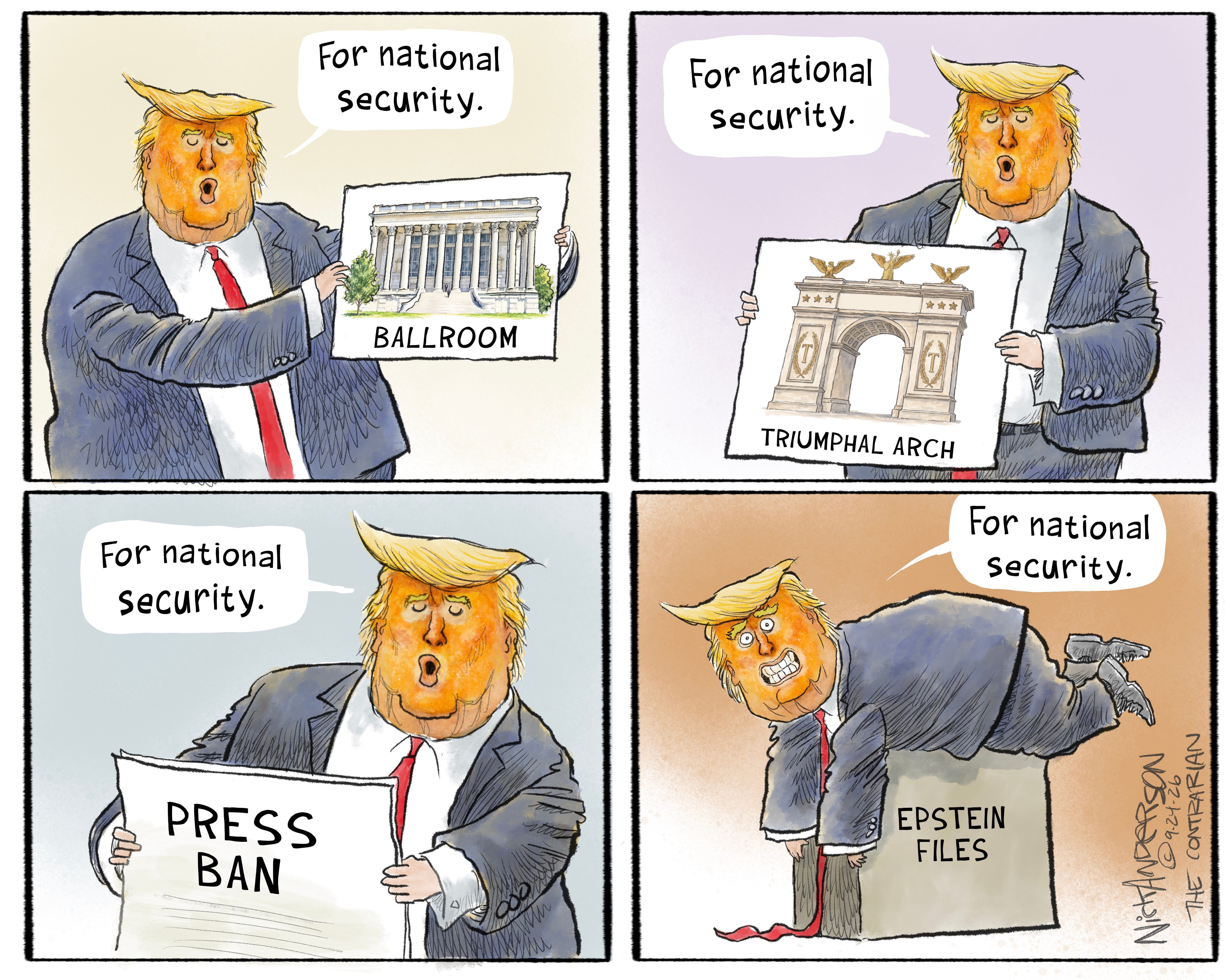
“National security” traditionally referred to things like wars, terrorism, espionage and protecting the country from foreign attack. In Donald Trump’s Washington, it’s becoming an increasingly versatile phrase.
Consider Trump’s proposed 250-foot “Triumphal Arch.” Originally promoted as a monumental gateway commemorating America’s 250th anniversary, Trump announced this week that it would also become a “Military Complex,” storing large numbers of drones, positioning snipers on the roof and plaza, and keeping sniper ammunition on site. Trump said the additions came at the “strong request” of the military (yeah, right) and were necessary for national security. Trump failed to identify any specific threat the installation was intended to address. Perhaps there’s an international mercenary force we don’t know about that targets absurdly large and gaudy arches.
The military justification arrived as the arch was facing lawsuits and criticism from preservationists and veterans. Retired Marine Col. Mark Cancian of the Center for Strategic and International Studies questioned the strategic logic, noting that Joint Base Myer-Henderson Hall is roughly a mile away and the Pentagon about two miles away. “It looks like it’s tacked on in order to strengthen the rationale for construction,” Cancian told Reuters.
There is also the small matter of putting a military drone facility next to Reagan National Airport. The FAA had previously determined that the structure wouldn’t pose an aviation hazard under specified conditions—but that review didn’t contemplate Trump subsequently adding drone operations. Rep. Don Beyer, a Virginia Democrat who opposes the arch, has called for a new FAA safety analysis.
Then there is Trump’s roughly $400 million White House ballroom complex, another presidential construction priority that has acquired a national-security component. Trump has recast the project to include a drone facility, bomb shelters and other military installations intended to protect Washington. Apparently America spent decades recklessly attempting to defend its capital without realizing what it really needed was a ballroom.
And then there’s the press. When Trump announced on September 18 that he was banning CNN, MS NOW and Politico from the White House, his stated explanation wasn’t national security. It was that they were “FAKE NEWS.” Asked about the decision, Trump complained about the outlets’ reporting and said the country needed “honest news.”
But as the dispute headed toward federal court, national security assumed a much larger role in the administration’s defense. The White House cited reporting it said created security risks, while Trump himself subsequently called what he considers “fake news” a “threat to our National Security.” The news organizations argued that the justification was retaliation for coverage the president disliked.
On Thursday, U.S. District Judge Timothy Kelly—whom Trump appointed during his first term—ordered the journalists’ access restored while the case proceeds. Kelly concluded that the news organizations were likely to succeed on their claims that the ban violated the First Amendment and due-process protections. The White House subsequently reinstated their access.
The sequence of events in each case is notable.
Trump wants a monumental arch. It becomes a national-security installation.
Trump wants an enormous White House ballroom. It acquires bunkers and military facilities.
Trump bans news organizations after publicly complaining that their reporting is “fake.” Their journalism subsequently becomes a national-security concern.
“National security” is an extraordinarily powerful phrase in government because genuine security needs can justify actions, spending and secrecy that would otherwise demand much more explanation.
Which may explain its newfound versatility. At the current rate, if Trump decides the Rose Garden needs a waterslide, we can probably expect the Pentagon to explain its vital role in amphibious warfare.
Maybe I shouldn’t give him any ideas.