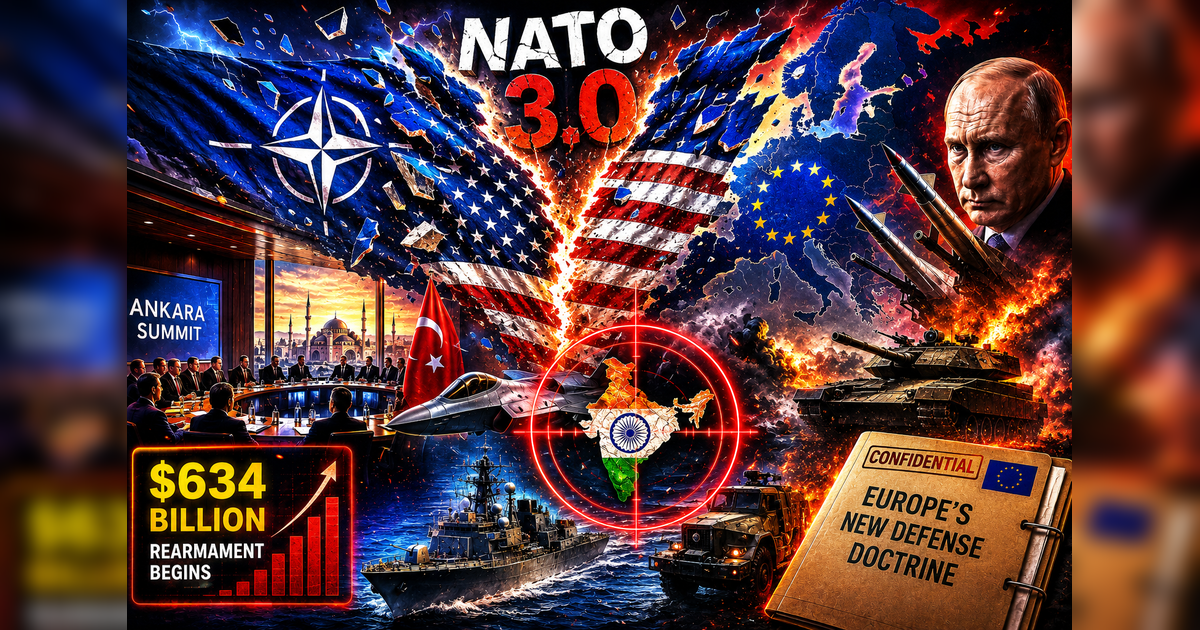
THE FULL, UNFILTERED INTELLIGENCE BRIEFING ON THE ALLIANCE COLLAPSE NOBODY WARNED YOU ABOUT — AND WHY IT’S ABOUT TO RESHAPE DEFENSE MARKETS, MINERAL SUPPLY CHAINS, AND GLOBAL POWER ALIGNMENTS FOR DECADES TO COME
Before you read another word, understand this: what follows isn’t speculation. It isn’t a hot take. It is the quiet unraveling of the single most important security relationship of the modern era — and it just happened in a room in Turkey, while most of the world scrolled past it as a diplomatic footnote.
This single meeting is already being read by strategists as the trigger point for a complete realignment of global power — not a minor adjustment, but a full re-shuffling of alliances, dependencies, and loyalties that the world has taken for granted since 1945.
By the end of this piece, you’ll understand why that “footnote” is actually the opening paragraph of a new chapter in world history. You’ll understand why it’s about to touch defense markets, mineral supply chains, and the foreign policy calculations of nations far beyond Europe. You’ll understand why India, sitting 3,000 miles away, is about to feel the shockwaves in its stock markets, its defense procurement pipelines, and its sacred principle of strategic autonomy.
Let’s go back to the beginning. Because this story doesn’t start today. It starts in the ashes of the Second World War.
When World War II ended, Europe wasn’t just tired. It was destroyed.
Its factories were rubble. Its currencies were worthless. Its militaries — the same militaries that had once ruled empires spanning the globe — were hollowed out, incapable of defending their own borders, let alone projecting power abroad. Europe was economically shattered and militarily collapsed. The continent that had once ruled the world was now powerless.
Into this vacuum stepped the United States, driven by a very specific fear.
The fear was simple: if Europe’s shattered economies were left vulnerable and desperate, the Soviet Union would exploit that desperation. Communist movements, backed by Moscow, could sweep into broken European nations one by one, turning capitalist Europe into a communist Europe — not through invasion, but through economic collapse and ideological opportunism.
Washington’s goal, stated in the plainest possible terms, was to keep Europe firmly inside the capitalist camp — prosperous, stable, and ideologically anchored to the West, rather than vulnerable to a communist takeover engineered from Moscow.
So America made its move. It launched a colossal reconstruction program — the Marshall Plan — to rebuild Europe’s economies and keep them capitalist, out of Soviet reach.
But rebuilding factories and currencies wasn’t enough. Europe also needed to feel safe enough to focus entirely on economic recovery without constantly looking over its shoulder at Moscow.
So alongside the Marshall Plan, America built something even more powerful as its umbrella project: a military alliance. The North Atlantic Treaty Organization. NATO.
And at the very heart of NATO sat one clause that would define the next 80 years of global history: Article 5.
Article 5, stripped of all diplomatic language, was a single extraordinary promise from America to Europe:
“If anyone attacks you, we will treat it as an attack on us. Our entire military might — conventional forces, nuclear weapons, everything — stands behind you. You will never have to face a threat alone.”
Think about what this actually meant in practice. America was telling sovereign European nations — proud, ancient nations with centuries of independent military history — something almost unthinkable. Translated into the plainest possible terms, here is what Washington was really saying to every capital in Western Europe:
“You do not need to worry about your own security at all. In fact, go ahead and dismantle your strategic independence completely, and hand it over to us. Become our forward anchor — our magnetic pole. We will take full responsibility for your economy and your security both. All you need to do is build policy and focus entirely on economic development.”
And Europe said yes.
This is the moment that matters most, because it explains everything that follows. Europe didn’t just receive a security guarantee. Europe outsourced its entire concept of self-reliance to another country. It handed over the keys to its own survival — and in doing so, it also relieved America of ever having to learn how to manage an ally that thought or acted independently. Because no European nation ever asserted its own strategic autonomy, Washington never had to develop the diplomatic instincts for handling a partner with an independent voice. That skill simply atrophied on both sides, together.
For the next several decades, this arrangement worked beautifully — for everyone involved.
European nations poured every ounce of national energy into economic development. They built world-class industries and welfare states, all while never seriously investing in “strategic autonomy” — the capability to independently defend their own territory and interests without depending on an outside power.
This arrangement continued seamlessly through the entire Cold War, deepening year by year, as Europe’s own military-industrial capabilities quietly atrophied under the comfort of the American umbrella.
Then, in 1990, the Cold War ended.
You would expect this moment — the collapse of the Soviet threat that had justified the whole arrangement — to have triggered Europe into reconsidering its total dependency on America. It didn’t.
With the Soviet Union gone, the United States effectively assumed the mantle of the world’s sole superpower. Unchallenged. Unrivaled.
And European nations, rather than using this moment to build independent strength, leaned further into dependency. Their logic: “Our security is guaranteed by the most powerful military force in human history. Why would we duplicate what America already provides for free?”
So instead of building independent capability, Europe redirected its energy toward joining U.S.-led military operations in far-flung regions — sending troops into Afghanistan, into Iraq, into Kuwait, participating in what strategists call “out-of-area stabilization operations.”
Notice what this reveals: Europe wasn’t building capability for its own defense. It was contributing manpower to America’s global agenda, secure in the knowledge that its own borders remained untouchable.
Through the entire Cold War, and through the decades that followed it, one thing never changed: Europe never seriously invested in the foundational tools of independent military power — what analysts call “strategic enablers”: independent satellite and intelligence networks, autonomous logistics, domestic weapons manufacturing at real scale. Why bother? Their security provider had one name, and it wasn’t any European capital. It was Washington.
Everything was, by every outward appearance, going smoothly. Until it wasn’t.
Eventually, cracks began appearing in America’s global position — and they came from two directions at once, forcing Washington into choices it had never had to make before.
The first challenge: Russia.
The second, and ultimately more consequential: China.
When Russia began reasserting itself militarily and politically near Europe’s borders, something revealing happened inside American strategic thinking.
Washington’s internal read was, in essence: “This isn’t really a threat to our global supremacy. Russia isn’t challenging us as the world’s dominant power. It’s trying to rebuild influence over territories that used to sit inside the old Soviet sphere — Europe’s backyard, not ours.”
Follow that logic to its natural conclusion, and you get something quietly devastating for Europe: if Russia’s ambitions don’t actually threaten America’s global standing, why should countering them be America’s fight to lead?
This is the moment the illusion started to crack. For the first time in nearly 80 years, European nations were forced to ask: if our actual security is threatened — not hypothetically, but by a real, resurgent Russia on our doorstep — will America show up the way Article 5 promised?
While Russia represented a regional headache, China represented something far more existential to American strategists: a genuine, global-scale competitor for economic and military supremacy.
And here America confronted a hard truth: you cannot fight a two-front strategic war with equal intensity. You cannot simultaneously serve as the primary security guarantor for an entire continent while also dedicating the full weight of your resources to countering a rising superpower on the other side of the world.
Something had to give. Slowly, deliberately, America began redirecting its strategic priorities away from the European theater and toward the Indo-Pacific — not through dramatic announcement, but through a steady, unmistakable drift of resources, attention, and diplomatic energy.
Europe felt it. Sharply.
Put yourself in the position of a European strategist watching this unfold in real time.
For nearly 80 years, your nation built its entire security philosophy around one foundational promise: America has your back, unconditionally, always. You never built independent military depth because you were told, explicitly and repeatedly, that you didn’t need to.
Now, as a real threat sits on your border, you watch the power that promised to protect you quietly redirect its attention toward a rival on the other side of the planet, treating your security crisis as somebody else’s problem.
Two conclusions crystallized in European minds, and both carry enormous weight:
First: America can no longer be treated as a fully dependable security partner. The 80-year-old promise now has an asterisk — “unless we have somewhere more important to be.”
Second: as America pivoted toward China, it began sending Europe an unmistakable message, over and over: “Handle your own security from now on.”
To European leaders, this didn’t feel like an understandable strategic pivot. It felt like being left standing after 80 years of marriage. It felt like abandonment, dressed in the polite language of “strategic prioritization.” Europe now openly regards America as a partner that broke faith — an ally that proved, in the bluntest possible terms, unfaithful to the very foundation of the alliance it built. And abandonment doesn’t just create fear — it creates fury, and a determination never again to be this vulnerable to another party’s whims.
That fury is exactly what walked into the room in Turkey.
Now we arrive at the meeting that triggered this entire investigation.
This is not a hypothetical or a future scenario — this is happening right now, in the year 2026, as you read this.
The 2026 NATO Summit was held in Ankara on July 7-8, at a moment the alliance is undergoing its most comprehensive strategic transformation since the Cold War. NATO entered this summit under unprecedented tension, with some European countries fearing that the US might withdraw from the alliance entirely. The summit was explicitly framed by analysts and insiders as a “make-or-break” test for the 77-year-old alliance.
Inside that room, European nations made a decision that will be remembered as a genuine turning point: they agreed to begin building a new security structure — one designed specifically to reduce, or eliminate entirely, their dependency on the United States.
Read that again. The nations that spent nearly a century outsourcing their entire strategic identity to American guarantees, that never built independent military depth because they were told they didn’t need to — those same nations just formally agreed they want out from under a security umbrella they had enjoyed, uninterrupted, for roughly 50 to 60 years.
Not a reformed NATO. Not a “let’s patch things up” NATO. A fundamentally different NATO — one explicitly designed to carry no American fingerprint at all.
Why such an extreme position? Because, in European eyes, America is no longer a faithful, dependable ally. It is a partner that broke its word when it mattered most. This isn’t diplomatic language anymore. This is heartbreak translated into military policy.
And this isn’t a label being applied from the outside by commentators trying to name a trend after the fact. The European nations themselves, inside that room in Turkey, are the ones calling this new structure “NATO 3.0.” They are consciously building on — and consciously breaking from — everything that came before it.
Turkish Foreign Minister Hakan Fidan put it in the starkest possible terms before the summit even began, delivering a statement that should have made global headlines but was largely ignored:
“If we are to speak in technical terms, Ankara will be the place where the NATO 3.0 Strategy is adopted. As you know, NATO 1.0 was adopted during the Cold War, NATO 2.0 operated from the Cold War until the present summit, and now the NATO 3.0 Strategy will be adopted, taking us into a new phase. Put simply, the burden-sharing system that existed from World War II until 2026 is no longer the same.”
Finnish President Alexander Stubb, speaking at the Ankara summit, declared with unmistakable clarity: “Now we start NATO 3.0, which is basically a stronger Europe in a stronger NATO.” He described the Ankara summit as “one of the most important NATO summits that we have ever had.”
Belgian Defense Minister Francken confirmed what this means in practice: “It means that Belgium and European allies need to step up and take the architecture of the European continent into our own hands.”
And the Ankara Summit Declaration itself formalized this transformation in black and white, stating: “We are building the future: a stronger Europe in a stronger NATO — a modernised Alliance. European Allies and Canada, working with the United States, are assuming greater responsibility for the Alliance’s defence.”
NATO 1.0— the original alliance, conceived and built by the United States after World War II, anchored around American leadership and the Article 5 guarantee. A deterrence-focused alliance designed to contain the Soviet Union.NATO 2.0— the version that emerged after the Cold War ended in 1990, still American-led, but increasingly focused on out-of-area operations rather than direct territorial defense — from the Balkans to Afghanistan.NATO 3.0— something entirely new: a European-conceived, European-led security structure, born out of disillusionment, distrust, and a determination to never again be this dependent on a single foreign power.
Crucially, the intelligence models being run inside the Ankara conference rooms are not describing this transition as “burden sharing” — a phrase that implies shared effort. NATO’s internal strategic planners are explicitly modeling this as a “burden shift” — a hard, mathematically quantifiable transfer of military liability.
Under the NATO 3.0 framework, European nations and Canada are expected to provide approximately 70% of the conventional military capabilities required for continental defense, with the United States drawing down to provide just 30% of the ground forces and theater-level capabilities. Washington retains responsibility for nuclear deterrence, strategic command, and certain high-end enablers (like space-based ISR), but on the conventional battlefield — the tanks, artillery, infantry, and logistics required to hold the line against Russia — the U.S. is stepping back in a numerically quantifiable way.
To put this in perspective: for eight decades, the ratio was nearly inverted — America provided the overwhelming bulk of conventional deterrence while Europe contributed marginal forces. The Ankara summit reverses that ratio. This…