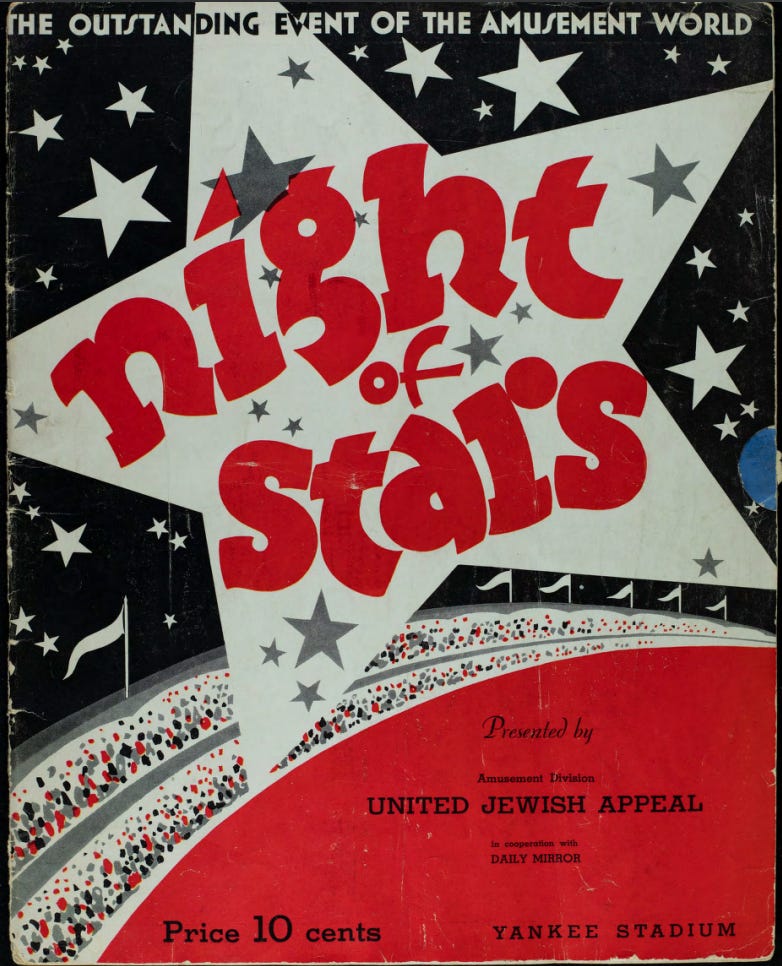
A subscriber friend sent me a PDF and I’ve been a little obsessed with it ever since. It’s 36 scanned pages from an old souvenir program, the paper yellowed with age and the cover still bright with red, white, and black. Night of Stars: A Panorama of American Entertainment. Yankee Stadium. September 20, 1934. Down at the bottom is the price: ten cents. A dime.
It’s a fabulous little piece of old New York memorabilia. The pages are packed with ads featuring Camel cigarettes, Scotch, Kodak film, Lane Bryant, Steinway pianos, banks, hotels, restaurants, and Ex-Lax (screenshots further down). Apparently nobody in 1934 thought twice about putting laxatives next to celebrities next to cigarettes. A different time, indeed.
And celebrities…they’re everywhere. Jack Benny, George Burns and Gracie Allen, Fanny Brice, Bob Hope, Milton Berle, Kate Smith, Cab Calloway, Bill “Bojangles” Robinson, and Ed Sullivan were part of the night. Irving Berlin, George Gershwin, Jerome Kern, Richard Rodgers, and Harold Arlen were among the composers represented. Star-studded would be an understatement.
Samuel Blitz, the executive director who helped put the whole thing together, later remembered 45,000 people filling Yankee Stadium. A huge stage had been built on the field and flooded with theatrical spotlights. Leopold Stokowski stepped out of the darkness, raised his arm in front of an orchestra of 600 musicians, and opened the first Night of Stars. Blitz called their original plans “grandiose,” which seems about right. They’d taken over Yankee Stadium and assembled a lineup that looked like half of American show business had decided to spend the evening in the Bronx.
The reason for all those big doings is printed right inside the program in plain block letters: FOR THE RELIEF OF GERMAN JEWS.
Mayor Fiorello La Guardia contributed a letter. Walter Winchell wrote an essay called “A World Without Jews.” Between the movie stars, musicians, cigarettes, whiskey, and advertisements are pages about Jews in Germany and refugees who’d already left.
And there, right in the middle of this very American 1934 souvenir program, is Chaim Weizmann.
His section stretches across several pages filled with photographs of Jewish refugees and immigrants. There are young people learning agricultural work, Jews arriving somewhere new, ships, fields, and people preparing for lives far away from the ones they’d expected to have. Across the top in large black letters are the words “PALESTINE—Home for Jewish Refugees.”
September 20, 1934. Hitler had been chancellor of Germany for not quite two years.
German Jews had spent those almost two years watching their lives shrink around them. The nationwide Nazi boycott of Jewish businesses came on April 1, 1933. Jewish civil servants were forced from government jobs. Doctors and lawyers faced restrictions on their work, professors lost university positions, students were pushed out of schools, and books burned in public squares. Families that had considered themselves German for generations were being told by their government that they no longer belonged.
American Jews started fighting back almost immediately. On March 27, 1933 barely two months after Hitler became chancellor, the American Jewish Congress organized a huge anti-Nazi demonstration at Madison Square Garden. Tens of thousands filled the Garden and surrounding streets. A boycott of German goods became one of the ways ordinary American Jews could hit the Nazi regime from three thousand miles away. They could leave German products on the shelf and keep American dollars out of Hitler’s economy.
Hitler had supporters in New York, and they were plenty mad about that boycott. On May 17, 1934 about 23,000 people packed Madison Square Garden for a gathering involving the Friends of New Germany and the German-American Commercial League, known as DAWA. The Friends of New Germany preceded the German-American Bund, but the organization was already capable of drawing huge crowds years before the infamous Bund rally of 1939.
The advertisement for the May gathering announced “ THE DAY OF AWAKENING GERMANDOM.” New York’s German community was called to a mass demonstration against what the organizers described as the
By August more than 16,000 people attended another Friends of New Germany gathering. This time at the Madison Square Garden Bowl in Queens. Uniformed storm troopers and swastikas were part of the scene. The famous photograph of American Nazis filling Madison Square Garden beneath an enormous portrait of George Washington was still five years away, but the movement behind that night was already gathering thousands of people in New York.
Four months after the May rally, 45,000 people filled Yankee Stadium to help Germany’s Jews.